Currently Empty: R0.00

Is Ultrafiltration Right for You? A Buyer’s Guide
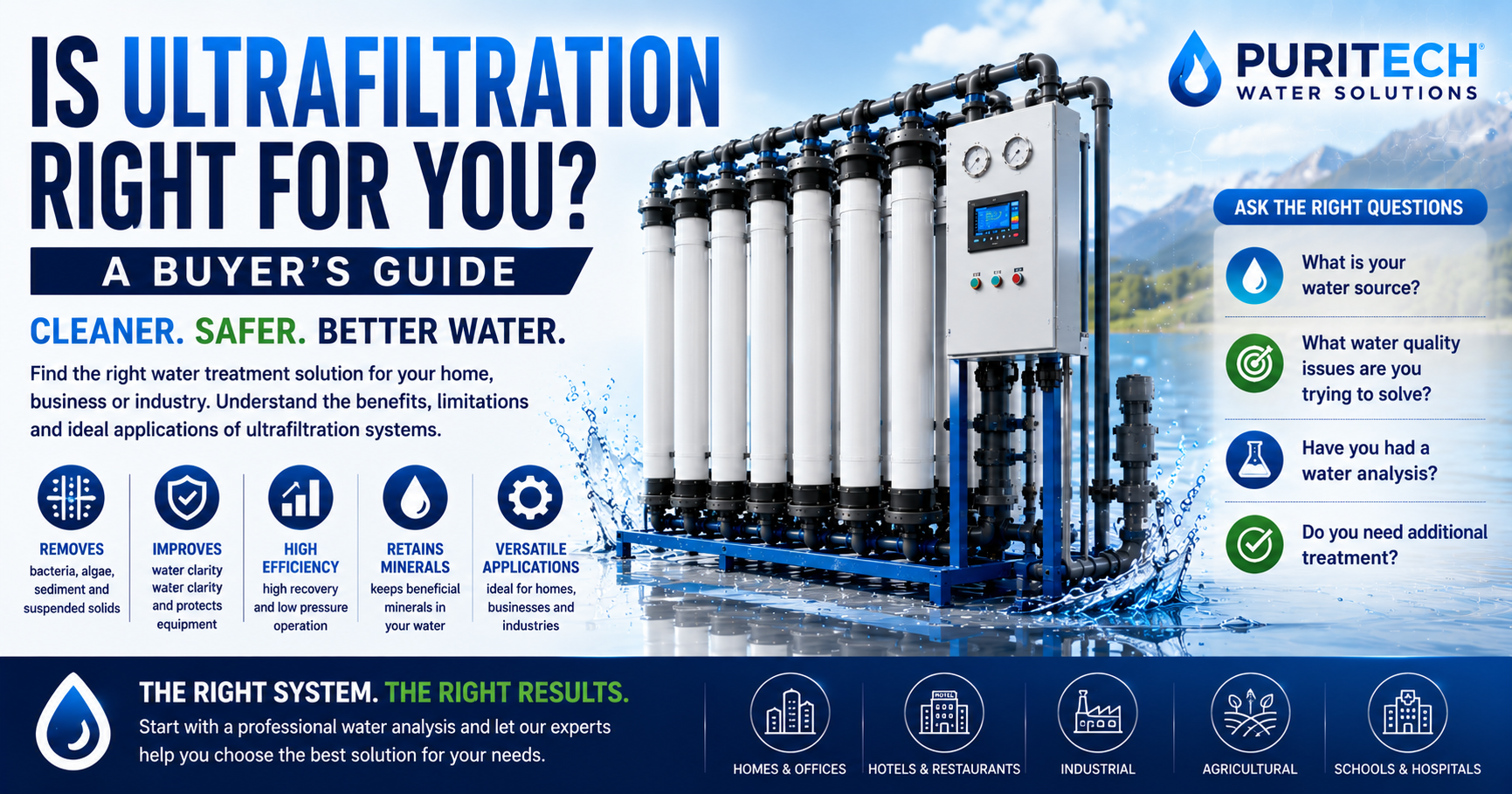
Choosing the right water treatment system can feel overwhelming because every water source and application is different. Whether ultrafiltration is right for you depends on your water quality, treatment goals and the contaminants you want to remove.
Ultrafiltration (UF) is a highly effective membrane filtration technology that removes suspended solids, bacteria, algae, and many other microscopic contaminants. However, it is not designed to remove dissolved salts or certain dissolved chemicals. Understanding where ultrafiltration performs best will help you choose a solution that delivers reliable, high-quality water.
This buyer’s guide explains when ultrafiltration is the ideal choice and when additional treatment technologies may be required.
What Is Ultrafiltration Best Suited For?
Ultrafiltration works exceptionally well where the goal is to improve water clarity and remove microbiological contaminants while retaining most naturally dissolved minerals.
Common applications include:
- Municipal water treatment
- Borehole water pre-treatment
- Food and beverage production
- Commercial buildings
- Schools and hospitals
- Hotels and restaurants
- Industrial process water
- Agricultural water treatment
Many systems also use ultrafiltration as a pre-treatment stage before reverse osmosis.
What Contaminants Does Ultrafiltration Remove?
Ultrafiltration effectively removes:
- Suspended solids
- Sediment
- Silt
- Rust particles
- Bacteria
- Algae
- Protozoa
- Many viruses (depending on membrane specification)
- Organic particles
Because of its microscopic pore size, UF delivers excellent physical filtration while maintaining high water flow.
What Doesn’t Ultrafiltration Remove?
Although ultrafiltration removes many contaminants, it does not remove:
- Dissolved salts
- Total dissolved solids (TDS)
- Most dissolved minerals
- Heavy metals in dissolved form
- Nitrates
- Fluoride
- Dissolved chemical contaminants
If these contaminants are present at elevated levels, additional treatment such as reverse osmosis may be recommended.
Questions to Ask Before Choosing Ultrafiltration
Before investing in any water treatment system, consider the following questions:
What Is My Water Source?
Your water may come from:
- Municipal supply
- Borehole
- River
- Dam
- Rainwater harvesting
Each source presents different treatment challenges.
What Problem Am I Trying to Solve?
For example, are you trying to
- Improve water clarity?
- Remove bacteria?
- Protect downstream equipment?
- Prepare water for reverse osmosis?
- Improve drinking water quality?
Identifying the primary objective helps determine whether ultrafiltration is the correct solution.
Has My Water Been Analysed?
A professional water analysis provides the information needed to recommend the most suitable treatment system.
Without testing the water first, selecting equipment becomes largely guesswork.
Do I Need Additional Treatment?
Depending on the water analysis, your system may also require:
- Activated carbon filtration
- Water softening
- Iron and manganese removal
- UV disinfection
- Reverse osmosis
Combining technologies often delivers the best overall results.
Advantages of Ultrafiltration
Understanding the benefits of ultrafiltration makes it easier to decide whether it suits your application. For many homes, businesses and industries, UF offers an excellent balance of water quality, efficiency and operating costs.
Key advantages include the following:
- Produces high-quality filtered water
- Removes suspended solids, bacteria and algae
- Operates with high water recovery rates
- Requires relatively low operating pressure
- Retains most beneficial dissolved minerals
- Protects downstream equipment
- Requires less water than many other membrane technologies
- Can serve as an excellent pre-treatment for reverse osmosis systems
As a result, ultrafiltration has become one of the most widely used membrane technologies in modern water treatment.
Limitations of Ultrafiltration
Although ultrafiltration is highly effective, it is not suitable for every water treatment challenge.
Ultrafiltration does not remove:
- Dissolved salts
- Total dissolved solids (TDS)
- Dissolved heavy metals
- Fluoride
- Nitrates
- Most dissolved chemicals
Therefore, if your water analysis identifies these contaminants at elevated levels, Puritech may recommend combining ultrafiltration with reverse osmosis or another suitable treatment technology.
Who Should Choose Ultrafiltration?
Ultrafiltration is an excellent choice for customers who want to improve water quality without removing naturally dissolved minerals.
It is particularly suitable for:
Homeowners
Homeowners who receive municipal water often choose ultrafiltration to improve water clarity and reduce bacteria and sediment.
Businesses
Restaurants, hotels, offices and retail facilities benefit from reliable, high-quality water for both customers and daily operations.
Industrial Facilities
Many industries use ultrafiltration to protect equipment, improve process water quality and reduce membrane fouling before reverse osmosis systems.
Agricultural Applications
Ultrafiltration helps improve water quality for irrigation systems, livestock operations and greenhouse applications where suspended solids and microorganisms can create operational challenges.
When Should You Consider Another Treatment Technology?
While ultrafiltration works well in many situations, another solution may be more appropriate if your objective is to:
- Reduce high TDS levels
- Desalinate brackish water
- Remove dissolved salts
- Reduce fluoride
- Remove dissolved heavy metals
- Produce ultra-pure process water
In these cases, reverse osmosis or a multi-stage treatment system often provides the best solution.
Frequently Asked Questions
Is ultrafiltration suitable for drinking water?
Yes. Ultrafiltration can produce high-quality drinking water by removing suspended solids, bacteria, and many other microorganisms. However, the suitability of any system depends on the results of a professional water analysis.
Can ultrafiltration replace reverse osmosis?
Not always. Ultrafiltration and reverse osmosis remove different types of contaminants. In many applications, they work together to provide the best overall water treatment.
Is ultrafiltration expensive to operate?
In general, ultrafiltration systems have relatively low operating costs because they operate at lower pressures and achieve high water recovery rates. Actual costs depend on water quality, maintenance requirements, and system size.
How do I know if ultrafiltration is right for me?
The best starting point is a professional water analysis. Once the water has been tested, Puritech can recommend the most suitable treatment solution for your specific water quality and application.
Conclusion
So, is ultrafiltration right for you? The answer depends on your water source, the contaminants present, and your treatment goals. Ultrafiltration is an excellent solution for removing suspended solids, bacteria, algae and other microscopic contaminants while retaining most naturally dissolved minerals.
However, when dissolved salts, high TDS, fluoride, or other dissolved contaminants are present, additional treatment technologies may be necessary. Therefore, the most reliable way to select the correct system is to begin with a professional water analysis.
With expert guidance, the correct system design and appropriate maintenance, ultrafiltration can provide dependable, efficient and cost-effective water treatment for homes, businesses, industries and agricultural applications throughout South Africa.