
Currently Empty: R0.00

Solar Charge Controller: PWM vs MPPT Explained
A solar charge controller is a vital component in many solar energy systems. It regulates the flow of electricity from your solar panels to your batteries, ensuring they charge safely and efficiently. Without a charge controller, batteries can become overcharged or excessively discharged, reducing their lifespan and overall performance.
Understanding how a solar charge controller works will help you choose the right equipment for a reliable and efficient solar installation.
What Does a Solar Charge Controller Do?
A solar charge controller acts as the bridge between your solar panels and battery bank. Its primary role is to manage charging while protecting the batteries.
Its main functions include:
- Preventing overcharging
- Preventing deep discharge
- Regulating charging voltage
- Monitoring battery health
- Improving charging efficiency
- Extending battery lifespan
These functions are especially important in off-grid and hybrid solar systems that rely on battery storage.
Types of Solar Charge Controllers
There are two main types of solar charge controllers.
PWM (Pulse Width Modulation)
PWM controllers are a proven and affordable solution.
Advantages:
- Lower cost
- Simple design
- Reliable operation
- Suitable for smaller systems
Disadvantages:
- Lower charging efficiency
- Less effective in cold or cloudy conditions
- Limited flexibility with higher-voltage solar arrays
PWM controllers are often used in basic residential or small off-grid systems.
MPPT (Maximum Power Point Tracking)
MPPT controllers use advanced technology to maximise the amount of power harvested from solar panels.
Advantages:
- Higher charging efficiency
- Better performance in changing weather
- Faster battery charging
- Supports larger systems
- Better energy harvest
Disadvantages:
- Higher initial cost
- More advanced electronics
Although MPPT controllers are more expensive, they often produce significantly more usable energy, especially in larger installations.
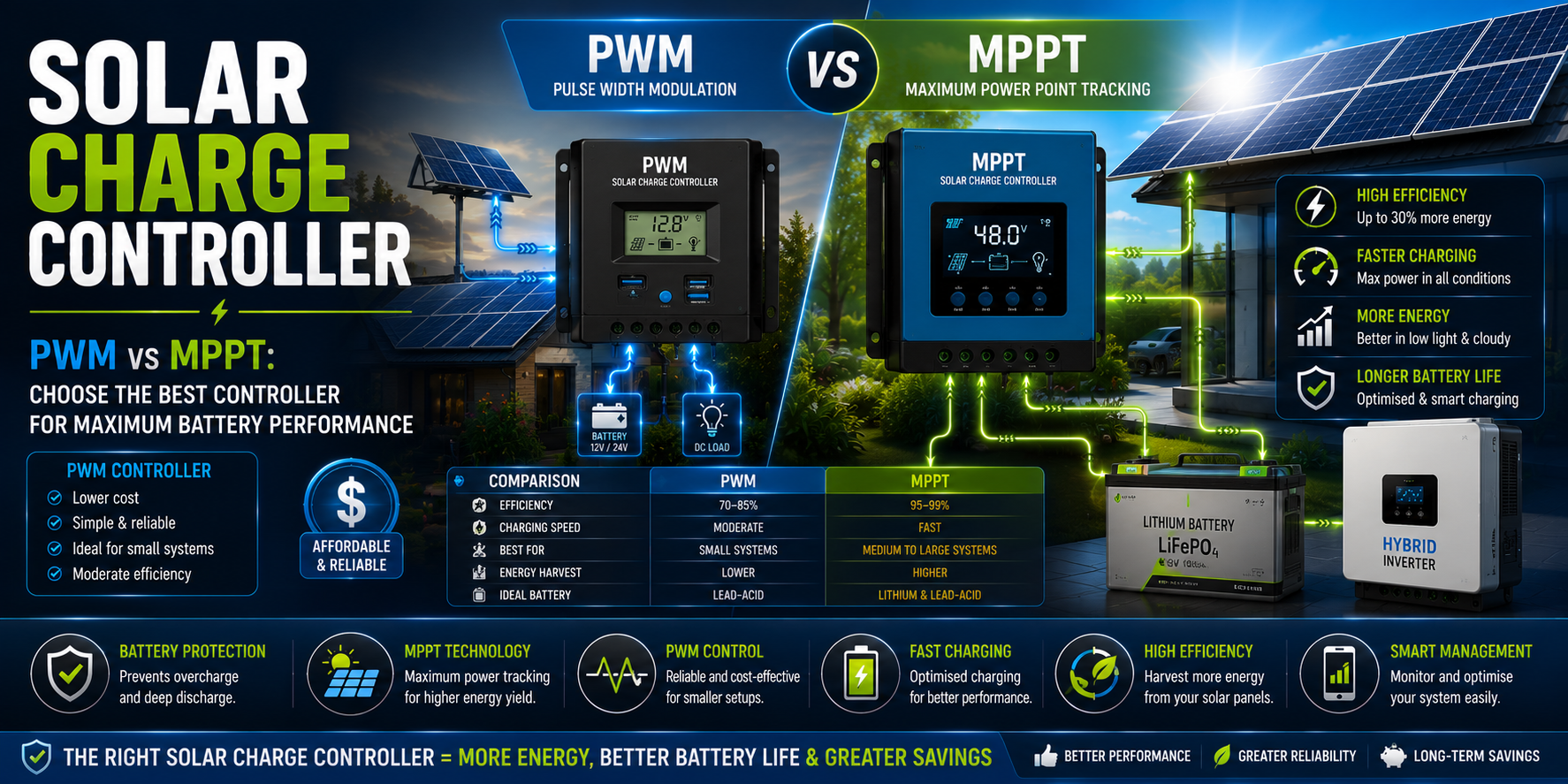
PWM vs MPPT: What’s the Difference?
| Feature | PWM | MPPT |
|---|---|---|
| Efficiency | Good | Excellent |
| Charging Speed | Moderate | Fast |
| Cost | Lower | Higher |
| System Size | Small | Medium to Large |
| Low-Light Performance | Moderate | Excellent |
| Energy Harvest | Lower | Higher |
Choosing between the two depends on your budget, system size and performance goals.
Which Solar Charge Controller Should You Choose?
A PWM controller may be suitable if you:
- Have a small solar system
- Want a lower-cost solution
- Use modest battery storage
An MPPT controller is often the better choice if you:
- Have larger solar arrays
- Want maximum efficiency
- Use lithium batteries
- Plan to expand your system
- Experience changing weather conditions
Do Hybrid Inverters Need a Separate Charge Controller?
Many modern hybrid inverters include a built-in MPPT solar charge controller.
This means you may not need a separate controller, depending on your system design.
However, larger installations or specialised applications may still require dedicated charge controllers.
Common Mistakes to Avoid
Avoid these common errors:
- Choosing a controller with insufficient current capacity
- Ignoring battery compatibility
- Undersizing the controller
- Mixing incompatible system voltages
- Prioritising price over efficiency
Selecting the correct controller improves battery performance and protects your investment.
Frequently Asked Questions
Can I use an MPPT controller with lead-acid batteries?
Yes. Most MPPT controllers support lead-acid batteries as well as many lithium battery types.
Is MPPT always better than PWM?
For most medium and large systems, MPPT offers higher efficiency and better long-term performance. However, PWM can still be a practical choice for smaller installations.
Does every solar system need a charge controller?
Systems that charge batteries generally require a charge controller. Grid-tied systems without batteries often rely on inverter technology instead.
Can a charge controller increase battery life?
Yes. Proper charging control helps protect batteries from overcharging and deep discharge, extending their service life.
Conclusion
A solar charge controller is essential for protecting your batteries and improving the performance of your solar energy system. While PWM controllers provide an affordable option for smaller systems, MPPT controllers offer greater efficiency, faster charging and better long-term value.
Choosing the right controller ensures your batteries charge safely, your solar panels operate efficiently and your investment delivers reliable energy for years to come.