Currently Empty: R0.00

Hollow Fibre Ultrafiltration Membrane: How It Works
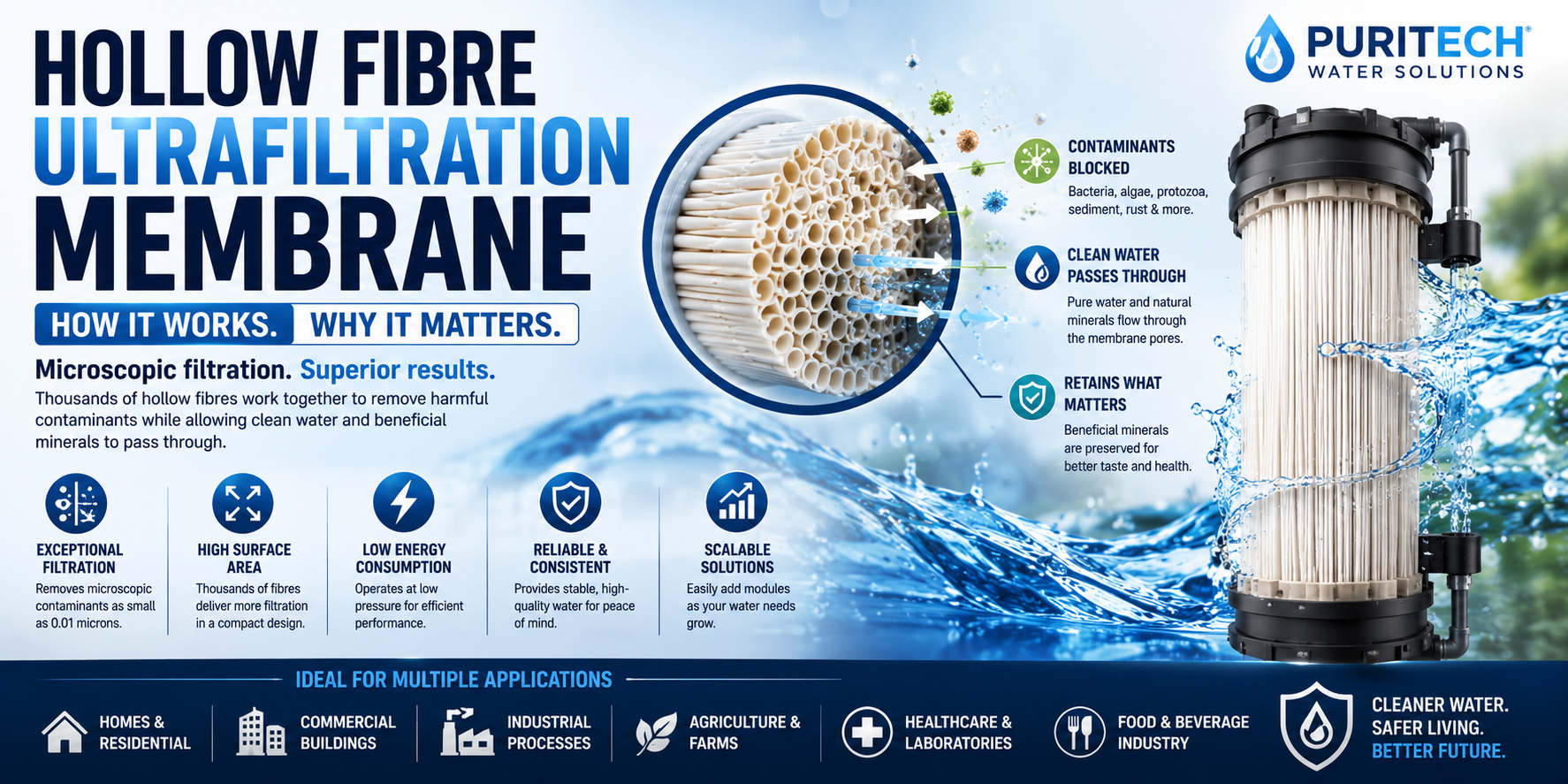
A hollow fibre ultrafiltration membrane is the core component of most modern ultrafiltration systems. Although many people see the complete filtration unit, few understand that thousands of microscopic hollow fibres inside the membrane perform the actual purification process.
These tiny fibres work together to remove suspended solids, bacteria, algae, protozoa and many other microscopic contaminants while allowing clean water and beneficial dissolved minerals to pass through.
Because of their excellent filtration performance, high surface area and reliable operation, hollow fibre membranes have become one of the most widely used membrane technologies in residential, commercial and industrial water treatment.
What Is a Hollow Fibre Ultrafiltration Membrane?
A hollow fibre ultrafiltration membrane consists of thousands of extremely thin tubular fibres bundled together inside a pressure vessel.
Each fibre resembles a tiny drinking straw with microscopic pores distributed along its wall.
As water flows through these fibres, the membrane separates contaminants according to particle size.
This process produces clean, high-quality water without adding chemicals.
Why Are Hollow Fibres Used?
Hollow fibre technology offers several important advantages over flat-sheet membranes and other filtration designs.
The fibres provide:
- Large filtration surface area
- Compact membrane design
- High water production
- Efficient contaminant removal
- Lower energy consumption
- Easy scalability
As a result, manufacturers can produce systems that deliver high performance while occupying relatively little installation space.
How a Hollow Fibre Ultrafiltration Membrane Works
The filtration process is straightforward yet highly effective.
Step 1: Raw Water Enters
Untreated water enters the membrane housing under pressure.
Step 2: Water Flows Through the Hollow Fibres
Water moves either from the outside of the fibres to the inside or from the inside to the outside, depending on the membrane design.
Step 3: Contaminants Are Retained
As water reaches the microscopic pores, larger contaminants remain on one side of the membrane.
These include:
- Sand
- Silt
- Rust
- Algae
- Bacteria
- Protozoa
- Suspended solids
Step 4: Clean Water Passes Through
Water molecules and naturally dissolved minerals pass through the membrane pores and exit the system as purified water.
Why Hollow Fibre Membranes Are So Efficient
One reason a hollow fibre ultrafiltration membrane performs so well is its enormous filtration area.
Thousands of fibres operate simultaneously.
Consequently, the membrane can filter large volumes of water while maintaining relatively low operating pressure.
This combination of efficiency and compact design makes hollow fibre membranes suitable for applications ranging from household systems to large industrial water treatment plants.
Types of Flow in Hollow Fibre Membranes
Depending on the manufacturer and application, water may flow through the membrane in different ways.
Outside-In Filtration
Water flows around the outside of each hollow fibre before passing through the membrane wall into the centre of the fibre.
This design is commonly used where suspended solids are relatively high.
Inside-Out Filtration
Water flows through the centre of the fibre before passing outward through the membrane wall.
Some specialised applications use this configuration depending on cleaning requirements and system design.
Materials Used in Hollow Fibre Ultrafiltration Membranes
A hollow fibre ultrafiltration membrane is manufactured from specialised polymers designed to withstand continuous filtration while maintaining excellent mechanical strength.
Common membrane materials include:
- Polyethersulfone (PES)
- Polyvinylidene Fluoride (PVDF)
- Polysulfone (PS)
- Polyacrylonitrile (PAN)
Each material offers different advantages depending on the application, water quality and operating conditions.
For example, some materials provide greater chemical resistance, while others offer improved durability or easier cleaning.
Advantages of a Hollow Fibre Ultrafiltration Membrane
One reason a hollow fibre ultrafiltration membrane is widely used throughout the water treatment industry is its combination of efficiency, reliability and compact design.
Key advantages include the following:
Excellent Filtration Performance
The microscopic membrane pores effectively remove suspended solids, bacteria, algae, protozoa and many other contaminants while allowing clean water and beneficial dissolved minerals to pass through.
High Surface Area
Thousands of hollow fibres are packed into a single membrane module.
Consequently, a large filtration area fits inside a relatively compact housing.
Low Energy Consumption
Ultrafiltration typically operates at much lower pressures than reverse osmosis systems.
As a result, energy consumption remains relatively low.
Reliable Water Quality
Because filtration relies on a physical membrane barrier rather than chemicals, water quality remains consistent throughout normal operation.
Easy Expansion
Additional membrane modules can often be added when water demand increases.
This allows systems to grow alongside changing requirements without completely replacing existing equipment.
Cleaning a Hollow Fibre Ultrafiltration Membrane
Over time, contaminants accumulate on the membrane surface.
Routine cleaning helps maintain performance and extends membrane life.
Maintenance procedures may include:
- Automatic backwashing
- Forward flushing
- Chemical cleaning where required
- Periodic membrane inspections
- Pre-filter replacement
Following the manufacturer’s maintenance recommendations helps maintain consistent water quality and reliable system performance.
Common Applications
Because of its versatility, a hollow fibre ultrafiltration membrane is used in many different industries.
Residential Water Treatment
Homeowners use ultrafiltration to improve drinking water quality while retaining naturally occurring minerals.
Commercial Buildings
Office buildings, shopping centres and public facilities often install ultrafiltration systems to provide high-quality drinking water.
Food and Beverage Processing
Manufacturers use ultrafiltration to improve process water quality while protecting downstream equipment.
Healthcare Facilities
Hospitals, laboratories and medical facilities rely on high-quality water for a variety of applications.
Industrial Water Treatment
Industries use hollow fibre membranes for process water, equipment protection and as pre-treatment for reverse osmosis systems.
Agriculture
Farms and agricultural businesses use ultrafiltration to improve borehole and surface water quality for various operational requirements.
Frequently Asked Questions
What is a hollow fibre ultrafiltration membrane made of?
Most membranes are manufactured from durable polymers such as PVDF, PES, polysulfone or PAN, depending on the intended application.
Why are hollow fibres better than flat membranes?
Hollow fibres provide a much larger filtration surface area within a compact module. Consequently, they deliver high water production while using relatively little installation space.
Can a hollow fibre ultrafiltration membrane remove bacteria?
Yes. Most bacteria are significantly larger than the membrane pores and are effectively removed during filtration.
Does a hollow fibre ultrafiltration membrane remove dissolved salts?
No. Dissolved salts, total dissolved solids (TDS), and many dissolved chemicals are much smaller than the membrane pores and therefore pass through the membrane.
Conclusion
A hollow fibre ultrafiltration membrane is one of the most advanced and efficient filtration technologies available for improving water quality. Its thousands of microscopic fibres create a large filtration surface capable of removing suspended solids, bacteria, algae and other contaminants while preserving naturally occurring minerals.
Because of its compact design, low operating pressure and reliable performance, hollow fibre membrane technology is widely used in residential, commercial, industrial and agricultural water treatment systems. When paired with a professional water analysis and appropriate pre-treatment where necessary, it provides a dependable and cost-effective solution for producing clean, high-quality water.