Currently Empty: R0.00

How Many Solar Panels Do I Need for My Home or Business?
One of the first questions people ask when considering solar power is, “How many solar panels do I need?” The answer depends on several factors, including your monthly electricity consumption, the size and efficiency of the solar panels, available roof space and whether you want to reduce your electricity bill or become more energy independent.
By understanding these factors, you can choose a solar system that meets your energy needs without paying for unnecessary capacity.
Why the Number of Solar Panels Varies
There is no one-size-fits-all answer because every property has different energy requirements.
Several factors influence system size, including:
- Monthly electricity consumption
- Average daily sunlight
- Roof size and orientation
- Panel efficiency
- Inverter capacity
- Battery storage requirements
- Future electricity usage
Therefore, calculating your energy demand is the first step before selecting a system.
Step 1: Calculate Your Electricity Usage
Start by reviewing your electricity bill.
Look for your monthly energy consumption measured in kilowatt-hours (kWh).
For example:
| Monthly Usage | Average Daily Usage |
|---|---|
| 300 kWh | 10 kWh/day |
| 600 kWh | 20 kWh/day |
| 900 kWh | 30 kWh/day |
| 1,200 kWh | 40 kWh/day |
This information provides the foundation for sizing your solar system.
Step 2: Consider Panel Wattage
Solar panels come in different power ratings.
Common options include:
- 450 W
- 500 W
- 550 W
- 600 W
Higher-wattage panels produce more electricity, which means fewer panels may be needed for the same energy output.
Step 3: Estimate Daily Energy Production
South Africa receives excellent sunlight in most regions.
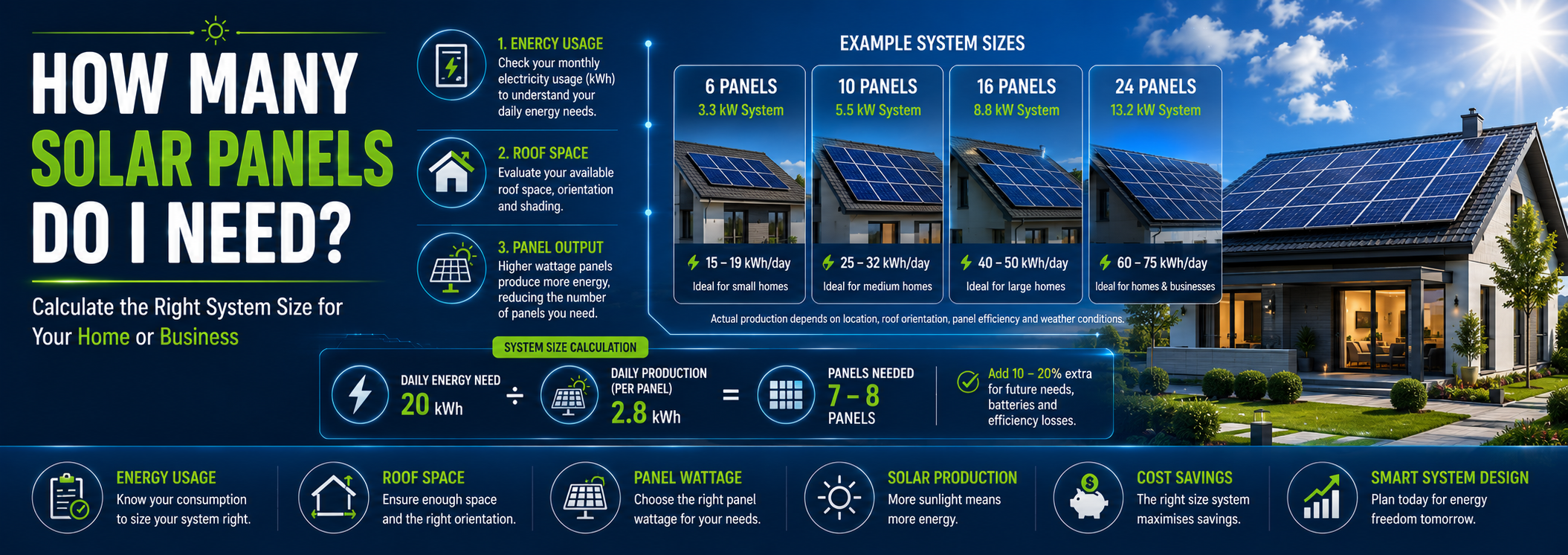
On average, one 550 W solar panel can produce approximately 2.5–3.2 kWh per day, depending on location, weather, and installation angle.
For example:
- 6 panels ≈ 15–19 kWh/day
- 10 panels ≈ 25–32 kWh/day
- 16 panels ≈ 40–50 kWh/day
These figures are estimates, and actual production varies with local conditions.
Step 4: Check Your Roof Space
Roof size is just as important as electricity demand.
A typical residential solar panel occupies approximately 2.2–2.6 m².
For example:
| Number of Panels | Approximate Roof Area |
|---|---|
| 6 | 14–16 m² |
| 10 | 22–26 m² |
| 16 | 35–42 m² |
| 24 | 53–62 m² |
Your installer should also assess roof orientation, shading and structural integrity.
Typical Solar System Sizes
The following examples provide a general guideline.
| Property Type | Suggested System |
|---|---|
| Small home | 3–5 kW |
| Medium home | 5–8 kW |
| Large home | 8–12 kW |
| Small business | 10–20 kW |
| Commercial property | 20 kW and above |
Final sizing should always reflect your actual electricity usage.
Should You Install Extra Panels?
In many cases, installing a few additional panels can be a smart long-term investment.
Extra capacity may help you.
- Offset future electricity price increases.
- Charge batteries more quickly.
- Support additional appliances.
- Prepare for electric vehicles.
- Expand your solar system later.
Planning often reduces future upgrade costs.
Common Mistakes to Avoid
Many buyers make avoidable mistakes during system planning.
Avoid:
- Estimating instead of measuring electricity usage.
- Ignoring roof shading.
- Choosing the cheapest panels without comparing quality.
- Buying an undersized inverter.
- Forgetting future energy requirements.
A professional assessment helps you avoid these problems.
Frequently Asked Questions
Can fewer high-wattage panels produce the same energy?
Yes. Higher-output panels can reduce the total number of panels required, provided they suit your roof layout and inverter.
Do batteries affect the number of panels I need?
Yes. If you plan to charge batteries fully during the day, you may need additional solar capacity.
Can I add more panels later?
Many systems allow expansion, although your inverter and roof space must accommodate the additional panels.
Will cloudy weather reduce production?
Yes. Solar panels still generate electricity on cloudy days, but energy production decreases compared with clear, sunny conditions.
Conclusion
If you’re wondering, “How many solar panels do I need?”, the answer depends on your electricity consumption, roof space, panel output and long-term energy goals. By calculating your daily energy needs and selecting quality equipment, you can build a solar system that delivers reliable performance and excellent value.
Working with an experienced solar installer also ensures your system is correctly sized, safely installed and ready to meet your future energy requirements.