Currently Empty: R0.00

How to Calculate Battery Backup Time for Your Solar System
Knowing your battery backup time helps you choose the right battery capacity for your home or business. If your battery is too small, it may not power your essential appliances for long enough. On the other hand, an oversized battery can increase installation costs unnecessarily.
Fortunately, calculating backup time is straightforward when you understand a few basic concepts. By estimating your energy usage and comparing it with your battery’s capacity, you can select a system that delivers reliable performance during load shedding and power outages.
What Is Battery Backup Time?
Battery backup time is the amount of time a battery can supply electricity before it needs to be recharged.
Several factors affect backup duration, including:
- Battery capacity
- Appliance power consumption
- Inverter efficiency
- Depth of discharge
- Battery condition
Because every installation is different, backup time varies from one system to another.
Understanding Battery Capacity
Battery capacity is normally measured in kilowatt-hours (kWh).
A larger capacity allows the battery to store more energy and power your appliances for longer.
For example:
- 5 kWh battery = stores approximately 5 kilowatt-hours of energy.
- 10 kWh battery = stores approximately 10 kilowatt-hours of energy.
However, you cannot always use the entire capacity because manufacturers recommend a safe depth of discharge to protect the battery.
Calculate Your Total Power Consumption
First, list the appliances you want to keep running during a power outage.
For example:
| Appliance | Power Rating |
|---|---|
| Refrigerator | 150 W |
| Television | 120 W |
| Wi-Fi Router | 20 W |
| LED Lights | 100 W |
| Laptop | 80 W |
Total Load = 470 W
Next, convert watts to kilowatts.
470 W ÷ 1,000 = 0.47 kW
Calculate Battery Backup Time
Use the following formula:
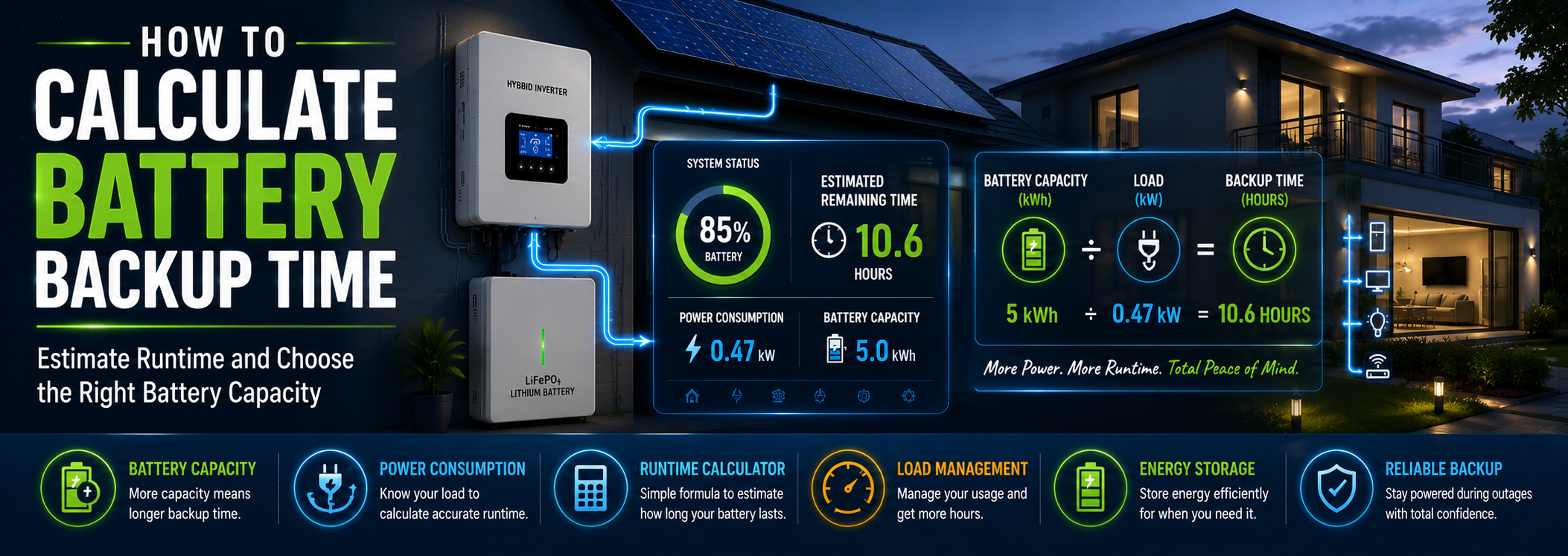
Battery Backup Time = Battery Capacity (kWh) ÷ Total Load (kW)
Example:
- Battery Capacity = 5 kWh
- Total Load = 0.47 kW
5 ÷ 0.47 = 10.6 hours
In real-world conditions, inverter efficiency and battery losses reduce this figure slightly. Therefore, the practical backup time may be closer to 9–10 hours.
Factors That Affect Battery Backup Time
Several conditions influence how long your battery can supply electricity.
Battery Capacity
Larger batteries store more energy and provide longer backup.
Appliance Usage
Running additional appliances increases electricity demand and shortens backup time.
Inverter Efficiency
A high-efficiency inverter converts more stored energy into usable electricity, improving overall runtime.
Depth of Discharge
Most lithium batteries allow a deeper discharge than lead-acid batteries. Consequently, they provide more usable energy.
Battery Age
As batteries age, their storage capacity gradually decreases. Therefore, older batteries usually provide shorter backup times.
Tips to Extend Battery Backup Time
You can improve runtime by managing your electricity consumption wisely.
Consider these practical tips:
- Turn off unnecessary appliances.
- Use LED lighting instead of incandescent bulbs.
- Choose energy-efficient appliances.
- Avoid running high-power devices during outages.
- Keep your battery properly maintained.
- Size your battery according to your daily energy needs.
These simple steps can significantly increase available backup time.
Common Mistakes to Avoid
Avoid these common errors when sizing a battery system:
- Ignoring inverter efficiency.
- Underestimating appliance power consumption.
- Forgetting surge power requirements.
- Choosing the cheapest battery without considering quality.
- Buying a battery that cannot meet future energy needs.
Planning helps prevent expensive upgrades later.
Frequently Asked Questions
Can one battery power an entire house?
Yes, provided the battery has enough capacity for your total electrical load and the required backup duration.
Does a larger battery charge more slowly?
Generally, yes. However, charging speed also depends on your solar array and inverter capacity.
How accurate are battery backup calculations?
The formula provides a reliable estimate. Actual runtime depends on weather conditions, battery health, inverter efficiency and appliance usage.
Can I increase my backup time later?
Yes. Many modern solar systems allow additional battery modules to be installed as your energy requirements grow.
Conclusion
Calculating battery backup time allows you to choose a battery that matches your energy needs without overspending. By understanding battery capacity, appliance loads, and inverter efficiency, you can estimate how long your system will provide electricity during outages.
Whether you need backup for a few essential appliances or your entire property, careful planning ensures reliable performance and better long-term value from your solar investment.