Currently Empty: R0.00

Understanding SDI (Silt Density Index): Why It Matters Before Reverse Osmosis
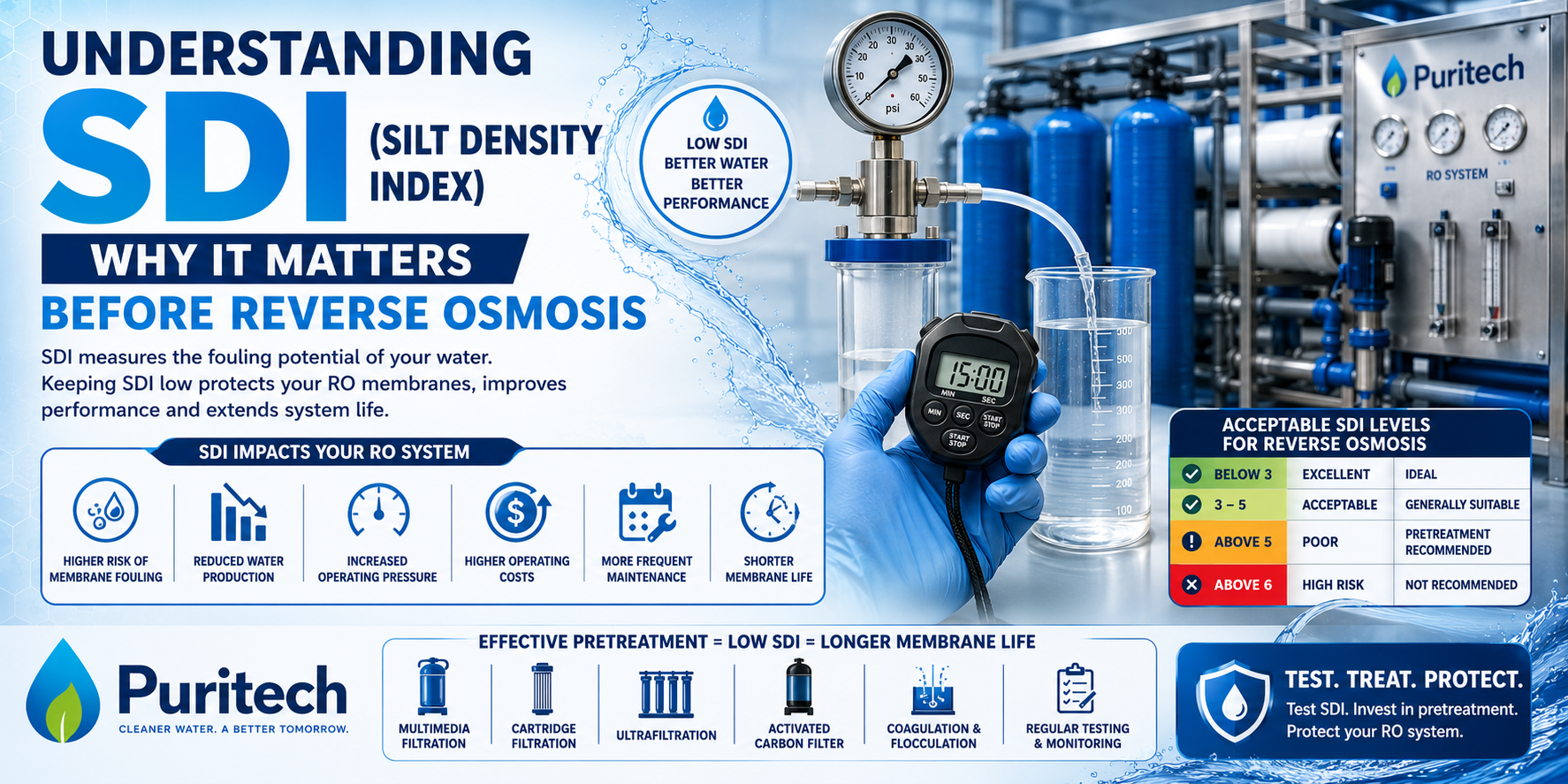
Understanding SDI before reverse osmosis is essential for anyone designing, operating, or maintaining a reverse osmosis (RO) system. While many people focus on Total Dissolved Solids (TDS), pH, or hardness, the Silt Density Index (SDI) is one of the most important indicators of feedwater quality.
A high SDI value can lead to rapid membrane fouling, reduced water production, increased operating pressure, higher maintenance costs, and premature membrane replacement. On the other hand, maintaining an acceptable SDI helps protect RO membranes, improve system efficiency, and reduce downtime.
Whether you’re treating municipal water, borehole water, surface water, or industrial process water, understanding SDI before reverse osmosis allows you to select the correct pretreatment equipment and maximize the lifespan of your RO system.
What Is Silt Density Index (SDI)?
The Silt Density Index (SDI) is a test used to measure the fouling potential of water before it enters a reverse osmosis system. Rather than measuring dissolved minerals, SDI estimates how quickly suspended particles and colloidal material can clog a standard membrane filter under controlled conditions.
The test provides an indication of how likely the feed water is to foul RO membranes. A lower SDI generally means cleaner water with fewer suspended solids, while a higher SDI indicates a greater risk of membrane fouling.
Because reverse osmosis membranes have extremely small pores, even tiny particles can accumulate over time and reduce system performance. Measuring SDI before reverse osmosis helps identify this risk early.
Why Understanding SDI Before Reverse Osmosis Is Important
Ignoring SDI can have significant consequences for any RO installation.
High SDI water may lead to:
- Rapid membrane fouling
- Reduced permeate production
- Increased differential pressure
- Higher energy consumption
- More frequent chemical cleaning
- Shorter membrane lifespan
- Higher maintenance costs
- Reduced water quality
- Unexpected system downtime
By contrast, maintaining a low SDI allows membranes to operate more efficiently and reduces maintenance frequency.
How Is SDI Measured?
The SDI test follows a standard procedure.
Water is passed through a 0.45-micron membrane filter at a constant pressure of 30 psi (approximately 2.1 bar).
The time taken to collect a fixed volume of water is recorded at the start of the test and again after a specified period, usually 15 minutes.
The reduction in flow rate caused by particles accumulating on the filter is then used to calculate the SDI value.
The higher the SDI, the greater the concentration of suspended solids that can foul an RO membrane.
What Causes High SDI?
Several factors can increase the silt density index of feed water.
Common causes include:
Fine Silt and Clay
Groundwater and surface water often contain microscopic mineral particles that remain suspended even after settling.
Organic Matter
Leaves, algae, plant material, and natural organic compounds contribute to higher SDI values and increase the risk of organic fouling.
Colloidal Particles
Very small particles that do not settle naturally are one of the main contributors to membrane fouling.
Iron and Manganese Precipitates
Oxidized iron and manganese can form fine particles that increase SDI if not removed before the RO system.
Biological Growth
Bacteria and other microorganisms may contribute to particulate loading and biofouling if pretreatment is inadequate.
Acceptable SDI Levels for Reverse Osmosis
Although membrane manufacturers may specify different limits, the following guidelines are commonly used:
| SDI Value | Water Quality | Suitability for RO |
|---|---|---|
| Below 3 | Excellent | Ideal |
| 3–5 | Acceptable | Generally suitable |
| Above 5 | Poor | Pretreatment recommended |
| Above 6 | High fouling risk | Not recommended without additional pretreatment |
Keeping SDI below the membrane manufacturer’s recommended limit is one of the most effective ways to reduce fouling.
Problems Caused by High SDI
High SDI affects more than just membrane cleanliness.
It can also result in:
- Reduced system recovery
- Increased pump workload
- Higher electricity consumption
- More frequent membrane replacement
- Increased cleaning chemical usage
- Lower production capacity
- Higher operating costs
These issues can significantly affect both residential and industrial water treatment systems.
How to Reduce SDI Before Reverse Osmosis
Reducing the Silt Density Index (SDI) before water reaches a reverse osmosis system is one of the most effective ways to improve membrane performance and extend equipment life. Since SDI measures the fouling potential of water, lowering the SDI reduces the amount of suspended material that can accumulate on the membrane surface.
The appropriate pretreatment method depends on the source water, contaminant levels, and the requirements of the RO system.
1. Multimedia Filtration
Multimedia filters are commonly installed as the first stage of pretreatment for commercial and industrial RO systems.
These filters typically contain layers of anthracite, sand, and gravel that remove larger suspended solids from the feed water.
Benefits include:
- Lower SDI values
- Reduced turbidity
- Longer cartridge filter life
- Improved overall system performance
Regular backwashing is essential to maintain filtration efficiency.
2. Cartridge Filtration
Cartridge filters provide a final polishing stage before water enters the RO membranes.
Common micron ratings include:
- 20 micron
- 10 micron
- 5 micron
- 1 micron
Selecting the correct micron rating depends on the feed water quality and the membrane manufacturer’s recommendations.
Blocked cartridge filters should be replaced promptly to maintain consistent flow and protect downstream equipment.
3. Ultrafiltration (UF)
Ultrafiltration systems remove extremely fine suspended solids, bacteria, algae, and colloidal particles that conventional filters may not capture.
UF pretreatment is particularly beneficial for:
- Surface water
- River water
- Dam water
- Wastewater reuse
- High-turbidity feed water
By significantly reducing SDI, ultrafiltration helps minimize membrane fouling and chemical cleaning requirements.
4. Coagulation and Flocculation
Some water sources contain very fine particles that cannot be removed through filtration alone.
Coagulation and flocculation use carefully selected chemicals to bind these particles together into larger flocs, making them easier to remove through clarification or filtration.
This process is commonly used in large municipal and industrial water treatment plants.
5. Proper Backwashing
Pretreatment equipment is only effective if it is maintained correctly.
Multimedia filters, sand filters, and certain other filtration systems require regular backwashing to remove accumulated contaminants.
Failure to backwash filters can lead to:
- Reduced flow rates
- Higher SDI values
- Increased pressure loss
- Reduced filtration efficiency
Routine maintenance helps ensure consistent pretreatment performance.
Best Pretreatment Equipment for Reducing SDI
The best pretreatment system depends on the quality of the incoming water. In many cases, a combination of technologies provides the most effective protection for reverse osmosis membranes.
| Water Quality Issue | Recommended Pretreatment |
|---|---|
| Sand and sediment | Multimedia filter |
| Fine suspended solids | Cartridge filter |
| High turbidity | Multimedia filter + cartridge filter |
| Colloidal particles | Ultrafiltration |
| Organic matter | Activated carbon filter |
| Biological contamination | UV sterilisation (where appropriate) |
| Iron and manganese | Oxidation and specialised filtration |
Selecting the right combination of pretreatment equipment helps maintain an acceptable SDI and protects the entire RO system.
Monitoring SDI
Testing SDI should not be a once-off exercise.
Routine monitoring allows operators to identify changes in feed water quality before they affect membrane performance.
SDI testing is especially important:
- Before commissioning a new RO system
- After changes in water source
- During seasonal changes
- Following heavy rainfall
- After maintenance work
- When membrane fouling increases unexpectedly
Keeping records of SDI results also helps identify long-term trends and optimize maintenance schedules.
The Relationship Between SDI and Membrane Fouling
Although SDI does not directly measure fouling, it provides a reliable indication of fouling potential.
High SDI water often contains:
- Fine silt
- Clay
- Organic material
- Colloidal particles
- Biological matter
These contaminants gradually accumulate on the membrane surface, restricting water flow and increasing operating pressure.
Reducing SDI before reverse osmosis helps minimize fouling and maintain consistent system performance.
Common Mistakes When Managing SDI
Many membrane fouling problems result from avoidable mistakes.
These include:
Skipping SDI Testing
Some system operators rely only on turbidity or TDS measurements.
While these parameters are useful, they do not replace SDI testing.
Assuming Clear Water Has a Low SDI
Water can appear crystal clear while still containing microscopic particles capable of fouling RO membranes.
Laboratory testing provides a much more accurate assessment.
Neglecting Pretreatment Maintenance
Dirty multimedia filters, blocked cartridge filters, and poorly maintained pretreatment equipment all contribute to higher SDI values.
Routine servicing is essential.
Ignoring Seasonal Changes
Water quality often changes throughout the year.
Heavy rainfall, drought, and increased river flow can all affect SDI.
Pretreatment systems should be adjusted accordingly.
Delaying Filter Replacement
Blocked cartridge filters reduce flow and compromise the effectiveness of the pretreatment system.
Replacing filters at the correct intervals helps maintain consistent water quality.
Frequently Asked Questions
What is a good SDI value for reverse osmosis?
Most membrane manufacturers recommend an SDI below 3, while values between 3 and 5 are generally considered acceptable. Always refer to the membrane manufacturer’s specifications.
Can reverse osmosis remove suspended solids?
Reverse osmosis membranes remove many suspended particles. However, allowing excessive solids to reach the membrane increases fouling and reduces system performance.
Pretreatment remains essential.
Is SDI the same as turbidity?
No.
Turbidity measures the cloudiness of water, whereas SDI measures the fouling potential caused by suspended particles and colloids.
Both parameters are important, but they provide different information.
How often should SDI be tested?
The testing frequency depends on the application.
Commercial and industrial facilities often perform routine SDI testing, particularly when feed water quality is variable.
Does municipal water require SDI testing?
In many municipal applications, SDI testing is still recommended, especially for large commercial or industrial RO systems where membrane protection is critical.
Final Thoughts
Understanding SDI before reverse osmosis is essential for protecting membranes, improving water quality, and reducing long-term operating costs. While SDI is often overlooked, it plays a critical role in determining how effectively an RO system will perform over time.
By monitoring SDI, maintaining effective pretreatment, and selecting the right filtration equipment, you can significantly reduce membrane fouling, extend membrane lifespan, and improve the reliability of your water treatment system.
Whether you operate a residential, commercial, or industrial reverse osmosis system, investing in proper pretreatment today can help prevent costly downtime and unnecessary membrane replacements in the future.
If you need assistance interpreting SDI results or selecting the right pretreatment equipment, the experts at Puritech can help you design a solution tailored to your water source and application.