Currently Empty: R0.00

Seawater Desalination vs Brackish Water Systems
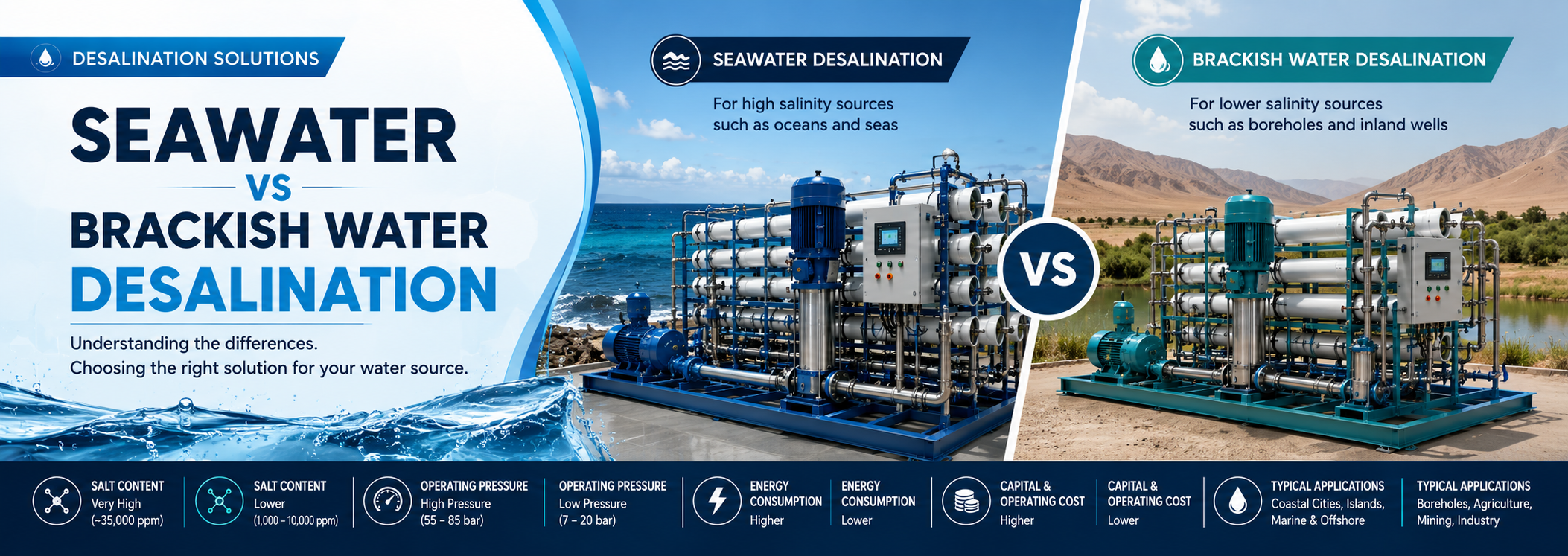
Seawater desalination and brackish water desalination both use reverse osmosis technology to remove dissolved salts and produce clean water. However, the two systems differ significantly in water quality, operating pressure, energy consumption, and overall system design.
Understanding these differences helps businesses, municipalities and industrial operators choose the most suitable desalination solution for their water source.
What Is Seawater?
Seawater contains very high concentrations of dissolved salts, typically around 35,000 ppm (parts per million).
Because of its high salinity, seawater requires greater operating pressure and more robust equipment to produce fresh water.
Common sources include:
- Oceans
- Coastal seawater intakes
- Harbours
- Offshore facilities
What Is Brackish Water?
Brackish water contains less salt than seawater but more dissolved salts than freshwater.
Typical sources include the following:
- Boreholes
- Estuaries
- Inland saline aquifers
- Mining operations
- Agricultural wells
Brackish water generally contains between 1,000 and 10,000 ppm TDS, although levels can vary.
Operating Pressure
One of the biggest differences between the two systems is operating pressure.
Seawater Desalination
Seawater reverse osmosis systems typically operate at much higher pressures because they must overcome greater osmotic pressure.
Higher pressure requires the following:
- Heavy-duty pumps
- Stronger pressure vessels
- More durable components
Brackish Water Desalination
Brackish water systems operate at significantly lower pressures.
As a result, they generally require:
- Smaller pumps
- Lower energy input
- Simpler system designs
This makes them more economical in many inland applications.
Energy Consumption
Energy use is a major operating cost in any desalination plant.
Because seawater contains much higher salt concentrations, seawater desalination typically consumes more electricity than brackish water systems.
Modern plants often include energy recovery devices to improve efficiency and reduce power consumption.
Membrane Selection
Although both systems use reverse osmosis membranes, the membrane specifications may differ.
Engineers select membranes based on:
- Feed water salinity
- Required water quality
- Recovery rate
- Plant capacity
- Fouling potential
Proper membrane selection helps maximise efficiency and water production.
Recovery Rates
‘Recovery rate’ refers to the percentage of feed water converted into fresh water.
Generally:
- Brackish water systems achieve higher recovery rates.
- Seawater systems produce lower recovery rates because of the higher salt concentration.
The exact recovery depends on feedwater quality and system design.
Typical Applications
Seawater Desalination
Seawater systems are commonly used for:
- Coastal cities
- Island communities
- Hotels and resorts
- Offshore platforms
- Marine vessels
- Emergency water supply
Brackish Water Desalination
Brackish water systems are widely used in the following:
- Agriculture
- Mining
- Manufacturing
- Municipal boreholes
- Food processing
- Remote communities
Which System Costs More?
In most cases, seawater desalination has higher capital and operating costs because it requires:
- Higher operating pressure
- Larger pumps
- Greater energy consumption
- More specialised materials
- Advanced energy recovery equipment
Brackish water systems are generally less expensive to install and operate.
Choosing the Right Desalination System
Selecting the correct solution depends on:
- Water source
- Salt concentration
- Required water production
- Available power supply
- Budget
- Water quality goals
A professional water analysis and system design ensure the equipment matches the application.
Frequently Asked Questions
Can the same desalination system treat both seawater and brackish water?
No. Although both use reverse osmosis technology, they are designed for different salinity levels and operating pressures.
Which system uses more electricity?
Seawater desalination typically requires more energy because of its higher operating pressure.
Why does seawater need higher pressure?
The higher salt concentration creates greater osmotic pressure, which must be overcome to force water through the membranes.
Which system is more affordable?
Brackish water desalination systems usually have lower installation and operating costs, depending on the application.
Conclusion
While both technologies produce high-quality fresh water, seawater desalination and brackish water desalination systems are designed for different water sources and operating conditions. Understanding the differences in pressure, energy use, recovery rates and equipment requirements helps ensure the right system is selected for each application.
Puritech supplies customised desalination solutions for both seawater and brackish water applications. Our experienced team designs systems that deliver reliable performance, efficient operation and long-term value for municipal, commercial and industrial projects.