Currently Empty: R0.00

Water Softener vs Reverse Osmosis: Which System Is Right for You?
Choosing between a water softener vs a reverse osmosis system can be confusing, especially if you’re experiencing hard water, poor-tasting drinking water, scale build-up or borehole water problems. Many homeowners assume these systems perform the same function, but they are designed to solve very different water quality issues.
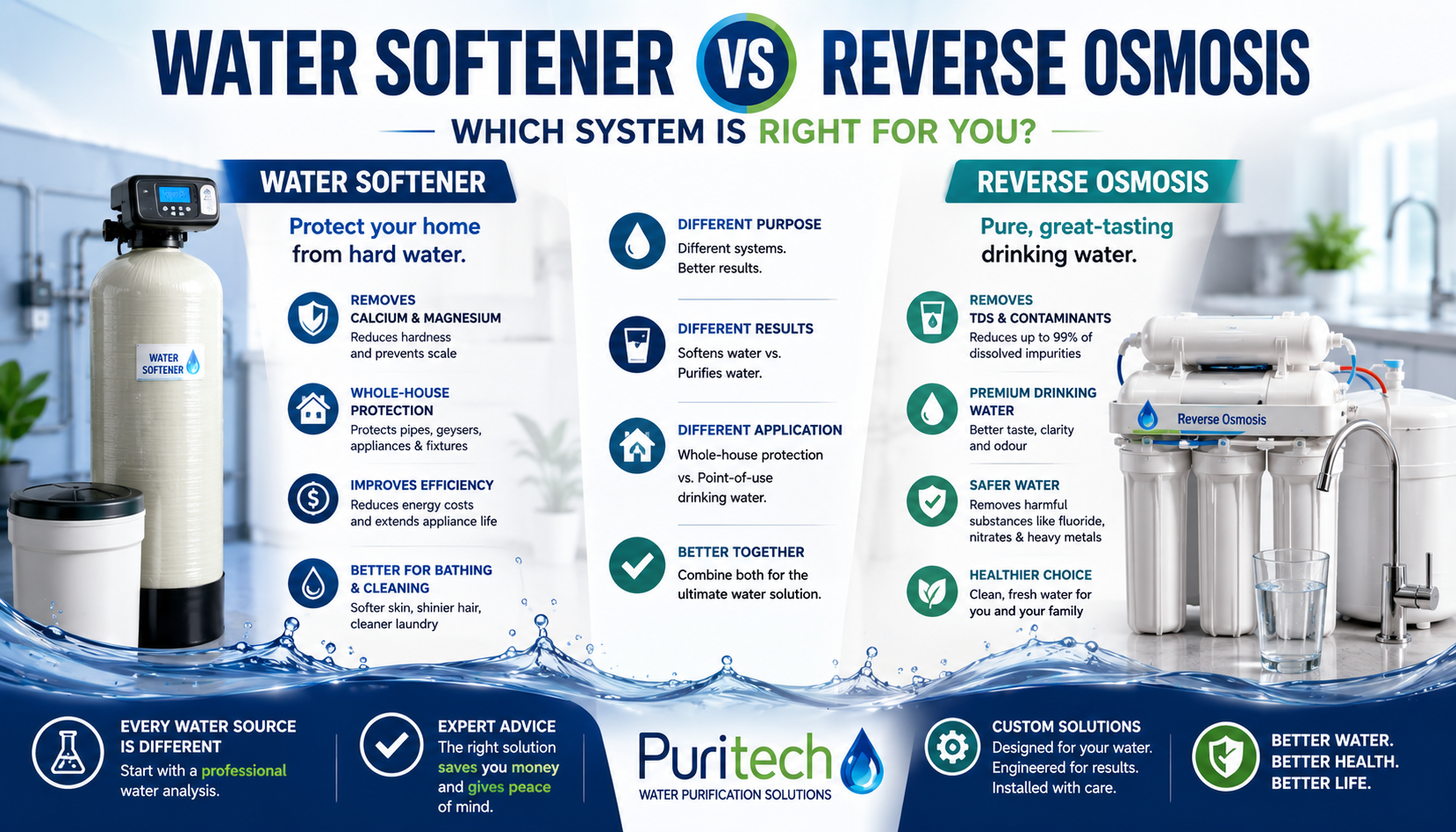
A water softener protects your plumbing and appliances by removing the minerals that cause hard water, while a reverse osmosis system produces exceptionally high-quality drinking water by removing a wide range of dissolved contaminants.
Understanding the difference is essential before investing in any water treatment system. At Puritech, we always recommend starting with a recent professional laboratory water analysis, ensuring every recommendation is based on the actual composition of your water rather than guesswork.
Why People Confuse Water Softeners and Reverse Osmosis
This is one of the most common misconceptions in the water treatment industry.
Many customers believe that:
- A water softener purifies drinking water.
- Reverse osmosis removes hard water throughout the house.
- Both systems perform the same job.
- Installing one automatically eliminates every water quality issue.
In reality, they are completely different technologies designed for different purposes.
Choosing the wrong system may leave your original problem unsolved while costing far more than necessary.
What Is a Water Softener?
A water softener is specifically designed to remove the minerals responsible for hard water.
These minerals are primarily:
- Calcium.
- Magnesium.
When these minerals are present in high concentrations, they form scale inside:
- Pipes.
- Geysers.
- Boilers.
- Coffee machines.
- Washing machines.
- Dishwashers.
- Industrial equipment.
A water softener exchanges calcium and magnesium ions with sodium or potassium ions through a specialised ion exchange resin.
The result is softened water that helps protect plumbing and equipment.
What Problems Does a Water Softener Solve?
Hard water affects far more than just your taps.
It can lead to:
- White scale deposits.
- Reduced appliance efficiency.
- Higher electricity consumption.
- Increased maintenance costs.
- Soap scum.
- Reduced soap performance.
- Shorter equipment lifespan.
By removing hardness minerals, a water softener helps improve efficiency and reduce long-term operating costs.
What a Water Softener Does NOT Remove
One of the biggest misunderstandings is believing a water softener purifies water.
It does not.
A standard water softener does not remove:
- Bacteria.
- Viruses.
- Nitrates.
- Fluoride.
- Chlorine.
- Pesticides.
- Heavy metals.
- Most dissolved salts.
- Total Dissolved Solids (TDS).
Its primary purpose is to reduce water hardness.
What Is Reverse Osmosis?
A reverse osmosis (RO) system is one of the most advanced water purification technologies available.
Instead of targeting hardness alone, reverse osmosis forces water through a semi-permeable membrane that removes a broad range of dissolved contaminants.
The result is exceptionally high-quality drinking water.
Reverse osmosis is commonly used in:
- Homes.
- Offices.
- Restaurants.
- Hospitals.
- Laboratories.
- Food manufacturing.
- Pharmaceutical facilities.
- Commercial and industrial water treatment.
What Does Reverse Osmosis Remove?
Depending on water quality, reverse osmosis can significantly reduce the following:
- Total Dissolved Solids (TDS).
- Sodium.
- Calcium.
- Magnesium.
- Fluoride.
- Nitrates.
- Sulphates.
- Chlorides.
- Many heavy metals.
- Various dissolved contaminants.
This makes reverse osmosis one of the most effective solutions for producing clean, great-tasting drinking water.
What Reverse Osmosis Does NOT Do
Although reverse osmosis removes many dissolved substances, it is not designed to replace every treatment system.
For example:
A small under-sink reverse osmosis unit will not prevent scale from forming inside:
- Geysers.
- Washing machines.
- Dishwashers.
- Whole-house plumbing.
Only the water supplied to the reverse osmosis tap is treated.
The remainder of the house continues receiving untreated water unless additional systems are installed.
The Biggest Difference
The simplest way to understand water softener vs reverse osmosis is this:
A water softener protects your home.
A reverse osmosis system protects your drinking water.
Although they sometimes work together, they perform very different jobs.
Municipal Water Example
Imagine a homeowner receiving municipal water with:
- High hardness.
- Good microbiological quality.
- Acceptable TDS.
- Chlorine taste.
The homeowner notices:
- White scale on taps.
- Soap doesn’t lather well.
- The kettle requires frequent descaling.
The primary problem is hard water.
A professionally sized water softener may solve the scaling issue.
If the homeowner also wants premium-quality drinking water, an under-sink reverse osmosis system can be installed at the kitchen tap.
Together, the systems provide whole-house protection and excellent drinking water.
Borehole Water Example
Now consider a borehole supplying:
- High TDS.
- Elevated hardness.
- Increased sodium.
- High sulphates.
Installing only a water softener would reduce hardness but leave many dissolved contaminants untouched.
Installing only reverse osmosis at one kitchen tap would improve drinking water but would not protect the rest of the home’s plumbing from scale.
A complete treatment solution might include:
- Sediment filtration.
- Water softening.
- Reverse osmosis.
- UV sterilisation (where required).
The correct design depends entirely on the laboratory analysis.
Why One Size Doesn’t Fit All
No two water sources are identical.
Two neighbouring properties may have completely different water chemistry.
One home may only require water softening.
Another may only require reverse osmosis.
A third may benefit from both systems working together.
This is why professional water treatment begins with understanding the water rather than recommending equipment based on assumptions.
Why Professional Water Analysis Comes First
Before investing in any treatment equipment, a recent professional laboratory water analysis should answer questions such as:
- Is the water hard?
- Are dissolved salts elevated?
- Is reverse osmosis necessary?
- Is water softening sufficient?
- Are additional treatment stages required?
- Is the water microbiologically safe?
Without this information, selecting the correct treatment system becomes little more than guesswork.
Water Softener vs Reverse Osmosis: A Side-by-Side Comparison
Now that we’ve explained the purpose of each system, let’s compare water softeners vs reverse osmosis in more detail.
Although both improve water quality, they solve different problems and are often installed in different parts of a home or business.
Understanding these differences will help you invest in the right solution for your specific water conditions.
Quick Comparison Table
| Feature | Water Softener | Reverse Osmosis |
|---|---|---|
| Primary purpose | Removes hardness minerals | Purifies drinking water |
| Removes calcium & magnesium | ✔ Yes | ✔ Yes |
| Removes Total Dissolved Solids (TDS) | ✘ No | ✔ Yes |
| Removes chlorine | ✘ No (unless combined with carbon) | ✔ Yes (with pre-filters) |
| Removes nitrates | ✘ No | ✔ Yes |
| Removes fluoride | ✘ No | ✔ Yes |
| Removes sodium | ✘ No | ✔ Yes |
| Improves drinking water taste | Limited | Excellent |
| Prevents scale | ✔ Yes | Only where installed |
| Whole-house protection | ✔ Yes | Usually no |
| Point-of-use drinking water | ✘ No | ✔ Yes |
What Does a Water Softener Remove?
A water softener is designed specifically to reduce water hardness.
It removes:
- Calcium.
- Magnesium.
These two naturally occurring minerals are responsible for:
- White scale deposits.
- Blocked pipes.
- Reduced heating efficiency.
- Soap scum.
- Appliance wear.
By removing hardness minerals, a water softener helps protect expensive household and commercial equipment.
What Does Reverse Osmosis Remove?
Reverse osmosis removes a much wider range of dissolved contaminants.
These include:
- Total Dissolved Solids (TDS).
- Sodium.
- Fluoride.
- Nitrates.
- Sulphates.
- Chlorides.
- Many heavy metals.
- Various dissolved salts.
This is why reverse osmosis is regarded as one of the best technologies for producing premium-quality drinking water.
Installation Location
Another major difference between water softeners and reverse osmosis is where the systems are installed.
Water Softener
Normally installed:
- At the main incoming water supply.
- Before the water enters the home or building.
This means softened water is supplied throughout the property.
Protected equipment includes:
- Geysers.
- Washing machines.
- Dishwashers.
- Coffee machines.
- Boilers.
- Plumbing.
- Showers.
- Taps.
Reverse Osmosis
Reverse osmosis is usually installed:
- Under the kitchen sink.
- At a drinking water point.
- In commercial kitchens.
- In food production facilities.
- In industrial process applications.
It normally treats only the water intended for drinking or production.
Drinking Water Quality
When comparing water softeners vs reverse osmosis, this is perhaps the biggest difference.
Water Softener
Water softeners improve water performance by reducing hardness.
However, they are not designed to produce purified drinking water.
Taste improvements are usually minimal.
Reverse Osmosis
Reverse osmosis dramatically improves the following:
- Taste.
- Odour.
- Clarity.
- Overall drinking water quality.
Many bottled water manufacturers rely on reverse osmosis because of its ability to produce consistently high-quality water.
Protecting Household Appliances
Hard water is one of the biggest causes of premature appliance failure.
Scale forms inside:
- Geysers.
- Kettles.
- Coffee machines.
- Dishwashers.
- Washing machines.
A water softener helps prevent this damage by removing hardness before the water reaches these appliances.
Reverse osmosis, on the other hand, only protects equipment connected directly to the RO system.
Maintenance Requirements
Every water treatment system requires regular servicing.
Water Softener Maintenance
Typical maintenance includes the following:
- Replenishing salt.
- Periodic servicing.
- Resin inspection.
- Performance testing.
When properly maintained, water softeners provide many years of reliable operation.
Reverse Osmosis Maintenance
Routine maintenance generally includes:
- Replacing sediment filters.
- Replacing activated carbon cartridges.
- Monitoring membrane performance.
- Sanitising the system.
- Replacing the RO membrane when required.
Maintenance intervals depend on water quality and system usage.
Operating Costs
Operating costs vary depending on water quality and system size.
Water Softener
Ongoing costs generally include:
- Regeneration salt.
- Periodic servicing.
- Water used during regeneration.
Operating costs are usually predictable.
Reverse Osmosis
Operating costs may include the following:
- Replacement filter cartridges.
- Membrane replacement.
- Water consumption during purification.
- Routine servicing.
Although operating costs may be higher than a water softener, the result is exceptionally high-quality drinking water.
Which System Lasts Longer?
Both systems can provide many years of reliable service when:
- Correctly sized.
- Professionally installed.
- Properly maintained.
Poor maintenance significantly shortens equipment life regardless of system type.
Commercial Applications
Water Softeners
Frequently used in:
- Hotels.
- Hospitals.
- Restaurants.
- Commercial laundries.
- Food processing.
- Manufacturing.
- Boiler systems.
The primary objective is protecting expensive equipment from scale.
Reverse Osmosis
Widely used in:
- Pharmaceutical production.
- Laboratories.
- Beverage manufacturing.
- Food production.
- Coffee shops.
- Bottled water plants.
- Medical facilities.
- Commercial drinking water systems.
The primary objective is producing exceptionally pure water.
Can They Work Together?
Absolutely.
In fact, combining both systems often provides the best overall solution.
A typical installation may include:
- Sediment filtration.
- Activated carbon filtration.
- Water softener.
- Reverse osmosis.
- UV sterilisation (where required).
The water softener protects the reverse osmosis membrane from excessive scale, while the reverse osmosis system produces premium-quality drinking water.
This combination improves both system performance and membrane lifespan.
Real-Life Example
A family in Pretoria contacted Puritech because they were experiencing the following:
- White scale throughout the house.
- Poor-tasting drinking water.
- Frequent kettle replacement.
- Soap not lathering properly.
Their laboratory water analysis showed:
- High hardness.
- Elevated Total Dissolved Solids (TDS).
- Good microbiological quality.
Puritech recommended:
- A whole-house water softener to eliminate hardness and protect plumbing.
- An under-sink reverse osmosis system to provide purified drinking water at the kitchen tap.
Within weeks, the family noticed:
- Less scale on taps and shower screens.
- Improved soap performance.
- Better-tasting drinking water.
- Reduced appliance maintenance.
- Greater confidence in their household water quality.
Instead of choosing either a water softener or reverse osmosis, the combination delivered the best overall result.
Why Water Analysis Is So Important
Many customers ask:
“Which system is better?”
The better question is the following:
“What does my water actually need?”
Without understanding the chemistry of your water, selecting between Water Softener vs Reverse Osmosis becomes guesswork.
A recent professional laboratory water analysis identifies:
- Hardness.
- TDS.
- Iron.
- Manganese.
- Fluoride.
- Nitrates.
- Sodium.
- Chlorides.
- Sulphates.
- Other water quality characteristics.
This information allows engineers to recommend the most effective and cost-efficient solution.
Which System Should You Choose?
After comparing water softeners vs reverse osmosis, you may still be asking:
“Which one is right for my home or business?”
The answer depends entirely on your water quality, how you use your water, and the specific problems you’re trying to solve.
There is no single system that is perfect for every situation.
At Puritech, every recommendation begins with a recent professional laboratory water analysis to ensure the treatment solution matches your water—not assumptions.
Choose a Water Softener If…
A water softener is the ideal solution when your primary concern is hard water.
You should consider a water softener if you experience:
- White scale on taps and shower screens.
- Soap that doesn’t lather properly.
- Frequent kettle descaling.
- Reduced geyser efficiency.
- Mineral deposits in coffee machines.
- Appliance repairs caused by scale.
- High hardness confirmed by a laboratory water analysis.
By removing calcium and magnesium, a water softener helps protect your plumbing and extends the lifespan of expensive equipment.
Choose Reverse Osmosis If…
A reverse osmosis system is the better choice when your goal is producing exceptionally high-quality drinking water.
It is commonly recommended when laboratory analysis identifies:
- Elevated Total Dissolved Solids (TDS).
- High sodium.
- High fluoride.
- Elevated nitrates.
- Excessive sulphates.
- High chlorides.
- Poor taste or odour.
- Multiple dissolved contaminants.
Reverse osmosis is particularly well suited to:
- Homes.
- Offices.
- Coffee shops.
- Restaurants.
- Medical facilities.
- Food manufacturers.
- Laboratories.
Choose Both Systems If…
Many South African homes and businesses achieve the best results by combining both technologies.
For example:
A borehole supplies water with the following:
- High hardness.
- Elevated TDS.
- Good microbiological quality.
A professionally designed treatment system may include:
- Sediment filtration.
- Activated carbon filtration.
- Water softener.
- Reverse osmosis at the kitchen sink.
- UV sterilisation where required.
This combination provides the following:
- Whole-house-scale protection.
- Excellent drinking water.
- Improved appliance lifespan.
- Lower maintenance costs.
- Better tasting water.
Rather than competing with one another, water softeners and reverse osmosis often work together.
Real-Life Case Study 1 – Municipal Water
A homeowner in Johannesburg contacted Puritech because they were constantly replacing kettles and cleaning scale from bathroom fittings.
Their municipal water analysis showed:
- High hardness.
- Moderate TDS.
- Safe microbiological quality.
The customer initially requested a reverse osmosis system for the entire house.
After reviewing the laboratory report, Puritech recommended:
- A whole-house water softener.
- A compact reverse osmosis system for drinking water at the kitchen sink.
The result included:
- Reduced scale throughout the home.
- Better tasting drinking water.
- Longer appliance lifespan.
- Lower electricity consumption due to improved geyser efficiency.
Real-Life Case Study 2 – Borehole Water
A small guest lodge relied on borehole water.
Guests frequently complained about:
- Poor tasting drinking water.
- Mineral deposits in bathrooms.
- Scale in coffee machines.
Laboratory testing revealed:
- High hardness.
- Elevated Total Dissolved Solids.
- High sulphates.
Puritech designed a treatment system incorporating the following:
- Sediment filtration.
- Water softening.
- Reverse osmosis for drinking water.
- Routine maintenance.
Within a few months, the lodge experienced the following:
- Improved guest reviews.
- Lower maintenance costs.
- Longer equipment life.
- Reduced scale build-up.
- Better tasting drinking water.
Common Mistakes to Avoid
Many customers purchase equipment before understanding their water.
Common mistakes include:
Buying Reverse Osmosis to Solve Hard Water
Reverse osmosis improves drinking water but does not protect the rest of the home’s plumbing when installed as a point-of-use system.
Installing a Water Softener for Drinking Water Problems
A water softener reduces hardness but does not remove many dissolved contaminants that affect drinking water quality.
Ignoring Professional Water Analysis
Without knowing what is actually in your water, choosing the correct treatment system becomes guesswork.
Choosing the Cheapest System
A lower purchase price can become more expensive if the system fails to solve the problem or requires unnecessary upgrades later.
Frequently Asked Questions
Which is better: water softener vs reverse osmosis?
Neither system is universally better.
A water softener removes hardness minerals, while reverse osmosis removes a wide range of dissolved contaminants. The best choice depends on your water quality and intended application.
Does a water softener purify drinking water?
No.
A water softener is designed to reduce hardness by removing calcium and magnesium. It is not intended to purify drinking water or remove most dissolved contaminants.
Does reverse osmosis soften water?
Reverse osmosis removes many dissolved minerals, including calcium and magnesium, from the water it treats. However, most residential systems only supply a dedicated drinking water tap and do not soften the water used throughout the rest of the property.
Can I install both systems together?
Yes.
In many homes and businesses, a whole-house water softener combined with a point-of-use reverse osmosis system provides the ideal balance between equipment protection and premium drinking water.
Which system is better for borehole water?
There is no single answer.
Some boreholes only require water softening, while others need reverse osmosis or additional treatment technologies. A professional laboratory water analysis determines the most appropriate solution.
How long do these systems last?
With professional installation and regular maintenance, both water softeners and reverse osmosis systems can provide many years of reliable service. The exact lifespan depends on water quality, usage and servicing.
Why Puritech Recommends Water Analysis First
No two water supplies are exactly alike.
A municipal supply in Cape Town will have different characteristics from a borehole in Limpopo or a commercial water source in Durban.
Before recommending any treatment system, Puritech evaluates a recent professional laboratory water analysis to determine:
- Hardness.
- Total Dissolved Solids (TDS).
- Iron.
- Manganese.
- Fluoride.
- Nitrates.
- Chlorides.
- Sulphates.
- Microbiological quality where applicable.
This allows our engineers to recommend a system that solves the actual problem rather than simply treating the symptoms.
Final Thoughts
The debate around water softeners vs reverse osmosis often assumes that one system is better than the other. In reality, they serve different purposes.
A water softener protects your plumbing, appliances, and equipment from the damaging effects of hard water, while a reverse osmosis system produces exceptionally pure, great-tasting drinking water by removing a wide range of dissolved contaminants.
For many South African homes and businesses, the best solution is not choosing one over the other—it is combining both technologies as part of a professionally designed treatment system.
At Puritech, every project starts with understanding your water. By reviewing a recent professional laboratory water analysis, we design customised treatment solutions that improve water quality, protect your investment and deliver long-term value.
If you’re unsure whether you need a water softener, a reverse osmosis system or a combination of both, let your water quality guide the decision—not assumptions.