Currently Empty: R0.00

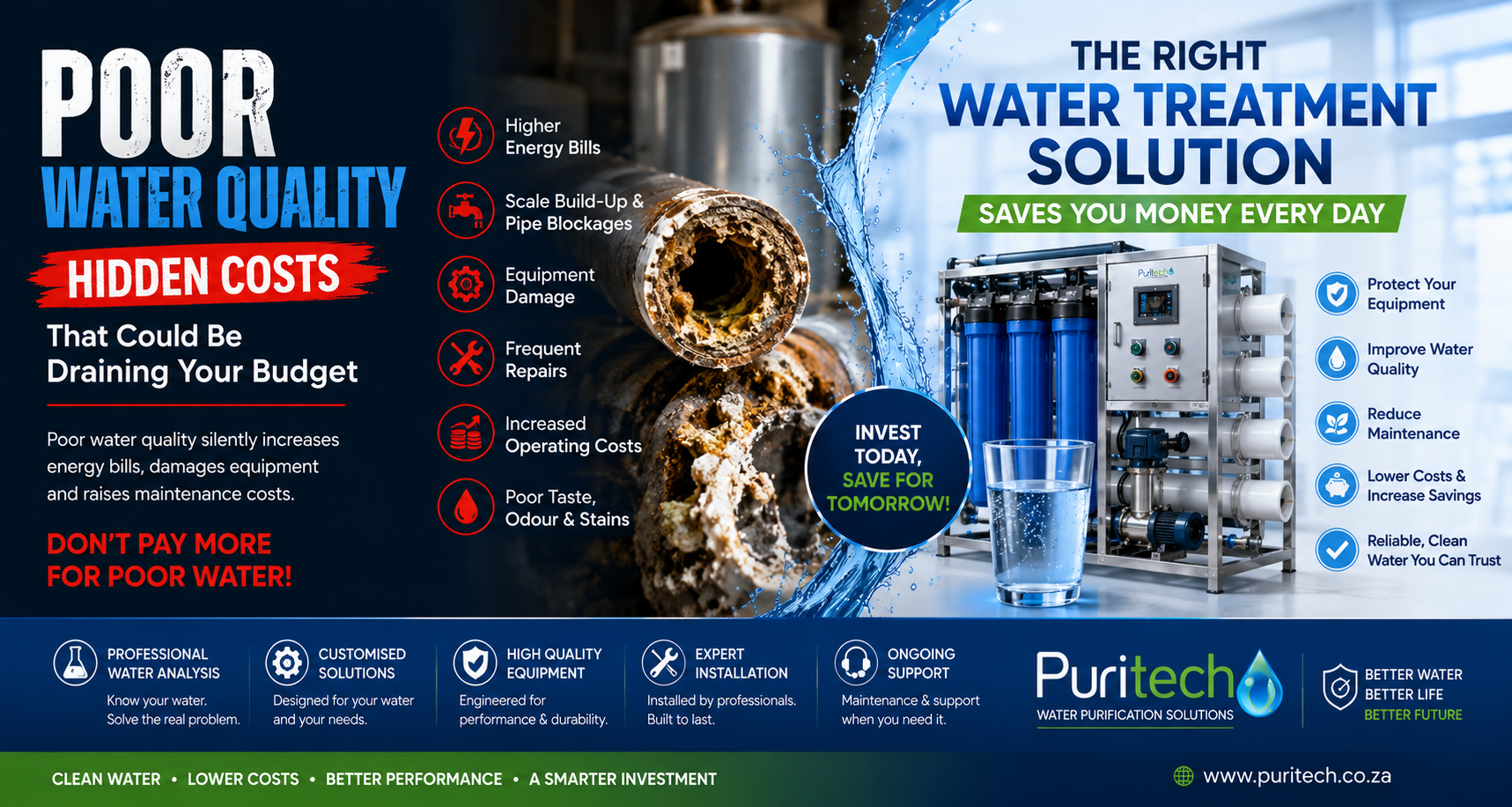
Poor Water Quality: Hidden Costs That Could Be Draining Your Budget
Poor water quality is often treated as a minor inconvenience. People notice unpleasant tastes, stains on bathroom fittings, scale inside kettles, or cloudy water and simply learn to live with it. What many homeowners and businesses don’t realise is that poor water quality quietly increases operating costs every single day.
Whether your water comes from a municipal supply or a borehole, untreated contaminants can shorten the lifespan of equipment, reduce energy efficiency, increase maintenance expenses, and disrupt daily operations. Over months and years, these hidden costs often exceed the investment required for a professionally designed water treatment system.
The good news is that these losses are largely preventable. By starting with a recent professional laboratory water analysis, engineers can identify the specific characteristics of your water and recommend a treatment solution that protects your property, equipment, and long-term budget.
The True Cost of Poor Water Quality
Most people judge water quality by appearance.
If the water looks clear, they assume everything is fine.
Unfortunately, many of the contaminants that cause the greatest damage are completely invisible.
Dissolved minerals; hardness; iron; manganese; high Total Dissolved Solids (TDS); chlorides; sulphates; and other dissolved substances may be present even when the water appears perfectly clean.
This is why poor water quality is often called a ‘silent expense’.
The damage happens slowly, making it difficult to recognise until repairs become necessary.
Higher Electricity Bills
One of the highest hidden costs of poor water quality is increased energy consumption.
Hard water contains elevated levels of calcium and magnesium.
As water is heated, these minerals form scale inside:
- Geysers.
- Boilers.
- Heat exchangers.
- Steam systems.
- Hot water pipes.
Even a thin layer of scale acts as an insulating barrier.
Heating elements must work harder and operate for longer periods to produce the same amount of hot water.
The result is:
- Higher electricity consumption.
- Increased energy costs.
- Reduced heating efficiency.
- Shorter equipment lifespan.
Over several years, these additional electricity costs can exceed the price of installing a water softener.
Geysers Rarely Fail Without a Reason
Many homeowners replace geysers believing they simply wear out.
While age certainly plays a role, poor water quality is often one of the biggest contributing factors.
Hard water causes mineral deposits to accumulate inside the tank and on heating elements.
Eventually, this leads to the following:
- Reduced efficiency.
- Overheating.
- Corrosion.
- Premature failure.
Protecting a geyser with the correct water treatment system can significantly extend its operating life.
Boilers and Industrial Heating Systems
Commercial and industrial facilities often rely on boilers to support manufacturing, food production, hospitality, healthcare, and many other operations.
Boilers operating with untreated water may experience the following:
- Heavy scale formation.
- Reduced steam production.
- Increased fuel consumption.
- Higher maintenance requirements.
- Unexpected downtime.
Even small improvements in water quality can generate substantial savings over the life of the equipment.
Scale Slowly Destroys Equipment
Scale is one of the most expensive consequences of poor water quality.
Unlike sudden equipment failures, scale develops gradually.
Over time, it affects the following:
- Dishwashers.
- Washing machines.
- Coffee machines.
- Ice makers.
- Steamers.
- Industrial processing equipment.
- Heat exchangers.
- Pumps.
- Pipework.
As scale thickens, equipment operates less efficiently while maintenance requirements increase.
Removing scale after it forms is often far more expensive than preventing it in the first place.
Plumbing Repairs Add Up
Mineral deposits do not only affect equipment.
They also accumulate inside plumbing systems.
This may result in:
- Reduced water pressure.
- Restricted flow.
- Blocked pipework.
- Valve failures.
- Increased corrosion.
- More frequent plumbing repairs.
Large commercial buildings may spend thousands of rand every year addressing plumbing problems that originate from untreated water.
Appliances Don’t Last as Long
Household appliances are designed to operate within specific water quality ranges.
Poor water quality increases wear on:
- Washing machines.
- Dishwashers.
- Coffee machines.
- Ice machines.
- Water dispensers.
- Water heaters.
Replacing these appliances earlier than expected represents another hidden cost that many families overlook.
More Soap, More Detergent, More Cleaning Products
Hard water reduces the effectiveness of soaps and detergents.
As a result, people often use larger quantities of:
- Laundry detergent.
- Dishwashing liquid.
- Shampoo.
- Hand soap.
- Cleaning chemicals.
Although each purchase seems relatively small, these additional expenses continue throughout the life of the property.
Softened water generally requires significantly less detergent to achieve the same cleaning results.
Poor Water Quality Affects Drinking Water Too
Not all costs are financial.
Unpleasant-tasting water often causes families and businesses to purchase bottled water instead.
For an average household, this can become a significant annual expense.
For hotels, offices, schools, and conference venues, bottled water purchases may represent tens of thousands of rand each year.
Installing a properly designed drinking water system often provides excellent long-term value while reducing plastic waste.
Untreated Borehole Water Can Become Extremely Expensive
Many South Africans rely on boreholes because of water restrictions or unreliable municipal supplies.
While boreholes offer excellent independence, untreated borehole water may contain:
- Iron.
- Manganese.
- High hardness.
- Elevated TDS.
- Sulphates.
- Chlorides.
- Nitrates.
- Low pH.
- Other naturally occurring minerals.
Without a professional laboratory water analysis, installing treatment equipment becomes guesswork.
The wrong system may fail to address the actual water quality challenges while creating unnecessary maintenance costs.
Real-Life Example
A homeowner contacted Puritech after replacing two geysers within four years.
The homeowner believed the geysers were poor quality.
A professional laboratory water analysis revealed extremely hard borehole water with elevated calcium and magnesium levels.
Instead of installing another geyser, Puritech recommended a correctly sized water softener ahead of the household plumbing system.
Within the following years:
- No additional geyser failures occurred.
- Heating efficiency improved.
- Soap consumption decreased.
- Bathroom fittings remained cleaner.
- Maintenance costs were significantly reduced.
The problem had never been the geysers.
It was the untreated water.
The Most Expensive Water Problem Is the One You Can’t See
Many of the costs associated with poor water quality develop so gradually that property owners simply accept them as normal.
However, when these costs are added together—including electricity, maintenance, repairs, replacement equipment, cleaning products, and bottled water—they often represent a substantial financial burden.
Understanding your water is the first step toward reducing these ongoing expenses.
How Poor Water Quality Affects Different Industries
The effects of poor water quality extend far beyond stained kettles or unpleasant-tasting drinking water. Across South Africa, businesses in almost every industry depend on water to support daily operations. When that water contains excessive minerals, dissolved salts, sediment, bacteria, or other contaminants, the financial impact can be significant.
Regardless of whether your organisation uses municipal water or a borehole, poor water quality can reduce productivity, increase maintenance costs, damage expensive equipment, and shorten the lifespan of critical infrastructure.
Let’s look at how different industries are affected.
Homes and Residential Properties
For homeowners, poor water quality often starts as a nuisance before becoming an expensive problem.
Common signs include:
- White scale on taps.
- Soap that doesn’t lather properly.
- Stained toilets and basins.
- Dry skin and hair.
- Poor-tasting drinking water.
- Cloudy ice cubes.
- Blocked showerheads.
Over time, hidden costs begin to accumulate.
These include:
- Higher electricity bills.
- Geyser replacements.
- Plumbing repairs.
- Appliance failures.
- Increased detergent use.
- Bottled water purchases.
A professionally designed residential water treatment system can improve drinking water quality while protecting the home’s plumbing and appliances.
Hotels, Guest Houses and Lodges
Guests expect clean, fresh, great-tasting water.
Unfortunately, poor water quality can negatively affect a hotel’s reputation without management even realising the underlying cause.
Common problems include:
- Unpleasant drinking water.
- White residue on bathroom fittings.
- Stained shower screens.
- Scale inside coffee machines.
- Reduced hot water efficiency.
- Frequent laundry equipment maintenance.
Hotels also consume enormous volumes of hot water every day.
Scale inside geysers and boilers reduces efficiency, increasing electricity consumption throughout the year.
Installing appropriate water treatment equipment often improves guest satisfaction while lowering operating costs.
Restaurants and Coffee Shops
Food businesses rely on water for almost every operation.
Water is used for:
- Food preparation.
- Beverage production.
- Ice machines.
- Coffee equipment.
- Dishwashing.
- Cleaning.
- Handwashing.
Poor water quality affects both product quality and equipment reliability.
Coffee brewed with high mineral content may taste inconsistent.
Scale damages espresso machines.
Ice machines require more maintenance.
Dishwashers consume more detergent.
The result is higher operating costs and inconsistent customer experiences.
Hospitals and Healthcare Facilities
Hospitals require exceptionally reliable water quality.
Water supports:
- Patient care.
- Surgical theatres.
- Sterilisation.
- Laboratories.
- Dialysis equipment.
- Kitchens.
- Laundry services.
- Staff facilities.
Poor water quality may affect sensitive medical equipment, increase maintenance requirements, and compromise operational efficiency.
Professionally designed treatment systems help healthcare facilities maintain dependable water quality while protecting expensive infrastructure.
Schools and Universities
Educational institutions consume large volumes of water every day.
Water is used in:
- Drinking fountains.
- Kitchens.
- Boarding facilities.
- Science laboratories.
- Sports facilities.
- Student accommodation.
- Staff kitchens.
Poor water quality increases maintenance costs while reducing the lifespan of plumbing and heating systems.
Schools that install professionally designed treatment systems often experience lower maintenance expenses and improved reliability across campus.
Manufacturing Facilities
Manufacturers depend on water for countless production processes.
Water may be used for:
- Product manufacturing.
- Cleaning.
- Cooling.
- Steam generation.
- Process water.
- Equipment washing.
- Chemical mixing.
Even minor variations in water quality may affect product consistency.
Scale inside production equipment increases energy consumption while reducing efficiency.
Unexpected water-related failures may interrupt production, resulting in lost revenue and delayed customer deliveries.
Food and Beverage Manufacturers
In food production, water often becomes part of the finished product.
Because of this, maintaining consistent water quality is essential.
Poor water quality may lead to the following:
- Inconsistent taste.
- Product quality variations.
- Equipment fouling.
- Increased cleaning requirements.
- Higher maintenance costs.
- Reduced production efficiency.
Professionally designed treatment systems help manufacturers produce consistent products while protecting valuable processing equipment.
Agriculture and Farming
South African farms depend heavily on reliable water supplies.
Water supports:
- Livestock.
- Irrigation.
- Dairy operations.
- Packhouses.
- Poultry production.
- Crop washing.
- Food processing.
Untreated borehole water containing excessive iron, manganese, hardness, or dissolved salts may damage irrigation systems and reduce equipment reliability.
Appropriate water treatment protects infrastructure while supporting efficient farming operations.
Mining Operations
Mining environments place exceptional demands on water treatment systems.
Water may be required for:
- Dust suppression.
- Mineral processing.
- Cooling.
- Washing.
- Employee facilities.
- Equipment maintenance.
Poor water quality contributes to the following:
- Pipe scaling.
- Pump wear.
- Equipment corrosion.
- Reduced operational efficiency.
- Higher maintenance costs.
Large-scale industrial treatment systems help mines improve reliability while reducing long-term operating expenses.
Office Buildings and Commercial Properties
Many office buildings overlook water quality because water is not directly involved in production.
However, water still affects:
- Staff kitchens.
- Washrooms.
- Air-conditioning systems.
- Cooling towers.
- Boilers.
- Coffee stations.
- Drinking water.
Employees appreciate clean, fresh drinking water, while building owners benefit from lower maintenance costs and improved equipment lifespan.
The Ripple Effect of Poor Water Quality
One water quality problem rarely affects only one piece of equipment.
For example:
Hard water forms scale inside a geyser.
The geyser becomes less efficient.
Electricity consumption increases.
Heating elements wear out sooner.
Hot water delivery slows down.
Maintenance costs rise.
Eventually, the geyser requires replacement.
One untreated water issue creates multiple expenses.
The same pattern occurs in factories, hotels, hospitals, schools, restaurants, and industrial facilities.
This is why solving the root cause delivers far greater value than repeatedly repairing the symptoms.
A Real-World Commercial Example
A large guest lodge experienced constant complaints about white stains on shower screens, inconsistent hot water, and poor-tasting drinking water.
Housekeeping staff spent additional hours cleaning bathroom fittings, while maintenance teams regularly serviced geysers and plumbing.
Instead of replacing equipment, the lodge commissioned a professional laboratory water analysis.
The results showed high hardness levels and elevated dissolved minerals.
Puritech designed a treatment solution that combined appropriate pre-treatment with water softening and drinking water purification.
Within months, the lodge experienced the following:
- Cleaner bathrooms.
- Lower electricity consumption.
- Reduced maintenance.
- Improved guest satisfaction.
- Better tasting drinking water.
- Lower cleaning chemical usage.
- Longer equipment lifespan.
The investment delivered ongoing savings while improving the guest experience.
Every industry has different water challenges.
Although poor water quality affects every industry, the appropriate solution depends entirely on the water itself.
A hotel may require different treatment technologies from a hospital.
A mine has different requirements from a school.
A food manufacturer requires different water quality from a residential property.
This is why every project should begin with a professional laboratory water analysis rather than assumptions.
Only by understanding the water can engineers design a solution that delivers reliable, long-term performance.
The Return on Investment of Water Treatment
Many people view water treatment as an expense.
In reality, a properly designed water treatment system is often one of the most cost-effective investments a homeowner or business can make.
Unlike many purchases that depreciate immediately, a water treatment system can continue generating savings year after year through:
- Lower electricity costs.
- Reduced maintenance.
- Longer equipment lifespan.
- Fewer plumbing repairs.
- Reduced chemical consumption.
- Lower bottled water costs.
- Improved operational efficiency.
- Reduced downtime.
The key is selecting the correct solution based on a recent professional laboratory water analysis.
The Cost of Prevention vs The Cost of Repair
Let’s compare two scenarios.
Scenario 1: Ignore the Problem
A business experiences the following:
- Hard water.
- Scale build-up.
- Reduced equipment efficiency.
- Increased electricity consumption.
Over several years the business incurs:
- Boiler repairs.
- Pump replacements.
- Higher energy bills.
- Plumbing maintenance.
- Production interruptions.
Although no major investment was made initially, operating costs continue increasing every year.
Scenario 2: Address the Root Cause
The business commissions a professional laboratory water analysis.
Engineers identify the causes of the water quality problems and recommend appropriate treatment.
The result:
- Improved efficiency.
- Reduced maintenance.
- Lower operating costs.
- Longer equipment lifespan.
- Better water quality.
Instead of repeatedly paying for repairs, the business invests in prevention.
In most cases, prevention costs significantly less than ongoing repairs.
Water Treatment Pays for Itself in Different Ways
The return on investment varies depending on the application.
However, the benefits generally fall into several categories.
Lower Energy Consumption
Scale acts as an insulator.
Even a small amount of scale reduces heat transfer efficiency.
As a result:
- Geysers consume more electricity.
- Boilers require more energy.
- Hot water systems operate less efficiently.
Removing hardness through proper treatment often reduces energy consumption while improving performance.
Reduced Equipment Replacement
Equipment lasts longer when water quality improves.
This includes:
- Geysers.
- Boilers.
- Pumps.
- Dishwashers.
- Washing machines.
- Coffee machines.
- Ice machines.
- Industrial processing equipment.
Replacing equipment less frequently creates significant long-term savings.
Lower Maintenance Costs
Maintenance budgets often decrease after water treatment systems are installed.
Facilities frequently experience:
- Fewer call-outs.
- Less scale removal.
- Reduced pipe cleaning.
- Fewer emergency repairs.
- Lower spare parts consumption.
These savings continue throughout the life of the system.
Reduced Downtime
Downtime can be one of the most expensive consequences of Poor Water Quality.
A failed boiler, blocked pipe, damaged pump, or fouled reverse osmosis membrane can disrupt operations for hours or even days.
Reliable water treatment reduces these risks while improving operational continuity.
The Most Common Question: “How Much Is Poor Water Costing Me?”
The honest answer is:
Most people don’t know.
That’s because the costs are spread across many areas.
For example:
- Higher electricity bills.
- Plumbing repairs.
- Cleaning chemicals.
- Bottled water.
- Appliance replacement.
- Maintenance labour.
- Downtime.
- Reduced efficiency.
Each cost may seem manageable.
However, when combined over several years, the total often becomes substantial.
Why Water Analysis Is the Smartest First Step
Many customers immediately ask the following:
“Which water treatment system should I buy?”
The better question is the following:
“What is in my water?”
A professional laboratory water analysis provides answers.
It identifies:
- Hardness.
- Iron.
- Manganese.
- Total Dissolved Solids (TDS).
- Chlorides.
- Sulphates.
- pH.
- Nitrates.
- Fluoride.
- Microbiological concerns where applicable.
This information allows engineers to recommend a solution that addresses the actual problem.
Without laboratory results, choosing equipment becomes guesswork.
Why One Solution Doesn’t Fit Every Customer
Every water source is different.
A homeowner using municipal water has different requirements from
- A hotel.
- A hospital.
- A school.
- A mine.
- A food manufacturer.
- A farmer.
Even neighbouring boreholes can produce dramatically different water quality results.
This is why professional system design always starts with understanding the water.
Why Customers Choose Puritech
At Puritech, we believe customers deserve solutions based on evidence rather than assumptions.
Our process includes:
- Professional consultation.
- Review of laboratory water analysis reports.
- Custom-engineered treatment systems.
- Equipment supply.
- Installation and commissioning.
- Preventative maintenance.
- Technical support.
- System optimisation.
- Future upgrades.
Whether you need residential, commercial, or industrial treatment, our goal remains the same:
Deliver reliable water quality while reducing long-term operating costs.
Frequently Asked Questions
Can poor water quality really increase electricity bills?
Yes.
Hard water causes scale formation on heating elements and heat exchangers, reducing efficiency and increasing energy consumption.
Is borehole water always suitable for drinking?
Not necessarily.
Borehole water quality varies significantly depending on location. A professional laboratory water analysis should always be completed before determining suitability and treatment requirements.
Does water treatment reduce maintenance costs?
In many cases, yes.
Proper treatment helps reduce scale, corrosion, fouling, and equipment wear, resulting in lower maintenance requirements.
Can a water treatment system increase equipment lifespan?
Yes.
Protecting equipment from scale, sediment, and other contaminants often extends operating life significantly.
How often should water be analysed?
For most commercial and industrial applications, annual testing is recommended. Borehole users may require more frequent testing depending on local conditions.
What is the first step in selecting a treatment system?
A recent professional laboratory water analysis.
Understanding the water allows engineers to recommend the most appropriate solution.
Final Thoughts
Poor water quality is rarely just a water problem.
It is often an energy problem, a maintenance problem, a reliability problem, and ultimately a financial problem.
Many of the costs associated with untreated water develop gradually. Higher electricity bills, scale build-up, plumbing repairs, equipment failures, increased chemical usage, and reduced efficiency may seem unrelated at first. However, they often share the same root cause: unsuitable water quality.
The good news is that these costs can often be reduced or eliminated through the correct treatment strategy.
At Puritech, we help homeowners, businesses, farms, schools, hospitals, hotels, factories, and mining operations understand their water and implement solutions that deliver measurable long-term value.
The process begins with a professional laboratory water analysis because the most effective water treatment system is not the most expensive one—it’s the one designed specifically for your water.