Currently Empty: R0.00

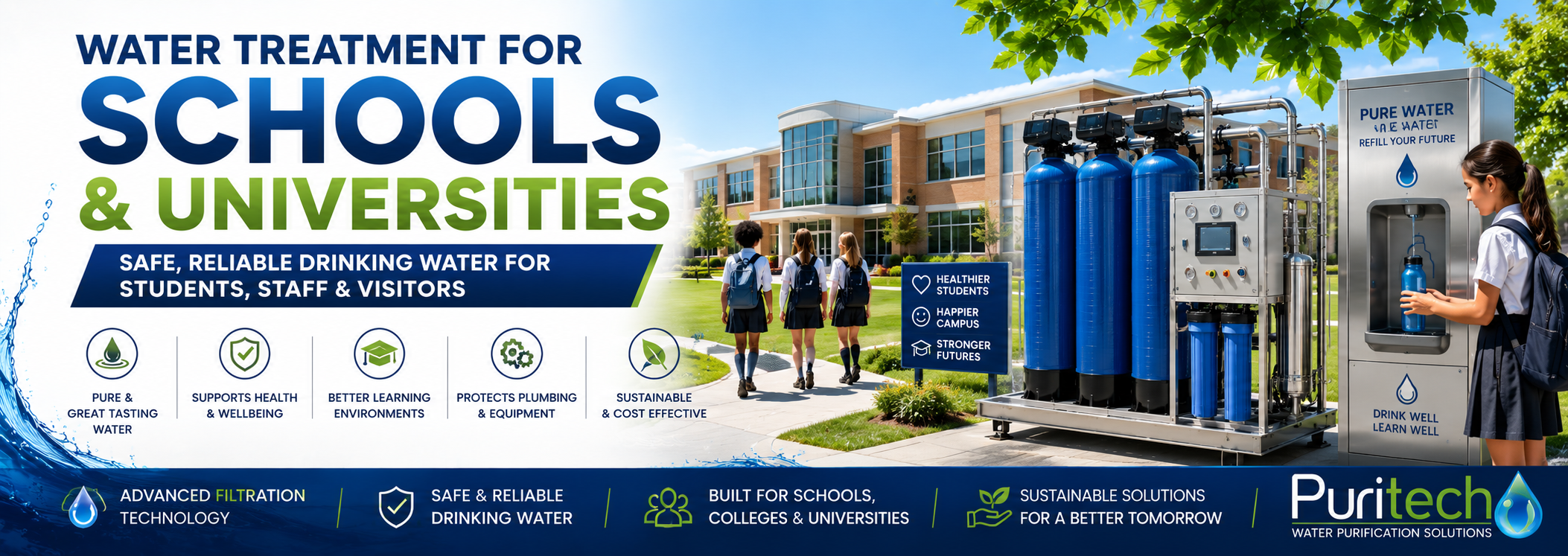
Water Treatment for Schools and Universities: Providing Safe Drinking Water for Students and Staff
Clean, reliable water plays a vital role in every educational institution. From preschools and primary schools to universities and technical colleges, students, teachers, and staff rely on safe water every day for drinking, food preparation, sanitation, cleaning, laboratories, sports facilities, and accommodation.
Although many educational facilities receive municipal water, its quality can vary depending on the location, ageing infrastructure, seasonal changes, and local treatment processes. Other schools, particularly those in rural areas, depend on boreholes, which require careful assessment before they can be used safely.
Poor water quality can lead to unpleasant tastes and odours, scale formation in plumbing systems, equipment failures, blocked pipes, and higher maintenance costs. More importantly, unsuitable drinking water can negatively affect the wellbeing of students and staff.
Because every institution has unique water sources and daily consumption patterns, there is no one-size-fits-all solution. Every school water treatment system should begin with a professional laboratory water analysis. Understanding the water quality allows engineers to recommend a treatment system that delivers reliable, high-quality water while protecting infrastructure and reducing operating costs.
In this guide, we’ll explore how schools and universities use water, the challenges educational facilities commonly face, and the treatment technologies that help create healthier, more efficient learning environments.
Why Water Quality Matters in Education
Water supports almost every aspect of an educational facility’s daily operation.
Reliable water quality helps to:
- Provide safe drinking water.
- Support student health and wellbeing.
- Improve food preparation.
- Protect plumbing systems.
- Reduce scale formation.
- Improve cleaning efficiency.
- Protect laboratory equipment.
- Support sports facilities.
- Lower maintenance costs.
- Improve long-term operational reliability.
Students spend many hours each day at school, making consistent access to high-quality drinking water an essential part of a healthy learning environment.
Where Water Is Used in Schools and Universities
Educational institutions use water for much more than drinking.
Different areas of the campus often have different water quality requirements.
Drinking Water Stations
Students and staff require access to clean, fresh-tasting drinking water throughout the day.
Water treatment systems commonly supply:
- Bottle filling stations.
- Drinking fountains.
- Staff kitchens.
- Administration offices.
- Student common areas.
Providing purified drinking water encourages better hydration while reducing reliance on bottled water.
School Kitchens and Cafeterias
School kitchens use water for:
- Food preparation.
- Cooking.
- Beverage preparation.
- Washing produce.
- Dishwashing.
- Cleaning.
Good water quality contributes to better food preparation while protecting kitchen appliances from scale and mineral deposits.
Student Residences and Boarding Facilities
Boarding schools, universities, and colleges often provide accommodation for students.
These facilities require water for:
- Drinking.
- Showers.
- Bathrooms.
- Laundry.
- Kitchens.
- General cleaning.
Reliable treatment systems help maintain consistent water quality throughout the residence.
Science Laboratories
Laboratories frequently require water for the following:
- Experiments.
- Equipment cleaning.
- Sample preparation.
- Scientific testing.
Depending on the laboratory’s activities, additional treatment such as reverse osmosis may be required to achieve the necessary water quality.
Sports Facilities
Schools and universities often operate the following:
- Gymnasiums.
- Swimming pools.
- Sports fields.
- Fitness centres.
- Changing rooms.
Water treatment helps maintain safe, clean water while protecting associated plumbing and heating systems.
Municipal Water vs Borehole Water
Educational institutions obtain water from different sources.
Understanding the source of water is the first step in selecting an appropriate treatment solution.
Municipal Water
Municipal water generally complies with drinking water standards. However, it may still contain:
- Chlorine.
- Hardness.
- Sediment.
- Variable Total Dissolved Solids (TDS).
- Taste and odour issues.
Treatment may improve taste while protecting plumbing systems and water-using equipment.
Borehole Water
Many rural schools and campuses rely on boreholes.
Depending on the local geology, borehole water may contain the following:
- High iron.
- Manganese.
- Hardness.
- Elevated Total Dissolved Solids.
- High salinity.
- Low pH.
- Microbiological contamination.
Because borehole water quality varies significantly, treatment recommendations should always be based on a recent professional laboratory water analysis.
Health Benefits of Safe Drinking Water
Access to high-quality drinking water benefits both students and staff.
A reliable water treatment system can help provide water that is
- Pleasant tasting.
- Free from unwanted odours.
- Suitable for daily consumption.
- Consistently available throughout the campus.
Well-maintained drinking water stations also encourage students to refill reusable bottles, supporting healthy hydration habits while reducing single-use plastic waste.
Why Every School Should Begin with a Professional Laboratory Water Analysis
A common question schools ask is the following:
“Which water treatment system do we need?”
The correct answer depends entirely on the quality of the incoming water.
A professional laboratory water analysis measures important characteristics such as:
- pH.
- Total Dissolved Solids (TDS).
- Conductivity.
- Turbidity.
- Hardness.
- Iron.
- Manganese.
- Chlorides.
- Sulphates.
- Nitrates.
- Fluoride.
- Sodium.
- Silica.
- Microbiological quality where appropriate.
These results enable engineers to recommend a treatment system that addresses the actual water quality rather than relying on assumptions.
Without laboratory data, schools risk investing in equipment that is either unsuitable or unnecessarily expensive.
Case Study: Independent School Using Borehole Water
An independent school in the North West Province relies on borehole water for its classrooms, boarding facilities, kitchens, and sports complex.
Over time, the school notices:
- Brown staining in bathrooms.
- Scale build-up on taps.
- Complaints about the taste of the drinking water.
- Increased maintenance of geysers and plumbing.
A professional laboratory water analysis reveals:
- High iron.
- Elevated hardness.
- Moderate manganese.
- Increased Total Dissolved Solids.
Recommended Treatment
- Multimedia filtration.
- Iron and manganese removal.
- Water softener.
- Activated carbon filtration.
- Reverse osmosis for drinking water stations.
- UV sterilisation.
Results
After the new system is commissioned, the school experiences the following:
- Fresh-tasting drinking water across the campus.
- Cleaner bathrooms and kitchens.
- Reduced scale in plumbing systems.
- Lower maintenance costs.
- Longer equipment lifespan.
- Greater confidence among staff, students, and parents.
Why Custom System Design Matters
No two educational institutions have identical water requirements.
A preschool, a boarding school, a university campus, and a technical college all differ in the following:
- Student population.
- Daily water demand.
- Water source.
- Accommodation facilities.
- Laboratory requirements.
- Kitchen capacity.
- Sports infrastructure.
- Future expansion plans.
For this reason, Puritech designs every school water treatment system around three key factors:
- A recent professional laboratory water analysis.
- The institution’s operational requirements.
- Current and future water demand.
This tailored approach helps ensure reliable performance, safe drinking water, and long-term value for educational institutions across South Africa.
Water Treatment Technologies for Schools and Universities
Every educational institution has different water requirements. A small primary school has different demands from a university campus, while a boarding school requires a different treatment approach from a technical college with science laboratories and workshops.
Some facilities simply require great-tasting drinking water, while others need treated water for laboratories, kitchens, accommodation, sports facilities, and boiler systems.
For this reason, school water treatment systems should always be designed around a professional laboratory water analysis, together with an assessment of the institution’s daily water demand and operational requirements.
Most educational facilities achieve the best results through a multi-stage treatment system rather than relying on a single filtration technology.
Multimedia Filtration
Multimedia filtration is often the first stage in a commercial water treatment system for schools.
Unlike standard sediment filters, multimedia filters contain multiple layers of filtration media that capture particles of different sizes.
They effectively remove:
- Sand.
- Silt.
- Rust.
- Clay.
- Organic matter.
- Suspended solids.
Removing these contaminants protects downstream treatment equipment and helps maintain reliable water quality throughout the campus.
Multimedia filtration also extends the service life of reverse osmosis membranes, activated carbon filters, UV sterilisers, and water softeners.
Activated Carbon Filtration
Activated carbon filtration improves the quality of drinking water by reducing:
- Chlorine.
- Unpleasant tastes.
- Odours.
- Organic compounds.
Many schools supplied by municipal water install activated carbon systems because chlorine, although important for municipal disinfection, can negatively affect the taste of drinking water.
Fresh-tasting water encourages students and staff to drink more water throughout the day.
Activated carbon also protects reverse osmosis membranes from chlorine damage, improving system performance and reducing maintenance costs.
Water Softeners
Hard water is common in many parts of South Africa.
High concentrations of calcium and magnesium contribute to scale formation inside:
- Geysers.
- Boilers.
- Kitchen equipment.
- Pipework.
- Water heaters.
- Laboratory equipment.
- Dishwashers.
Over time, scale reduces efficiency while increasing maintenance costs.
Installing a commercial water softener helps:
- Reduce scale formation.
- Improve energy efficiency.
- Protect plumbing infrastructure.
- Extend equipment lifespan.
- Reduce maintenance costs.
Educational institutions often recover the cost of a water softener through lower repair and maintenance expenses.
Reverse Osmosis Systems
Reverse osmosis (RO) is one of the most effective technologies for producing high-quality drinking water.
RO systems significantly reduce:
- Total Dissolved Solids (TDS).
- Hardness.
- Nitrates.
- Fluoride.
- Sulphates.
- Chlorides.
- Heavy metals.
- Many dissolved minerals.
Schools and universities commonly install reverse osmosis systems for:
- Drinking water stations.
- Staff kitchens.
- Student residences.
- Cafeterias.
- Laboratories.
- Medical rooms.
Providing consistently high-quality drinking water improves confidence among students, staff, parents, and visitors.
UV Water Sterilisation
Ultraviolet (UV) sterilisation provides additional microbiological protection without adding chemicals to the water.
UV systems are typically installed:
- After reverse osmosis.
- Before drinking water storage tanks.
- Before bottle filling stations.
- Before kitchen supply lines.
Properly maintained UV systems help protect drinking water quality throughout the campus.
Drinking Water Stations
Modern schools are increasingly replacing traditional drinking fountains with purified water refill stations.
These stations encourage students and staff to refill reusable bottles while reducing reliance on single-use plastic bottles.
Benefits include:
- Fresh-tasting water.
- Improved hydration.
- Lower bottled water costs.
- Reduced plastic waste.
- Convenient access throughout the campus.
Well-positioned refill stations also promote healthier hydration habits during the school day.
Student Residences and Boarding Facilities
Boarding schools, colleges, and universities require reliable water treatment because students use water around the clock.
Treatment systems support:
- Bathrooms.
- Kitchens.
- Laundry rooms.
- Drinking water.
- Shower facilities.
- Dining halls.
Reliable treatment helps maintain consistent water quality while protecting plumbing and hot water systems from scale and corrosion.
School Kitchens and Cafeterias
Educational kitchens prepare hundreds or even thousands of meals every day.
Good water quality supports:
- Food preparation.
- Cooking.
- Beverage preparation.
- Dishwashing.
- Cleaning.
Reducing hardness also protects commercial kitchen equipment such as dishwashers, steamers, boilers, and coffee machines.
Science Laboratories
Laboratories often require higher-quality water than general campus facilities.
Depending on the educational programme, laboratories may require treated water for:
- Sample preparation.
- Scientific experiments.
- Glassware rinsing.
- Equipment cleaning.
- Analytical testing.
Reverse osmosis systems are commonly installed where higher water purity is required.
Case Study 2: Primary School
A municipal primary school experiences complaints about unpleasant-tasting drinking water.
Although laboratory results confirm the water is safe, elevated chlorine affects taste.
Recommended Treatment
- Multimedia filtration.
- Activated carbon filtration.
- Reverse osmosis.
- UV sterilisation.
Results
The school reports:
- Improved drinking water taste.
- Increased student water consumption.
- Reduced bottled water purchases.
- Greater confidence among parents and staff.
Case Study 3: Boarding School
A boarding school using borehole water experiences recurring plumbing maintenance and heavy scale inside geysers.
Laboratory testing identifies:
- High hardness.
- Elevated iron.
- Moderate manganese.
Recommended Treatment
- Multimedia filtration.
- Iron and manganese removal.
- Water softener.
- Reverse osmosis for drinking water.
- UV sterilisation.
Results
The boarding school benefits from:
- Reduced maintenance.
- Longer geyser lifespan.
- Better-tasting drinking water.
- Cleaner bathrooms.
- Lower operating costs.
Case Study 4: University Campus
A large university seeks to reduce bottled water consumption while improving access to drinking water across campus.
Recommended Treatment
- Central reverse osmosis system.
- UV sterilisation.
- Bottle refill stations across campus.
- Smart monitoring of water consumption.
Results
The university achieves the following:
- Significant reductions in plastic waste.
- Improved student convenience.
- Lower bottled water expenditure.
- Better sustainability performance.
Case Study 5: Technical College
A technical college requires treated water for engineering workshops, laboratories, student accommodation, and administration buildings.
Following a professional laboratory water analysis, engineers recommend:
- Multimedia filtration.
- Activated carbon filtration.
- Water softener.
- Reverse osmosis for laboratories and drinking water.
- UV sterilisation.
Results
The college experiences:
- Reliable laboratory water quality.
- Improved drinking water.
- Lower equipment maintenance.
- Reduced plumbing repairs.
- Greater operational efficiency.
Why Every Educational Institution Needs a Custom Water Treatment System
Every campus has unique requirements.
Treatment system design depends on:
- Student population.
- Daily water demand.
- Municipal or borehole supply.
- Boarding facilities.
- Laboratory requirements.
- Kitchen size.
- Sports facilities.
- Budget.
- Future expansion plans.
For this reason, Puritech begins every education project with:
- A recent professional laboratory water analysis.
- A detailed assessment of the institution’s operational needs.
- Identification of drinking water and utility water requirements.
- Evaluation of daily and peak water demand.
- Selection of appropriate treatment technologies.
- Design of a scalable solution that supports future growth.
This tailored approach ensures reliable performance, protects infrastructure, and provides students and staff with safe, high-quality water for years to come.
Preventative Maintenance: Keeping School Water Treatment Systems Operating Reliably
Installing a professionally engineered water treatment system is only the first step toward providing safe, reliable water. Regular preventative maintenance is equally important to ensure the system continues to perform efficiently throughout the year.
Schools, colleges, and universities depend on consistent water quality every day. Unexpected equipment failures can disrupt kitchens, student accommodation, laboratories, sports facilities, and drinking water stations, potentially affecting hundreds or even thousands of people.
A structured maintenance programme helps educational institutions:
- Maintain consistent drinking water quality.
- Protect expensive plumbing and equipment.
- Reduce unexpected breakdowns.
- Lower long-term maintenance costs.
- Improve energy efficiency.
- Extend equipment lifespan.
- Ensure reliable operation throughout the academic year.
By servicing equipment before problems develop, institutions can minimise disruptions while protecting their investment.
Recommended Maintenance Schedule
Maintenance requirements vary depending on the water source, treatment technologies, and water consumption.
The following schedule provides a practical guideline.
Daily
- Inspect the system for alarms or warning indicators.
- Check operating pressures and flow rates.
- Verify booster pump operation.
- Confirm UV steriliser operation.
- Inspect storage tank levels.
- Review water quality monitoring where available.
Weekly
- Inspect multimedia filters.
- Check activated carbon filters.
- Verify water softener regeneration cycles.
- Inspect reverse osmosis operating pressures.
- Check valves, fittings, and pipework for leaks.
- Review system performance data.
Monthly
- Test treated water quality.
- Inspect reverse osmosis membranes.
- Verify UV lamp performance.
- Inspect chemical dosing systems where installed.
- Check storage tanks.
- Review campus water consumption trends.
Annually
- Replace consumables according to the manufacturer’s recommendations.
- Service pumps and motors.
- Calibrate monitoring equipment.
- Conduct a new professional laboratory water analysis.
- Review opportunities for system upgrades or expansion.
Routine servicing helps ensure uninterrupted access to high-quality water while reducing the likelihood of costly emergency repairs.
Water Quality Monitoring
Maintaining excellent water quality requires ongoing monitoring rather than occasional inspections.
Educational institutions should periodically review the following:
- pH.
- Total Dissolved Solids (TDS).
- Hardness.
- Chlorine where applicable.
- Turbidity.
- Iron.
- Manganese.
- Microbiological quality where appropriate.
Monitoring these parameters allows facility managers to identify changes in water quality before they become operational problems.
Schools using borehole water should schedule regular professional laboratory analyses because groundwater quality may change over time due to seasonal conditions, rainfall, or geological factors.
Sustainability and Water Conservation
Water conservation is becoming increasingly important for educational institutions across South Africa.
Reducing water consumption not only lowers operating costs but also teaches students the importance of responsible environmental stewardship.
Modern water treatment systems can contribute to sustainability through:
- Efficient reverse osmosis recovery rates.
- Water-saving technologies.
- Leak detection programmes.
- Smart monitoring systems.
- Preventative maintenance.
- Energy-efficient pumps.
- Optimised storage and distribution systems.
These measures help institutions reduce waste while maintaining reliable water quality.
Rainwater Harvesting Integration
Many schools are exploring rainwater harvesting as part of their sustainability initiatives.
Collected rainwater may be suitable for selected non-potable applications, including:
- Landscape irrigation.
- Toilet flushing.
- Sports field maintenance.
- General cleaning.
- Washdown areas.
Depending on the intended use and water quality, rainwater may require filtration, disinfection, or additional treatment.
A professionally designed rainwater harvesting system can supplement existing water supplies while reducing dependence on municipal water.
Return on Investment (ROI)
A professionally designed school water treatment system offers benefits that extend well beyond providing clean drinking water.
Educational institutions may realise long-term savings through:
- Reduced plumbing repairs.
- Lower equipment maintenance costs.
- Improved energy efficiency.
- Longer geyser lifespan.
- Reduced bottled water purchases.
- Lower detergent consumption.
- Improved kitchen efficiency.
- Reduced scale formation.
- Better water quality across campus.
- Lower overall operating costs.
For example, preventing scale inside geysers and hot water systems improves heating efficiency while extending equipment life. Likewise, installing purified drinking water stations can significantly reduce the ongoing cost of purchasing bottled water for staff meetings, sporting events, and campus activities.
These operational savings often offset the initial investment over time.
Common Mistakes Educational Institutions Make
Many water-related problems can be avoided by making informed decisions during the planning stage.
Choosing a System Without a Water Analysis
Every school receives water with unique characteristics.
Installing treatment equipment without a recent professional laboratory water analysis increases the risk of selecting an unsuitable system.
Laboratory testing should always guide system design.
Buying Equipment Based Only on Price
Choosing the lowest-cost system may appear attractive initially.
However, lower-quality equipment often results in:
- Higher maintenance costs.
- More frequent repairs.
- Greater energy consumption.
- Shorter equipment lifespan.
- Higher long-term operating costs.
Evaluating total ownership costs usually provides better long-term value.
Ignoring Preventative Maintenance
Routine servicing protects water quality and equipment performance.
Delaying maintenance may result in:
- Scale build-up.
- Reduced filtration efficiency.
- Membrane fouling.
- Equipment failures.
- Higher repair costs.
- Unplanned downtime.
Preventative maintenance remains one of the most effective ways to maximise system reliability.
Treating All Campus Water the Same
Different parts of an educational institution often require different water qualities.
Drinking water, laboratory water, kitchen water, sports facilities, and irrigation systems may each benefit from different treatment strategies.
Designing treatment around each application improves efficiency while avoiding unnecessary operating costs.
Why Partner with Puritech?
At Puritech, we understand that every educational institution has unique water requirements.
Whether you manage a primary school, high school, university, college, boarding school, or training centre, our team designs treatment solutions that match your water source, student population, and operational requirements.
Our services include:
- Professional consultation.
- Review of laboratory water analysis reports.
- Custom water treatment system design.
- Equipment supply.
- Installation and commissioning.
- Preventative maintenance.
- Technical support.
- Consumables and replacement parts.
- System upgrades and optimisation.
By combining proven technologies with customised engineering, we help educational institutions provide reliable, high-quality water while protecting infrastructure and controlling operating costs.
Frequently Asked Questions
Why do schools need water treatment?
Water treatment improves drinking water quality, protects plumbing and equipment, supports food preparation, and creates a healthier environment for students and staff.
Is municipal water always suitable without additional treatment?
Municipal water generally meets drinking water standards, but it may still contain chlorine, hardness, sediment, or dissolved minerals that affect taste, equipment, or operational efficiency.
Why is a professional laboratory water analysis important?
A laboratory analysis identifies the characteristics of the incoming water, allowing engineers to design a treatment system that meets the institution’s specific requirements.
Can schools use borehole water?
Yes.
However, borehole water quality varies significantly depending on the location. A professional laboratory water analysis should always be completed before selecting treatment equipment.
How often should school water treatment systems be serviced?
Service intervals depend on the water source, treatment technologies, system usage, and manufacturer’s recommendations. Regular preventative maintenance helps maintain reliable performance.
Can existing systems be upgraded?
Yes.
Many systems can be expanded or upgraded as student numbers increase or campus facilities grow.
Final Thoughts
Reliable access to clean, safe water is fundamental to creating a healthy and productive learning environment. From classrooms and laboratories to kitchens, boarding facilities, and sports complexes, every part of an educational institution depends on consistent water quality.
Because every school and university has unique water sources and operational requirements, the most effective solution begins with a professional laboratory water analysis. This information enables engineers to design a treatment system that delivers dependable performance while protecting infrastructure and supporting the wellbeing of students and staff.
At Puritech, we work with educational institutions across South Africa to design, install, and maintain customised water treatment systems for municipal supplies, boreholes, and other water sources. Our solutions help schools and universities provide high-quality drinking water, reduce maintenance costs, and build healthier campuses for future generations.