Currently Empty: R0.00

Off-Grid vs Grid-Tied vs Hybrid Solar Systems
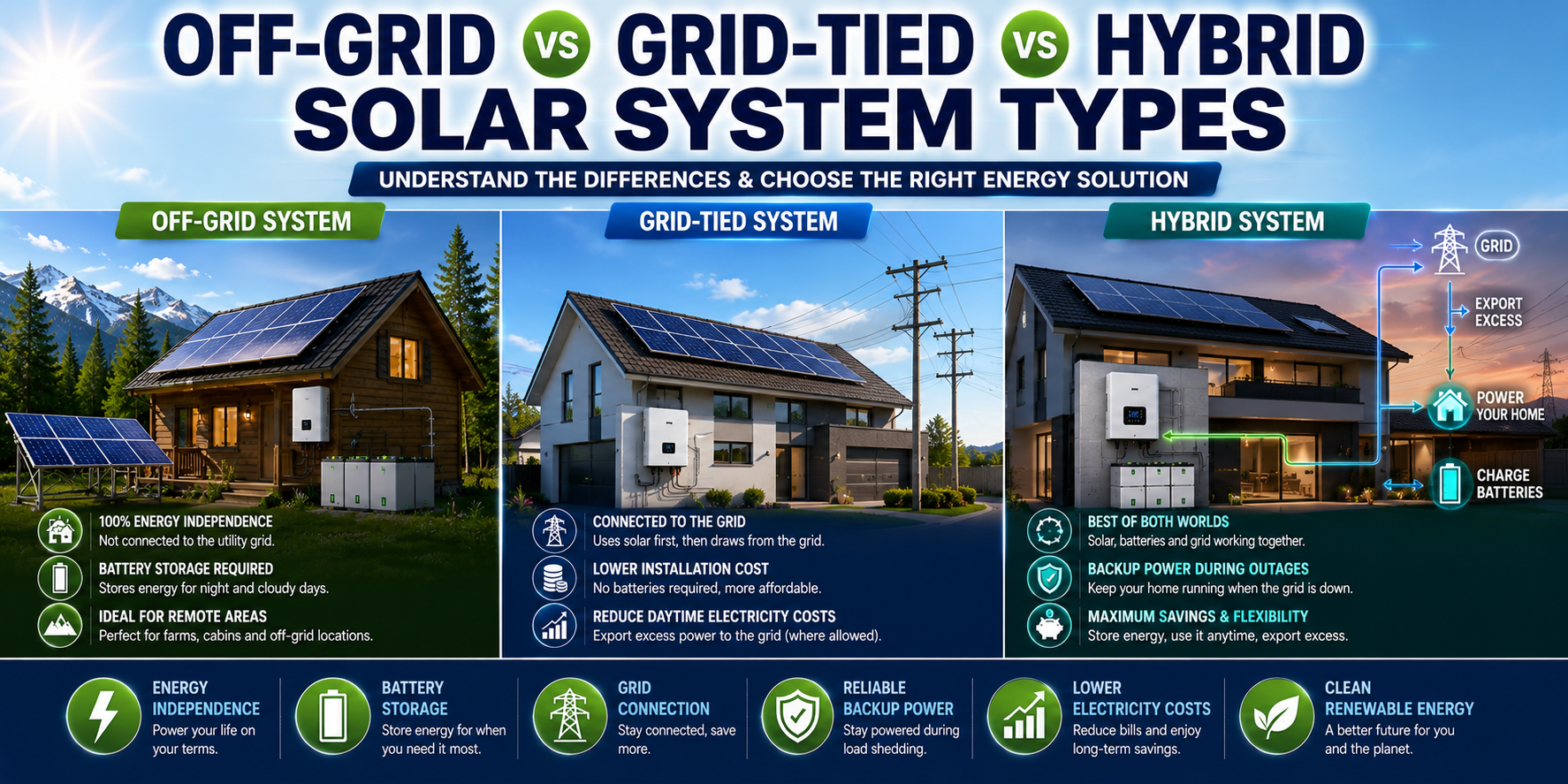
Understanding solar system types is one of the most important steps before investing in solar energy. Whether you’re planning a residential, commercial or industrial installation, choosing the right configuration affects your energy independence, electricity costs and long-term savings. The three main solar system types are grid-tied, off-grid and hybrid systems. Each offers unique advantages depending on your location, budget and energy requirements.
What Is a Grid-Tied Solar System?
A grid-tied solar system remains connected to the municipal or utility electricity network.
During the day, solar panels generate electricity that powers your property. If your solar production does not meet demand, the system automatically draws additional electricity from the grid.
In some regions, excess electricity can be exported back to the utility grid if local regulations and equipment allow.
Advantages
- Lower installation cost
- High system efficiency
- No batteries required
- Lower maintenance
- Reduces daytime electricity costs
Disadvantages
- Stops supplying power during grid outages
- Limited energy independence
- Relies on the utility network at night
What Is an Off-Grid Solar System?
An off-grid solar system operates independently from the utility grid.
It generates electricity through solar panels and stores excess energy in batteries. This stored energy powers the property after sunset or during poor weather conditions.
Because there is no grid connection, careful system design is essential.
Advantages
- Complete energy independence
- Ideal for remote areas
- No monthly electricity bills
- Reliable where grid access is unavailable
Disadvantages
- Higher installation cost
- Larger battery bank required
- Careful energy management needed
- Backup generator may be recommended
What Is a Hybrid Solar System?
A hybrid solar system combines the benefits of both grid-tied and off-grid systems.
It uses solar panels, batteries and a hybrid inverter while remaining connected to the utility grid.
During the day, solar energy powers the property and charges the batteries. At night or during load shedding, stored battery energy supplies electricity. If required, the system can also draw power from the grid.
Where regulations permit, excess electricity can even be exported back to the utility.
Advantages
- Backup power during outages
- Battery storage included
- Greater energy independence
- Lower electricity bills
- Flexible energy management
- Future expansion is simple
Disadvantages
- Higher initial investment
- More complex installation
- Batteries require eventual replacement
Side-by-Side Comparison
| Feature | Grid-Tied | Off-Grid | Hybrid |
|---|---|---|---|
| Connected to the grid | ✔ | ✘ | ✔ |
| Battery storage | Optional | Required | Included |
| Backup during outages | ✘ | ✔ | ✔ |
| Monthly electricity bills | Reduced | Eliminated | Significantly reduced |
| Initial cost | Lowest | Highest | Medium to High |
| Energy independence | Low | Complete | High |
Which Solar System Costs Less?
A grid-tied system usually has the lowest upfront cost because it does not require battery storage.
Off-grid systems have the highest installation costs because they rely entirely on batteries and often require additional backup equipment.
Hybrid systems fall between the two. Although they cost more initially, they often deliver greater long-term savings through battery storage and reduced grid dependence.
Which System Is Best for South Africa?
The ideal solution depends on your location and energy requirements.
A grid-tied system suits properties with a reliable electricity supply that want to reduce daytime energy costs.
An off-grid system is ideal for remote farms, lodges and properties without access to the utility network.
A hybrid system is often the preferred choice for homeowners and businesses affected by load shedding because it combines solar generation, battery storage and grid support.
Frequently Asked Questions
Can I upgrade from a grid-tied system to a hybrid system?
Yes. Many installations can be upgraded by replacing the inverter and adding compatible battery storage.
Which system provides backup during power failures?
Hybrid and off-grid systems can continue supplying electricity during outages, provided they include sufficient battery capacity.
Which system offers the lowest maintenance?
Grid-tied systems generally require the least maintenance because they do not rely on batteries.
Can off-grid systems power an entire house?
Yes. When properly designed, an off-grid system can supply all the electricity required by a home or business.
Conclusion
Understanding the available solar system types helps homeowners and businesses choose an energy solution that matches their budget and electricity needs. Grid-tied systems provide an affordable way to reduce electricity costs; off-grid systems deliver complete independence, while hybrid systems combine battery storage with grid connectivity for maximum flexibility.
By comparing these solar system types, you can confidently invest in a solar solution that provides reliable performance, lower energy costs, and long-term value.