Currently Empty: R0.00

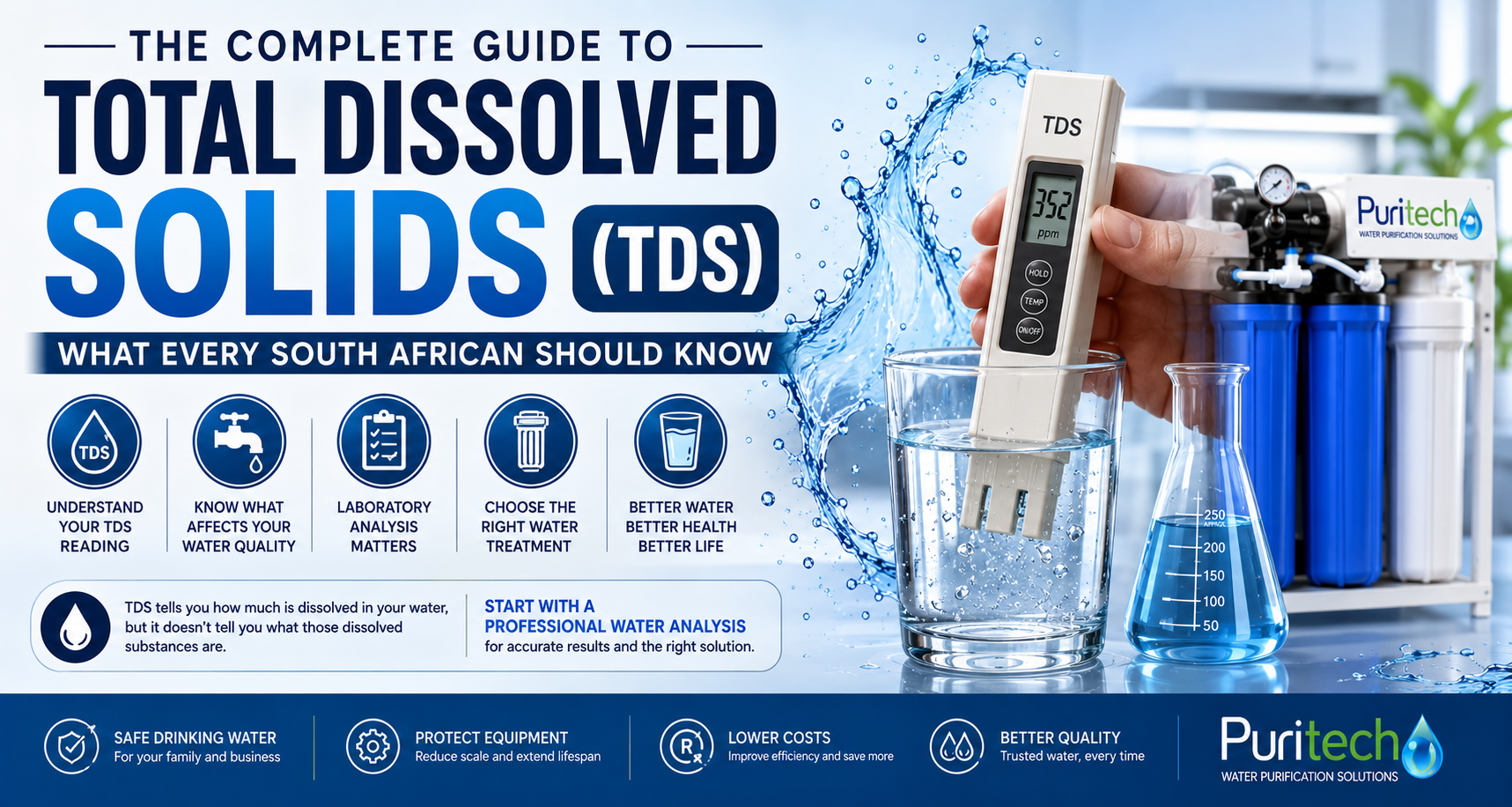
The Complete Guide to Total Dissolved Solids (TDS): What Every South African Should Know
Total Dissolved Solids (TDS) is one of the most important measurements used to evaluate water quality, yet it is also one of the most misunderstood. Many South Africans purchase a TDS meter, receive a laboratory water analysis report, or install a borehole and immediately focus on the TDS reading without fully understanding what it represents.
A high TDS reading does not automatically mean your water is unsafe to drink, and a low TDS reading does not guarantee that your water is free from harmful contaminants. Total dissolved solids is an important indicator of water quality, but it is only one piece of the puzzle.
Whether your water comes from a municipal supply or a borehole, understanding Total Dissolved Solids helps you make informed decisions about water treatment, equipment protection, and drinking water quality. The most reliable way to interpret any TDS result is alongside a professional laboratory water analysis, which identifies exactly what is dissolved in the water and whether treatment is required.
What Are Total Dissolved Solids?
‘Total Dissolved Solids’ refers to the combined amount of dissolved substances present in water.
These substances are so small that they cannot be removed by a simple sediment filter and are invisible to the naked eye.
Unlike sand or dirt, dissolved solids become part of the water itself.
They may originate from:
- Natural underground minerals.
- Rock formations.
- Soil composition.
- Municipal treatment chemicals.
- Agricultural activities.
- Industrial processes.
- Seawater intrusion.
- Ageing water infrastructure.
Every water source contains some dissolved solids.
The question is not whether dissolved solids exist but rather the following:
How much is present, and what are those dissolved substances?
What Makes Up Total Dissolved Solids?
A TDS reading is not a single contaminant.
Instead, it represents the combined concentration of many dissolved substances.
These commonly include:
Minerals
- Calcium
- Magnesium
- Sodium
- Potassium
Salts
- Chlorides
- Sulphates
- Bicarbonates
Naturally Occurring Elements
- Iron
- Manganese
- Silica
Other Dissolved Compounds
- Nitrates
- Fluoride
- Trace metals
- Organic compounds
The exact combination varies depending on the water source.
No two boreholes produce identical water.
Even neighbouring properties can have dramatically different water chemistry.
Why Is TDS Important?
Total dissolved solids affect much more than drinking water.
It also influences:
- Water taste.
- Appliance lifespan.
- Scale formation.
- Plumbing performance.
- Industrial equipment.
- Reverse osmosis design.
- Boiler efficiency.
- Cooling systems.
- Manufacturing processes.
High TDS can increase operating costs, shorten equipment lifespan and affect the performance of many water treatment technologies.
Understanding your TDS level helps engineers recommend the most effective treatment solution.
Does High TDS Mean Water Is Unsafe?
One of the biggest misconceptions is that high TDS automatically means dangerous water.
This is not always true.
For example:
Water with a TDS of 900 mg/L may consist largely of naturally occurring calcium and magnesium.
Although this water may be very hard and cause scale build-up, it is not necessarily unsafe to drink.
Conversely, water with a relatively low TDS reading could still contain harmful bacteria or microorganisms.
This demonstrates an important principle:
A TDS reading measures quantity, not quality.
It tells you how much is dissolved in the water.
It does not tell you what those dissolved substances are.
Only a professional laboratory water analysis can identify the individual contaminants.
Why Clear Water Can Still Have High TDS
Many people believe clear water must be clean water.
Unfortunately, appearance can be misleading.
Water containing high concentrations of dissolved minerals often looks clear.
In fact, some of the highest TDS borehole water in South Africa appears crystal clear.
Without laboratory testing, it is impossible to determine the actual dissolved mineral content by looking at the water alone.
This is why visual inspection should never replace proper water analysis.
Municipal Water vs Borehole Water
Both municipal and borehole water contain dissolved solids.
However, the sources are different.
Municipal Water
Municipal water often contains dissolved minerals that occur naturally in the source water, along with treatment chemicals added during the purification process.
TDS levels generally remain relatively stable but can vary depending on the municipality and source water.
Borehole Water
Borehole water travels through underground rock formations before reaching the aquifer.
Along the way, it dissolves minerals from the surrounding geology.
As a result, borehole water often contains higher concentrations of:
- Calcium.
- Magnesium.
- Sodium.
- Iron.
- Manganese.
- Chlorides.
- Sulphates.
Some boreholes produce excellent drinking water.
Others require extensive treatment.
Only testing can determine the difference.
How Is TDS Measured?
There are two common methods.
TDS Meter
Portable TDS meters estimate dissolved solids by measuring the water’s electrical conductivity.
They are:
- Fast.
- Affordable.
- Easy to use.
However, they only provide an estimate.
A TDS meter cannot identify which dissolved substances are present.
Professional Laboratory Analysis
A laboratory analysis provides a detailed breakdown of the water’s chemistry.
Instead of simply reporting one TDS value, the laboratory identifies the individual substances contributing to that reading.
This allows engineers to design an effective treatment system rather than making assumptions.
For residential, commercial, and industrial applications, a laboratory report is always the preferred starting point.
Understanding TDS Units
TDS is commonly reported as the following:
- mg/L (milligrams per litre)
- ppm (parts per million)
For practical purposes:
1 mg/L is approximately equal to 1 ppm.
This means a TDS reading of:
450 mg/L
is essentially the same as the following:
450 ppm
Both describe the total amount of dissolved material in one litre of water.
Typical TDS Ranges
| TDS (ppm or mg/L) | General Description |
|---|---|
| 0–50 | Very low mineral content |
| 50–150 | Low dissolved solids |
| 150–300 | Moderate dissolved solids |
| 300–500 | Elevated but common in many areas |
| 500–1,000 | High dissolved solids |
| 1,000–2,000 | Very high dissolved solids |
| Above 2,000 | Requires detailed investigation and appropriate treatment |
Important: These ranges are general guidelines. A TDS value alone cannot determine whether water is safe, suitable, or requires treatment.
The Biggest Mistake People Make
Many people buy a TDS meter and believe the number tells them everything about their water.
It doesn’t.
A TDS meter is an excellent screening tool, but it cannot identify:
- Which minerals are present.
- Whether bacteria are present.
- Whether nitrates exceed acceptable levels.
- Whether fluoride is elevated.
- Whether iron or manganese requires treatment.
The TDS reading is the beginning of the investigation—not the conclusion.
Understanding Your Total Dissolved Solids (TDS) Reading
Receiving a Total Dissolved Solids (TDS) reading without knowing what it means can be confusing. Many people immediately assume that a high number means their water is unsafe, while others believe a low number guarantees excellent water quality.
Neither assumption is correct.
A Total Dissolved Solids reading tells you how much dissolved material is present in your water, but it does not identify what those dissolved substances are. The only way to determine that is through a professional laboratory water analysis.
Let’s examine what different TDS ranges typically indicate and how they may affect your home or business.
TDS Below 50 ppm
Water with Total Dissolved Solids below 50 ppm contains very few dissolved minerals.
This level is commonly found in:
- Reverse osmosis treated water.
- Deionised water.
- Distilled water.
Characteristics
- Very low mineral content.
- Extremely clean appearance.
- Neutral taste that some people describe as “flat”.
- Minimal scale formation.
Is This Good?
For many applications, yes.
Reverse osmosis systems are designed to reduce TDS significantly, producing high-quality drinking water.
However, naturally occurring water with a TDS below 50 ppm is relatively uncommon in South Africa.
TDS Between 50 and 150 ppm
This range is generally associated with excellent drinking water.
Typical sources include the following:
- High-quality municipal supplies.
- Properly treated borehole water.
- Reverse osmosis systems with controlled blending.
Characteristics
- Pleasant taste.
- Low scaling potential.
- Suitable for drinking.
- Gentle on household appliances.
Many premium bottled waters fall within this range because they provide a balance between purity and taste.
TDS Between 150 and 300 ppm
This is a common range for many municipal water supplies.
Water usually contains moderate concentrations of naturally occurring minerals.
Characteristics
- Fresh taste.
- Moderate mineral content.
- Generally suitable for domestic use.
- Limited scaling in most households.
Many South Africans receive municipal water within this range.
Depending on the specific minerals present, treatment may not be necessary.
TDS Between 300 and 500 ppm
Water in this range often remains suitable for many domestic applications.
However, additional factors become increasingly important.
Laboratory analysis should evaluate:
- Hardness.
- Iron.
- Manganese.
- Sodium.
- Chlorides.
- Sulphates.
- Nitrates.
Possible Effects
- Slight mineral taste.
- Increased scaling.
- Soap becoming less effective.
- Reduced appliance efficiency.
Treatment recommendations depend entirely on the composition of the dissolved solids.
TDS Between 500 and 1,000 ppm
This range often requires closer investigation.
Many boreholes throughout South Africa produce water within this range.
Common Characteristics
- Noticeable mineral taste.
- Scale formation.
- White deposits on taps.
- Kettles requiring regular descaling.
- Geyser efficiency reduced.
- Higher maintenance requirements.
Real-World Example
A homeowner in Gauteng receives a laboratory report showing:
- TDS: 720 ppm
- Hardness: High
- Iron: Within acceptable limits
- pH: Neutral
The primary issue is hardness rather than dangerous contamination.
In this case, a water softener may be recommended to protect plumbing and appliances, while a reverse osmosis unit at the kitchen sink can provide high-quality drinking water.
Without laboratory analysis, the customer might have purchased an unnecessarily large reverse osmosis system for the entire house.
TDS Between 1,000 and 2,000 ppm
This range is considered very high.
Water often contains elevated concentrations of dissolved salts and minerals.
Possible Symptoms
- Strong mineral taste.
- Heavy scaling.
- White stains on taps.
- Frequent appliance repairs.
- Poor soap performance.
- Increased operating costs.
Real-World Example
A small guest lodge relies on a borehole with the following:
- TDS: 1,350 ppm
- High chlorides.
- Elevated sulphates.
- Moderate hardness.
Guests complain that the drinking water tastes unpleasant, while housekeeping spends extra time removing scale from bathroom fittings.
Following a professional laboratory water analysis, Puritech designs a treatment system that includes appropriate pretreatment and reverse osmosis for drinking water.
The result is improved guest satisfaction, reduced maintenance, and lower long-term operating costs.
TDS Above 2,000 ppm
Water above 2,000 ppm requires careful investigation.
Although some naturally occurring groundwater reaches these levels, treatment requirements become more complex.
Possible Challenges
- Extremely poor taste.
- Significant scaling.
- Corrosion issues in some cases.
- Reduced equipment lifespan.
- High operating costs.
- Unsuitable for many industrial applications without treatment.
At these levels, engineers evaluate the complete laboratory report before recommending an appropriate treatment process.
What Causes High Total Dissolved Solids?
Several factors influence total dissolved solids.
These include:
Geological Formations
As groundwater moves through underground rock formations, it dissolves naturally occurring minerals.
Different geological regions therefore produce different water chemistry.
Hard Water
Calcium and magnesium contribute significantly to TDS.
Although these minerals are naturally occurring, excessive concentrations lead to scale formation.
Salinity
High sodium and chloride concentrations increase TDS.
This is more common in coastal regions or areas affected by saline groundwater.
Agricultural Activity
Fertilisers may contribute the following:
- Nitrates.
- Sulphates.
- Other dissolved compounds.
Professional laboratory testing identifies whether these substances are present.
Industrial Activity
Certain industrial processes may influence groundwater quality depending on local environmental conditions.
Again, laboratory analysis provides the necessary information.
How Does High TDS Affect Your Home?
Elevated total dissolved solids can affect:
Plumbing
- Pipe scaling.
- Reduced water flow.
- Increased maintenance.
Geysers
- Heating element scaling.
- Higher electricity consumption.
- Reduced lifespan.
Coffee Machines
- Scale inside boilers.
- Poor extraction.
- Frequent servicing.
Ice Machines
- Mineral deposits.
- Reduced efficiency.
- Increased maintenance.
Washing Machines
- More detergent required.
- Mineral deposits.
- Reduced efficiency.
Dishwashers
- Spotting on glassware.
- White residue.
- Increased chemical consumption.
How Does High TDS Affect Businesses?
Commercial facilities often experience the following:
- Increased maintenance.
- Higher energy costs.
- More frequent equipment replacement.
- Production interruptions.
- Reduced operational efficiency.
Industries commonly affected include:
- Hotels.
- Hospitals.
- Food manufacturers.
- Restaurants.
- Schools.
- Mines.
- Manufacturing plants.
Reducing TDS where appropriate can improve both equipment reliability and operating efficiency.
Can You Taste High TDS?
Often, yes.
As total dissolved solids increase, water may develop the following:
- Salty taste.
- Bitter taste.
- Metallic taste.
- Mineral taste.
However, taste alone is not a reliable indicator.
Some water with relatively high TDS tastes perfectly acceptable, while water with moderate TDS may taste unpleasant due to specific dissolved compounds.
Does High TDS Always Require Reverse Osmosis?
No.
This is one of the most common misconceptions.
For example:
Water with:
- TDS: 650 ppm
- High hardness.
- Good microbiological quality.
may benefit from a combination of water softening and point-of-use reverse osmosis for drinking water only.
Another water source is
- TDS: 650 ppm
- High sodium.
- Elevated nitrates.
may require a different treatment approach.
The TDS number is only part of the story.
The composition of the dissolved solids determines the most appropriate solution.
The Importance of Looking Beyond the Number
Imagine two properties with identical TDS readings of 700 ppm.
Property A has water rich in calcium and magnesium, resulting in hard water and scale build-up.
Property B has elevated sodium and nitrates, creating a completely different treatment challenge.
Although both properties have the same TDS reading, they require different treatment solutions.
This is why relying on the TDS number alone can lead to costly mistakes.
A professional laboratory water analysis reveals the full picture, enabling engineers to recommend a system tailored to the specific contaminants present.
Should You Reduce Total Dissolved Solids?
After receiving a water analysis report or using a TDS meter, one of the first questions customers ask is:
“Is my TDS too high?”
The answer depends entirely on what is contributing to the total dissolved solids reading.
Many people assume that lower TDS always means better water.
That isn’t necessarily true.
Water naturally contains dissolved minerals, many of which are completely harmless and even desirable in moderate concentrations.
The objective of water treatment is not simply to achieve the lowest possible TDS—it is to produce water that is safe, pleasant to drink, suitable for its intended purpose, and economical to maintain.
Is Lower TDS Always Better?
No.
A very low total dissolved solids reading does not automatically indicate better water quality.
For example:
Example 1
A reverse osmosis system produces water with:
- TDS: 25 ppm
The water is exceptionally pure and ideal for many drinking-water and commercial applications.
Example 2
Another water source measures:
- TDS: 180 ppm
Laboratory analysis shows the dissolved solids consist mainly of naturally occurring calcium, magnesium and bicarbonates.
This water is also excellent for drinking.
Neither result is automatically “better”.
The suitability depends on the intended application.
Does High TDS Affect Your Health?
This is one of the most misunderstood aspects of Total Dissolved Solids.
A high TDS reading alone does not indicate that water is unsafe.
For example:
Water containing elevated calcium and magnesium may have a relatively high TDS but still be perfectly acceptable for drinking.
On the other hand, water with a lower TDS could contain:
- Harmful bacteria.
- Viruses.
- Excessive nitrates.
- Chemical contaminants.
These issues cannot be identified using a TDS meter alone.
This is why laboratory testing is essential whenever water quality is uncertain.
Does Reverse Osmosis Reduce Total Dissolved Solids?
Yes.
Reverse osmosis is one of the most effective technologies available for reducing total dissolved solids.
A professionally designed reverse osmosis system can significantly reduce:
- Dissolved salts.
- Sodium.
- Calcium.
- Magnesium.
- Fluoride.
- Nitrates.
- Sulphates.
- Chlorides.
- Many heavy metals.
This is why reverse osmosis is widely used in the following:
- Homes.
- Hospitals.
- Hotels.
- Food manufacturing.
- Pharmaceutical production.
- Laboratories.
- Commercial water treatment.
- Industrial applications.
However, reverse osmosis should only be recommended after evaluating a professional laboratory water analysis.
When Is Reverse Osmosis Recommended?
Reverse osmosis is often recommended when laboratory analysis identifies the following:
- High Total Dissolved Solids.
- Elevated sodium.
- Excessive fluoride.
- High nitrates.
- Salinity issues.
- Multiple dissolved contaminants.
It is also suitable when exceptionally high-quality drinking water is required.
Examples include:
- Coffee shops.
- Restaurants.
- Medical facilities.
- Food production.
- High-end residential applications.
When Is Reverse Osmosis Not Necessary?
Not every customer needs reverse osmosis.
For example:
A municipal water supply may have:
- TDS: 190 ppm
- Neutral pH.
- Low hardness.
- Good microbiological quality.
The only concern is chlorine taste.
In this case, an activated carbon filtration system may provide excellent drinking water without the additional cost of reverse osmosis.
Choosing treatment based solely on TDS often results in unnecessary expenditure.
Real-Life Example 1 – The Borehole
A family contacts Puritech after installing a new borehole.
Their handheld meter shows:
TDS: 980 ppm
They immediately assume reverse osmosis is required throughout the house.
Instead of making assumptions, Puritech recommends a professional laboratory water analysis.
The results reveal:
- High hardness.
- Moderate iron.
- Acceptable microbiological quality.
- Elevated calcium.
- Elevated magnesium.
Rather than installing a large, whole-house reverse osmosis system, Puritech designs the following:
- Sediment filtration.
- Iron removal.
- Water softening.
- Point-of-use reverse osmosis for drinking water.
The result is excellent water quality at a significantly lower installation and operating cost.
Real-Life Example 2 – The Hotel
A hotel experiences:
- White staining.
- Frequent boiler maintenance.
- Guest complaints about water taste.
Laboratory analysis identifies:
- TDS: 1,250 ppm
- High chlorides.
- Elevated sulphates.
- Significant hardness.
Puritech engineers a multi-stage treatment system incorporating pretreatment, water softening and reverse osmosis for designated drinking water points.
Within months, the hotel reports:
- Reduced maintenance costs.
- Improved guest satisfaction.
- Lower energy consumption.
- Longer equipment lifespan.
The investment delivers measurable long-term savings.
Common Myths About Total Dissolved Solids
Myth 1: High TDS Means Unsafe Water
False.
Many dissolved minerals occur naturally and are not harmful at typical concentrations.
Myth 2: Low TDS Means Perfect Water
False.
Low TDS does not guarantee the absence of bacteria or harmful microorganisms.
Myth 3: Every Borehole Needs Reverse Osmosis
False.
Some boreholes require only filtration, while others need more advanced treatment.
The decision should always be based on laboratory analysis.
Myth 4: A TDS Meter Replaces Laboratory Testing
False.
A TDS meter is a useful screening tool, but it cannot identify individual contaminants.
Myth 5: Reverse Osmosis Is Always the Best Solution
False.
The best solution is the one designed specifically for your water quality and intended application.
Why Professional Water Analysis Matters
A TDS meter answers one question:
“How much is dissolved in the water?”
A laboratory water analysis answers many more:
- What minerals are present?
- Is the water microbiologically safe?
- Are nitrates elevated?
- Is fluoride above recommended levels?
- Does the water require softening?
- Is reverse osmosis necessary?
- What pretreatment is required?
This information allows engineers to recommend the correct solution rather than relying on assumptions.
Why Customers Trust Puritech
At Puritech, we believe that every successful water treatment project begins with understanding the water.
Our process includes:
- Reviewing recent professional laboratory water analysis reports.
- Evaluating the intended application.
- Designing custom treatment solutions.
- Supplying high-quality equipment.
- Professional installation and commissioning.
- Preventative maintenance.
- Ongoing technical support.
Whether you require water treatment for a home, farm, hotel, hospital, factory or commercial facility, our recommendations are based on science, engineering and experience—not guesswork.
Frequently Asked Questions
What is Total Dissolved Solids (TDS)?
Total Dissolved Solids is the combined concentration of dissolved minerals, salts and other substances present in water, usually measured in milligrams per litre (mg/L) or parts per million (ppm).
Is high TDS dangerous?
Not necessarily.
High TDS simply indicates that more dissolved material is present. A laboratory water analysis is needed to determine whether those dissolved substances present a health concern or mainly affect taste, scaling or equipment performance.
Can a TDS meter tell me what is in my water?
No.
A TDS meter estimates the total concentration of dissolved substances but cannot identify the individual contaminants.
Does reverse osmosis reduce TDS?
Yes.
Reverse osmosis is highly effective at reducing total dissolved solids, including many dissolved salts and minerals.
Should I install a reverse osmosis system if my TDS is high?
Not automatically.
The correct treatment depends on the complete laboratory analysis, the source of the water, and the intended application.
Final Thoughts
Total dissolved solids is one of the most useful indicators of water quality—but it should never be viewed in isolation.
A TDS reading tells you how much dissolved material is present, but it does not reveal what those dissolved substances are or whether they require treatment. Two water sources with the same TDS value can have completely different chemical compositions and therefore require entirely different treatment solutions.
That is why professional water treatment always begins with a recent laboratory water analysis. By understanding the complete composition of your water, engineers can recommend the most effective and cost-efficient treatment system, whether that involves filtration, water softening, reverse osmosis, or a combination of technologies.
At Puritech, we don’t believe in one-size-fits-all solutions. We believe every customer deserves a treatment system designed specifically for their water, ensuring safe, high-quality drinking water while protecting equipment and reducing long-term operating costs.
Understanding your TDS is the first step. Understanding your water is what truly makes the difference.