Currently Empty: R0.00

Reverse Osmosis System Cost South Africa: What Should You Expect to Pay?
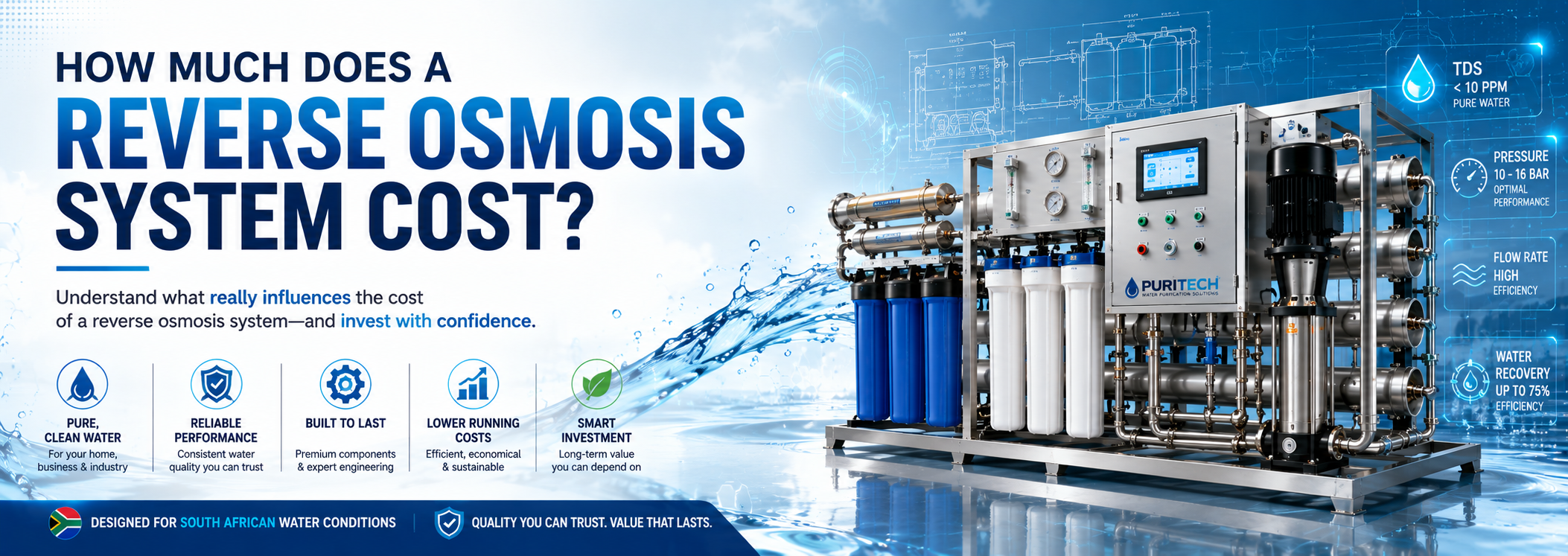
Understanding Reverse Osmosis System Cost South Africa is one of the most important steps when investing in a water purification system. Whether you’re looking for a compact unit for your kitchen, a commercial system for your business or an industrial plant for manufacturing, you’ll quickly discover that prices vary significantly.
Many buyers ask, “How much does a reverse osmosis system cost?” The honest answer is that the price depends on several factors, including your water quality, daily water demand, the complexity of the installation, and the quality of the components used.
At Puritech, we believe the best investment starts with a recent professional laboratory water analysis. By understanding exactly what is in your water, we can recommend a reverse osmosis system that delivers the best performance and long-term value for your budget.
Why Do Reverse Osmosis System Prices Vary So Much?
One of the first things buyers notice is the wide range of prices available online.
Some systems appear surprisingly inexpensive, while others represent a much larger investment.
The difference usually comes down to:
- Water quality.
- Production capacity.
- Component quality.
- Engineering design.
- Pretreatment requirements.
- Automation.
- Installation.
- After-sales support.
Comparing systems based on price alone can be misleading because two units with similar production capacities may be designed for completely different water conditions.
Your Water Quality Determines the System
No two water supplies are exactly alike.
A municipal water supply in Johannesburg may require a different reverse osmosis system from a borehole in Limpopo or a factory supplied by process water.
A professional laboratory water analysis identifies:
- Total Dissolved Solids (TDS).
- Hardness.
- Iron.
- Manganese.
- Fluoride.
- Nitrates.
- Sulphates.
- Chlorides.
- Sodium.
- pH.
- Other water quality characteristics.
These results determine the level of treatment required before the water reaches the reverse osmosis membranes.
The better the system matches your water quality, the better your long-term return on investment.
Home, Commercial or Industrial?
The reverse osmosis system cost South African buyers can expect depends largely on the intended application.
Home Reverse Osmosis Systems
Domestic systems are generally designed for:
- Drinking water.
- Cooking.
- Small households.
- Apartments.
- Offices.
These compact systems usually produce purified water at a single tap and require relatively simple installation.
Commercial Reverse Osmosis Systems
Commercial systems are designed for higher daily demand.
Typical applications include the following:
- Restaurants.
- Coffee shops.
- Schools.
- Hotels.
- Medical facilities.
- Water refill businesses.
These systems require larger pumps, membranes, and storage capacity, which naturally affects the overall investment.
Industrial Reverse Osmosis Systems
Industrial reverse osmosis systems are engineered for demanding applications, such as:
- Food and beverage manufacturing.
- Pharmaceutical production.
- Agriculture.
- Mining.
- Industrial process water.
- Bottled water production.
These systems are custom-designed and often include advanced automation, multiple membrane vessels, and specialised pretreatment equipment.
Water Production Capacity
One of the biggest pricing factors is the amount of purified water required each day.
Ask yourself:
- How many people will use the water?
- Is it only for drinking?
- Will it support a business?
- Is it needed for manufacturing?
- Will production increase in the future?
Choosing the correct production capacity helps avoid unnecessary costs while ensuring a reliable supply of purified water.
Water Source Matters
Your water source also influences system design and cost.
Common sources include:
- Municipal water.
- Borehole water.
- River water.
- Dam water.
- Rainwater.
- Process water.
Some water sources require minimal pretreatment, while others require multiple treatment stages before reverse osmosis can operate efficiently.
This is why two customers purchasing systems with similar capacities may receive very different quotations.
Why Pretreatment Is So Important
A reverse osmosis membrane is designed to remove dissolved contaminants—not large particles, chlorine or excessive hardness.
Depending on your water quality, pretreatment may include the following:
- Sediment filtration.
- Activated carbon filtration.
- Water softening.
- Iron and manganese removal.
- Chemical dosing.
- UV sterilisation.
Although pretreatment increases the initial investment, it significantly improves membrane life and reduces long-term operating costs.
Bigger Isn’t Always Better
Some buyers believe purchasing the largest available reverse osmosis system provides the best value.
In reality, an oversized system can:
- Increase electricity consumption.
- Raise maintenance costs.
- Require more installation space.
- Increase unnecessary capital expenditure.
A professionally sized system delivers better efficiency while reducing lifetime operating costs.
Common Pricing Misconceptions
Many people believe all reverse osmosis systems are essentially the same.
This is one of the biggest misconceptions in the water treatment industry.
Factors such as membrane quality, pump performance, automation, engineering design, and technical support all influence the total investment.
The lowest purchase price rarely reflects the true cost of ownership.
Think Beyond the Purchase Price
The initial investment is only one part of the overall cost.
When comparing systems, consider:
- Energy efficiency.
- Membrane lifespan.
- Filter replacement intervals.
- Spare parts availability.
- Technical support.
- Maintenance requirements.
- Water recovery efficiency.
A higher-quality system often delivers lower operating costs over many years of service.
Why Professional Water Analysis Saves Money
Some buyers try to save money by skipping laboratory testing.
Unfortunately, this often leads to the following:
- Incorrect system selection.
- Poor water quality.
- Premature membrane failure.
- Higher maintenance costs.
- Expensive upgrades.
A recent professional laboratory water analysis helps ensure the reverse osmosis system is correctly designed from the start.
Real-Life Example
A small coffee roasting business requested quotations from several suppliers.
One quotation was significantly cheaper than the others, so the business initially planned to proceed with the lowest-priced option.
After reviewing their municipal water analysis, Puritech identified elevated hardness and chlorine levels that required additional pretreatment to protect the RO membranes.
Although the professionally designed solution involved a higher initial investment, it offered:
- Longer membrane life.
- Better tasting water for coffee production.
- Lower maintenance costs.
- Improved reliability.
- Reduced long-term operating expenses.
The customer quickly realised that value—not just price—should drive the purchasing decision.
Understanding Total Cost of Ownership
The Reverse Osmosis System cost South African buyers should focus on is not simply the purchase price.
The true cost includes the following:
- Equipment.
- Installation.
- Pretreatment.
- Maintenance.
- Energy.
- Replacement filters.
- Membranes.
- Technical support.
- Downtime.
A professionally engineered system often delivers the lowest total cost over its lifetime.
What Influences the Final Cost of a Reverse Osmosis System?
When comparing reverse osmosis system costs in South Africa, it’s important to understand that the purchase price reflects far more than just the size of the machine.
A professionally engineered reverse osmosis system is made up of several components, each playing a vital role in water quality, efficiency and long-term reliability.
Understanding these factors will help you compare quotations more accurately and avoid costly mistakes.
Membrane Quality
The membrane is the heart of every reverse osmosis system.
Its job is to separate purified water from dissolved contaminants.
Higher-quality membranes generally provide the following:
- Better contaminant rejection.
- Higher water recovery.
- Longer service life.
- More consistent water quality.
- Lower operating costs over time.
Lower-quality membranes may reduce the initial purchase price but often require more frequent replacement and may not perform as efficiently.
When comparing quotations, ask your supplier:
- Which membrane brand is supplied?
- What rejection rate can be expected?
- Are replacement membranes readily available in South Africa?
High-Pressure Pumps
The pump generates the pressure needed to force water through the RO membrane.
Its performance directly affects:
- Water production.
- System efficiency.
- Energy consumption.
- Reliability.
- Operating pressure.
Premium pumps are built for continuous operation and typically last much longer than low-cost alternatives.
Although quality pumps increase the initial investment, they often reduce maintenance costs and downtime.
Pretreatment Equipment
Pretreatment is one of the most overlooked cost factors.
Without proper pretreatment, membranes can become damaged by:
- Sediment.
- Chlorine.
- Hardness.
- Iron.
- Manganese.
- Organic matter.
Depending on your laboratory water analysis, pretreatment may include the following:
- Sediment filters.
- Activated carbon filters.
- Water softeners.
- Iron and manganese removal systems.
- Chemical dosing equipment.
- UV sterilisation.
While pretreatment increases the upfront investment, it protects the most valuable components of the reverse osmosis system and significantly extends membrane life.
Automation and Control Systems
Modern reverse osmosis systems often include advanced automation that improves efficiency and reduces operator involvement.
These features may include:
- Automatic start and stop.
- Low-pressure protection.
- High-pressure protection.
- Automatic membrane flushing.
- Water level controls.
- Dry-run protection.
- Digital monitoring.
- Alarm notifications.
Advanced control systems increase convenience, improve reliability and reduce the risk of equipment damage.
Installation Requirements
Installation costs vary depending on:
- System size.
- Available space.
- Existing plumbing.
- Electrical requirements.
- Water supply.
- Drainage.
- Storage tanks.
- Additional treatment equipment.
A professionally installed system ensures optimal performance and helps avoid expensive problems later.
Water Storage
Many reverse osmosis systems require storage tanks to ensure a continuous supply of purified water.
Storage capacity depends on:
- Daily water demand.
- Peak usage periods.
- Production rate.
- Available installation space.
Larger commercial and industrial systems often require custom storage solutions, which influence the total project cost.
Water Recovery Efficiency
Water recovery refers to the percentage of incoming water converted into purified water.
Higher recovery rates:
- Reduce water wastage.
- Improve efficiency.
- Lower operating costs.
However, recovery should never be increased beyond the limits recommended for your water quality.
Proper engineering ensures the best balance between efficiency and membrane lifespan.
Energy Consumption
Electricity usage is another factor affecting long-term costs.
Energy consumption depends on:
- Pump efficiency.
- System pressure.
- Production capacity.
- Operating hours.
- Feedwater quality.
Professionally engineered systems are designed to maximise water production while minimising unnecessary energy consumption.
Maintenance Costs
Routine maintenance is essential for reliable performance.
Typical maintenance includes the following:
- Replacing sediment filters.
- Replacing activated carbon cartridges.
- Monitoring operating pressure.
- Water quality testing.
- Membrane inspection.
- System sanitisation.
- Replacing membranes when required.
Regular servicing helps prevent unexpected failures and extends the lifespan of the equipment.
Replacement Parts
Before purchasing a reverse osmosis system, confirm that replacement parts are readily available.
These include:
- Membranes.
- Pumps.
- Pressure gauges.
- Solenoid valves.
- Filter cartridges.
- Flow restrictors.
- Fittings.
- Electronic controllers.
Local availability reduces downtime and simplifies future servicing.
Warranty
Warranty coverage provides valuable peace of mind.
When comparing suppliers, ask:
- What components are covered?
- How long is the warranty?
- What conditions apply?
- Does professional servicing affect the warranty?
A strong warranty reflects the manufacturer’s confidence in the quality of the equipment.
After-Sales Support
A reverse osmosis system is a long-term investment.
Choose a supplier that offers:
- Professional installation.
- System commissioning.
- Preventative maintenance.
- Technical support.
- Spare parts.
- Emergency repairs.
- Water quality monitoring.
Reliable after-sales support can save considerable time and money over the life of the system.
Why the Cheapest System Can Cost More
Many buyers are tempted by low-priced systems advertised online.
However, these systems may include:
- Inferior membranes.
- Lower-quality pumps.
- Minimal pretreatment.
- Limited automation.
- Poor technical support.
- Difficult-to-source spare parts.
The result can include:
- Frequent breakdowns.
- Higher maintenance costs.
- Reduced water quality.
- Increased operating expenses.
- Shorter equipment lifespan.
Paying slightly more for a professionally engineered system often results in significantly lower ownership costs over time.
Real-Life Example
A medium-sized restaurant needed a reliable source of purified water for cooking, beverages and ice production.
After receiving several quotations, management initially selected the lowest-priced option.
Before finalising the purchase, Puritech reviewed the available quotations alongside the restaurant’s laboratory water analysis.
It became clear that the lower-cost system lacked adequate pretreatment and used lower-grade components that were unlikely to withstand the site’s water conditions.
Puritech recommended a correctly specified commercial reverse osmosis system with:
- Premium membranes.
- High-pressure pumps.
- Activated carbon pretreatment.
- Sediment filtration.
- Automatic flushing.
Although the initial investment was higher, the restaurant benefited from:
- Reliable daily water production.
- Consistent water quality.
- Lower maintenance costs.
- Extended membrane lifespan.
- Reduced equipment downtime.
Within a few years, the higher-quality system had delivered a lower total cost of ownership than the cheaper alternative.
Invest in Long-Term Value
When evaluating Reverse Osmosis system cost in South Africa, don’t focus solely on the purchase price.
Instead, compare:
- Component quality.
- Engineering design.
- Membrane performance.
- Pump reliability.
- Pretreatment.
- Automation.
- Installation quality.
- Maintenance requirements.
- Warranty.
- After-sales support.
The right system is one that delivers dependable performance, excellent water quality and low operating costs for many years.
Getting the Best Value for Your Investment
Understanding Reverse Osmosis System Cost South Africa is about more than comparing quotations. The true value of a reverse osmosis system lies in its ability to deliver reliable, high-quality water while keeping operating and maintenance costs under control for many years.
Choosing the right supplier, investing in quality components and ensuring the system is correctly designed for your water conditions will almost always provide a better return on investment than simply choosing the lowest price.
How to Get the Best Return on Your Investment
A reverse osmosis system is a long-term asset.
To maximise its value:
- Start with a recent professional laboratory water analysis.
- Choose a system that matches your daily water demand.
- Invest in quality components.
- Ensure proper pretreatment is included.
- Follow the recommended maintenance schedule.
- Work with an experienced supplier who provides ongoing technical support.
These steps help improve performance, reduce downtime and extend the lifespan of your system.
Hidden Costs Many Buyers Overlook
When comparing reverse osmosis system costs in South Africa, many buyers focus only on the purchase price and overlook the costs that arise after installation.
Common hidden costs include:
- Frequent membrane replacement due to inadequate pretreatment.
- Poor-quality pumps requiring early replacement.
- Increased electricity consumption from inefficient equipment.
- Expensive emergency repairs.
- Lost productivity caused by system downtime.
- Difficulty sourcing replacement parts.
- Poor water quality affecting products or processes.
A professionally engineered system helps minimise these hidden expenses.
Questions to Ask Before Buying
Before purchasing a reverse osmosis system, ask your supplier:
Has my water been professionally analysed?
Every recommendation should be based on a recent laboratory water analysis.
Is the system designed specifically for my water?
No two water sources are the same.
The system should be selected according to your actual water quality—not generic assumptions.
Can the system be expanded in the future?
If your business grows, your water treatment system should be able to grow with it where practical.
Are replacement parts readily available?
Membranes, filters and pumps should be easy to source within South Africa.
What maintenance is required?
Ask about:
- Service intervals.
- Filter replacement.
- Membrane lifespan.
- Running costs.
- Preventative maintenance programmes.
What after-sales support is available?
Reliable suppliers should provide:
- Installation.
- Commissioning.
- Technical support.
- Preventative maintenance.
- Emergency repairs.
- Water quality monitoring.
Real-Life Case Study 1 – Homeowner
A family in Durban wanted to improve the quality of their municipal drinking water.
After comparing several online systems, they noticed prices varied considerably.
Rather than purchasing the cheapest option, they contacted Puritech for professional advice.
A laboratory water analysis identified elevated chlorine levels and moderate hardness.
Puritech recommended a compact reverse osmosis system with appropriate pretreatment.
The family now enjoys the following:
- Fresh, clean drinking water.
- Improved taste.
- Reliable performance.
- Predictable maintenance costs.
- Confidence that the system is designed specifically for their water.
Real-Life Case Study 2 – Manufacturing Facility
A manufacturing company required purified water for production.
Their original system experienced:
- Frequent membrane fouling.
- High maintenance costs.
- Production interruptions.
- Poor water recovery.
Following a detailed laboratory water analysis and site assessment, Puritech designed a customised industrial reverse osmosis system with improved pretreatment, premium membranes and automated controls.
The new installation delivered the following:
- Higher production capacity.
- Improved water recovery.
- Lower operating costs.
- Reduced maintenance.
- Increased production reliability.
Although the initial investment was greater, the improved efficiency provided a significantly better return over time.
Frequently Asked Questions
How much does a reverse osmosis system cost in South Africa?
The Reverse Osmosis System Cost: South African buyers can expect variation depending on water quality, production capacity, application, and system design.
Domestic systems differ significantly from commercial and industrial installations, so a professional assessment is the best way to determine the correct solution.
Why are some reverse osmosis systems much cheaper than others?
Lower-priced systems often use lower-quality components, simplified pretreatment, or limited automation.
While they may cost less initially, they can result in higher maintenance costs and shorter equipment lifespan.
Is a laboratory water analysis really necessary?
Yes.
A recent professional laboratory water analysis identifies the contaminants present in your water and helps ensure the reverse osmosis system is correctly specified.
Without this information, selecting the correct system becomes guesswork.
What ongoing costs should I expect?
Typical operating costs include the following:
- Replacement filter cartridges.
- Membrane replacement when required.
- Electricity.
- Routine servicing.
- Water consumption.
Regular maintenance helps keep these costs predictable.
How long does a reverse osmosis system last?
With proper installation, quality components and scheduled maintenance, a professionally engineered reverse osmosis system can provide many years of dependable service.
Can reverse osmosis be used for borehole water?
Yes.
However, borehole water often requires additional pretreatment depending on the results of the laboratory water analysis.
Why Puritech Focuses on Value Instead of Price
At Puritech, we understand that every customer wants the best possible value.
That’s why we don’t recommend systems based solely on budget.
Instead, we:
- Review a recent laboratory water analysis.
- Assess your water source.
- Calculate daily water demand.
- Design a customised treatment solution.
- Supply premium-quality equipment.
- Provide professional installation.
- Offer preventative maintenance and ongoing technical support.
This approach helps ensure your investment delivers reliable performance and long-term value.
Final Thoughts
The Reverse Osmosis System Cost: What South African buyers should consider is not simply the price on a quotation—it is the total cost of owning and operating the system throughout its lifespan.
A professionally designed reverse osmosis system may require a higher initial investment, but it often delivers lower operating costs, greater reliability and superior water quality over many years.
By starting with a recent professional laboratory water analysis, you can avoid costly mistakes and invest in a system that is tailored to your specific water conditions and operational requirements.
Whether you need purified drinking water for your home, a reliable commercial solution for your business, or a high-capacity industrial system, choosing quality, engineering expertise and dependable support will always provide the best long-term value.
At Puritech, we are committed to designing customised reverse osmosis solutions that protect your investment, improve water quality and support your success for years to come.