Currently Empty: R0.00

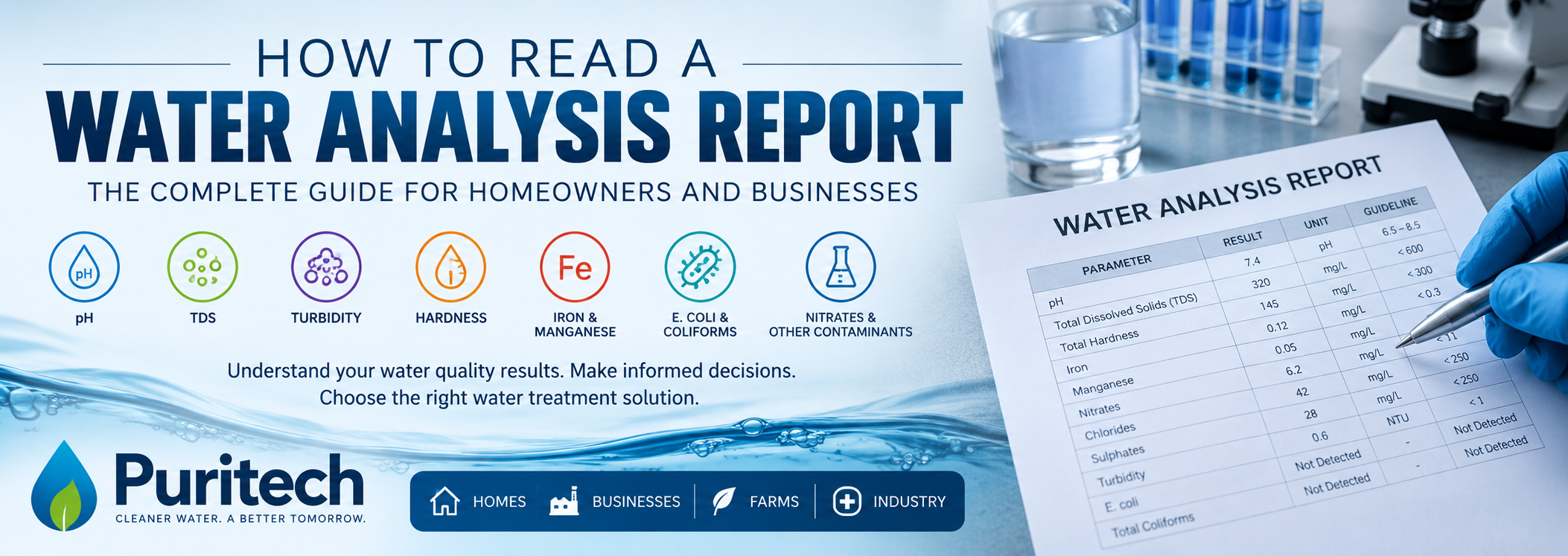
How to Read a Water Analysis Report: The Complete Guide for Homeowners and Businesses
Have you recently received a water analysis report and found yourself staring at numbers, symbols, and scientific terms that don’t make much sense? You’re not alone. Whether your water comes from a municipal supply, a borehole, a river, or another source, a laboratory water test is only useful if you know how to interpret the results.
A water analysis report reveals the chemical, physical, and microbiological quality of your water. It can help identify contaminants, explain taste and odour issues, highlight health concerns, and determine the most suitable water treatment system for your home, business, farm, or industrial facility.
In this guide, we’ll explain each important parameter in plain English, show you what the numbers mean, and help you understand which water treatment solutions are appropriate for different water quality problems.
What Is a Water Analysis Report?
A water analysis report is a laboratory document that measures the quality of your water. It identifies substances that are present and shows whether those levels fall within recommended drinking water standards.
The report provides valuable information about your water’s
- Safety
- Taste
- Odour
- Appearance
- Mineral content
- Bacteria levels
- Suitability for drinking
- Suitability for industrial processes
Water analysis reports are commonly used for:
- Municipal water supplies
- Boreholes
- Farms
- Schools
- Hospitals
- Food processing plants
- Manufacturing facilities
- Hotels
- Restaurants
Without proper testing, selecting a water treatment system becomes guesswork.
Why Water Testing Matters
Many people assume that clear water is clean water. Unfortunately, that’s not always true.
Water can appear crystal clear while containing:
- Harmful bacteria
- High nitrate levels
- Excessive iron
- Heavy metals
- High dissolved salts
- Chemical contaminants
Similarly, water that looks cloudy may simply contain harmless suspended particles.
Testing removes uncertainty. Instead of guessing, you can choose a treatment system based on accurate laboratory results.
Understanding the Different Types of Water Tests
A complete water analysis usually includes three categories.
Physical Analysis
These tests evaluate how the water looks and feels.
They include:
- Colour
- Turbidity
- Temperature
- Suspended solids
- Odour
These factors mainly affect appearance and usability.
Chemical Analysis
Chemical testing measures dissolved substances such as:
- pH
- Total Dissolved Solids (TDS)
- Hardness
- Iron
- Manganese
- Calcium
- Magnesium
- Nitrates
- Chlorides
- Sulphates
- Sodium
These results determine which treatment technology will be most effective.
Microbiological Analysis
This section checks for living organisms that may cause illness.
Laboratories commonly test for:
- E. coli
- Total Coliforms
- Faecal Coliforms
Any positive result requires immediate attention.
How to Read Your Water Analysis Report
Most laboratory reports follow a similar layout.
You’ll usually see:
| Parameter | Your Result | Recommended Limit | Unit |
|---|---|---|---|
| pH | 7.3 | 6.5–8.5 | pH |
| TDS | 280 | Less than 600 | mg/L |
| Iron | 0.1 | Less than 0.3 | mg/L |
| Nitrates | 5 | Less than 11 | mg/L |
| Turbidity | 0.8 | Less than 1 | NTU |
Rather than looking at one number in isolation, compare your result with the recommended guideline.
If your result falls outside the acceptable range, further investigation or treatment may be necessary.
Understanding Each Water Quality Parameter
How to Read a Water Analysis Report: Understanding pH
What is it?
pH measures how acidic or alkaline your water is.
The pH scale ranges from 0 to 14.
- Below 7 = acidic
- 7 = neutral
- Above 7 = alkaline
Ideal Range
6.5–8.5
Problems Caused by Low pH
- Corroded pipes
- Metallic taste
- Copper leaching
- Equipment damage
Problems Caused by High pH
- Scale formation
- Reduced effectiveness of chlorine
- Poor soap performance
Possible Treatment
- pH correction systems
- Chemical dosing
- Neutralising filters
How to Read a Water Analysis Report: Understanding TDS
TDS measures the amount of dissolved minerals and salts in water.
Common contributors include:
- Calcium
- Magnesium
- Sodium
- Potassium
- Chlorides
- Sulphates
General Guide
| TDS Level | Water Quality |
|---|---|
| Below 300 | Excellent |
| 300–600 | Good |
| 600–900 | Fair |
| 900–1200 | Poor |
| Above 1200 | Unsuitable for many applications |
High TDS often affects taste and may indicate the need for reverse osmosis, depending on the intended use.
Turbidity
Turbidity measures how cloudy the water is.
Cloudiness is caused by suspended particles such as:
- Clay
- Sand
- Silt
- Organic matter
High turbidity can reduce the effectiveness of UV sterilisation and clog filters.
Typical treatment options include sediment filtration, multimedia filtration, or ultrafiltration.
Hardness
Hardness is caused mainly by calcium and magnesium.
Signs of hard water include:
- White scale on taps
- Soap that doesn’t lather well
- Reduced appliance efficiency
- Mineral build-up in geysers and pipes
Water softeners are commonly used where hardness levels are high.
How to Read a Water Analysis Report: Iron Levels
Iron can cause:
- Brown stains
- Metallic taste
- Discoloured laundry
- Clogged plumbing
Although small amounts are generally not a health concern, excessive iron affects both appearance and equipment.
Treatment may include oxidation followed by filtration or specialized iron removal systems.
Manganese
High manganese levels often produce black staining on fixtures and laundry. It may also affect taste and contribute to deposits inside pipes.
Specialised oxidation and filtration systems are commonly used to reduce manganese.
Nitrates
High nitrate levels are especially concerning for infants and pregnant women.
Common sources include:
- Agricultural fertilisers
- Animal waste
- Septic systems
Reverse osmosis and ion exchange are among the most effective treatment methods.
Chlorides
Chlorides can give water a salty taste and accelerate corrosion in plumbing systems.
High chloride concentrations are often associated with coastal areas, industrial activity, or saline groundwater.
Sulphates
Elevated sulphates may cause a bitter taste and, at very high levels, can have a laxative effect for some people.
Treatment depends on the concentration and may include reverse osmosis.
How to Read a Water Analysis Report: Bacterial Results
E. coli bacteria indicate recent faecal contamination.
If detected:
- Do not drink the water untreated.
- Investigate the source of contamination.
- Disinfect the water supply.
- Install an appropriate treatment system, such as UV sterilization combined with effective pre-filtration.
Total Coliforms
Total coliform bacteria do not always indicate a direct health risk, but they can signal that the water system has become vulnerable to contamination.
A positive result should be investigated promptly.
Choosing the Right Water Treatment Solution
Your water analysis report provides the foundation for selecting the right treatment system.
| Water Quality Issue | Possible Treatment |
|---|---|
| High sediment | Sediment filters |
| Chlorine | Activated carbon filters |
| Hard water | Water softeners |
| High TDS | Reverse osmosis |
| Bacteria | UV sterilisation |
| Iron & manganese | Oxidation and filtration |
| Unpleasant taste or odour | Activated carbon filtration |
In many cases, the most effective solution combines several treatment technologies to address multiple water quality issues.
Common Mistakes When Reading a Water Analysis Report
Avoid these common errors:
- Focusing on only one parameter.
- Assuming clear water is safe.
- Ignoring microbiological results.
- Choosing a treatment system without testing.
- Overlooking changes in water quality over time.
- Using a one-size-fits-all solution for every water source.
Frequently Asked Questions
Is a water analysis report necessary before buying a treatment system?
Yes. A laboratory report helps ensure that the chosen system is suitable for your specific water quality.
How often should water be tested?
Municipal water should be tested periodically if there are concerns about quality or noticeable changes. Borehole water should be tested at least once a year, or more frequently if contamination is suspected or surrounding conditions change.
Can one treatment system solve every water problem?
No. Different contaminants require different treatment methods. Many installations combine several technologies for the best results.
What if my report shows several problems?
This is common. A properly designed treatment system can often address multiple issues through staged filtration and purification.
Final Thoughts
Understanding a water analysis report doesn’t require a scientific background. Once you know what each parameter represents, you can make informed decisions about your water supply and avoid investing in unsuitable treatment equipment.
Whether you’re managing a home, farm, commercial facility, or industrial process, a professional water analysis is the first step toward cleaner, safer, and more reliable water.
If you’re unsure how to interpret your results, the team at Puritech can help assess your report and recommend a water treatment solution tailored to your specific water quality and application.