
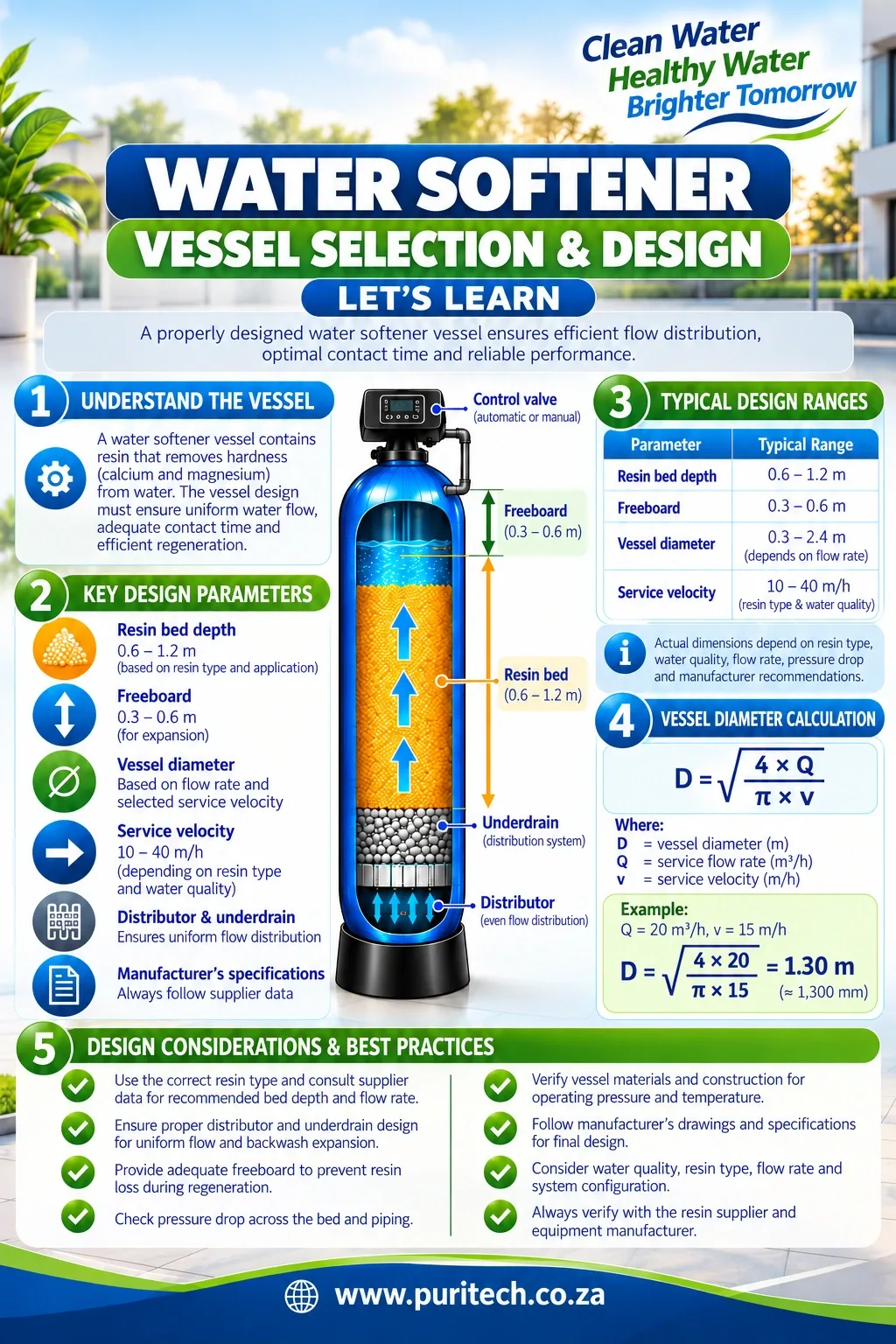
A water softener vessel holds the resin used to remove hardness-causing calcium and magnesium from water. Vessel selection needs to consider the resin, water demand, flow distribution and regeneration requirements together.
Open the full-size vessel selection infographic
Understand the vessel and its components
- Control valve: directs water through the service and regeneration stages. Select a valve suitable for the vessel, required flow and regeneration arrangement.
- Resin bed: provides the ion-exchange media that performs the softening process. The resin supplier’s data determines suitable operating conditions.
- Freeboard: is the space above the resin bed. It must allow the required bed expansion during backwashing without losing resin.
- Distributor and underdrain: distribute and collect water through the vessel. Correct selection helps avoid uneven flow through the resin bed.
Key parameters to check
The infographic illustrates resin bed depth, freeboard, vessel diameter and service velocity. Its ranges are general design examples, not universal specifications. Use the resin and equipment manufacturers’ data for the actual system.
- Confirm feed-water hardness and quality, required treated-water quality, peak flow and daily demand.
- Match resin volume and bed depth to the treatment duty and regeneration plan.
- Allow sufficient freeboard for the selected resin’s expansion at the actual backwash rate and water temperature.
- Check service and backwash flow, pressure drop, valve capacity and distributor compatibility.
- Verify the vessel’s pressure and temperature ratings and follow the manufacturer’s installation requirements.
An illustrative vessel diameter calculation
For a circular cross-section, service velocity relates to flow rate and area as v = Q / A. With A = πD² / 4, the diameter is:
D = √(4Q / (πv))
- D: vessel diameter in metres (m).
- Q: service flow rate in cubic metres per hour (m³/h).
- v: selected service velocity in metres per hour (m/h).
Using the example values Q = 20 m³/h and v = 15 m/h gives D = √(80 / (15π)) ≈ 1.30 m, or approximately 1,300 mm. This is an illustrative hydraulic calculation, not a final vessel recommendation.
Confirm the complete design
Final sizing must also account for resin capacity and kinetics, hardness loading, regeneration frequency, available pressure, backwash requirements and the manufacturer’s standard vessel sizes. Have the complete arrangement checked against the resin supplier’s recommendations and equipment drawings before ordering or installation.
Ask the Puritech team about selecting a water softener vessel.