Currently Empty: R0.00

Ultrafiltration System: How It Works Step by Step
An ultrafiltration system is one of the most effective water purification technologies available today. It removes suspended solids, bacteria, algae, and other microscopic contaminants while allowing beneficial minerals to remain in the water.
Unlike systems that rely on chemicals, ultrafiltration uses a physical membrane with microscopic pores to separate contaminants from clean water. As a result, it provides reliable filtration for homes, businesses and industrial applications.
Understanding how an ultrafiltration system works will help you determine whether it is the right solution for your water treatment needs.
What Is an Ultrafiltration System?
An ultrafiltration system is a water treatment system that uses pressure to force water through an ultrafiltration membrane.
The membrane acts as a physical barrier, trapping contaminants while allowing purified water to pass through.
Unlike reverse osmosis systems, ultrafiltration generally retains dissolved minerals, making it an excellent choice for municipal water that already meets chemical quality standards but requires improved microbiological and physical filtration.
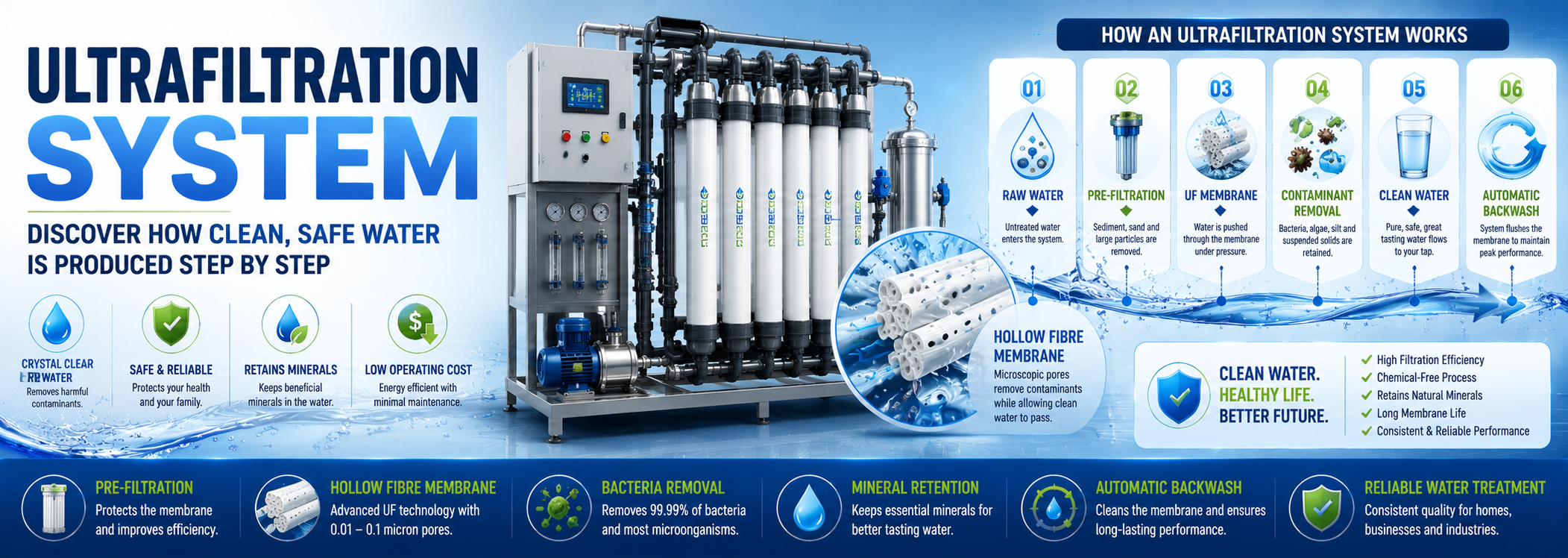
Step 1: Raw Water Enters the System
The process begins when untreated water enters the ultrafiltration system.
Depending on the application, the water source may include the following:
- Municipal water
- Borehole water
- Rainwater
- Surface water
- Process water
The incoming water first passes through pre-filtration components designed to protect the ultrafiltration membrane.
Step 2: Pre-Filtration Protects the Membrane
Most ultrafiltration systems include one or more pre-filters.
These filters remove:
- Large sediment
- Sand
- Rust
- Leaves
- Suspended debris
Consequently, the membrane experiences less fouling and enjoys a longer service life.
Step 3: Water Reaches the Ultrafiltration Membrane
Next, the water flows into the ultrafiltration membrane.
The membrane contains thousands of hollow fibres with microscopic pores measuring approximately 0.01 to 0.1 microns.
As pressure pushes water through these pores, contaminants remain on the outside while purified water passes through.
Step 4: Contaminants Are Retained
During filtration, the ultrafiltration membrane removes:
- Bacteria
- Algae
- Protozoa
- Suspended solids
- Rust particles
- Fine sediment
- Microplastics
Because these particles are larger than the membrane pores, they cannot pass through.
Step 5: Clean Water Leaves the System
Once filtration is complete, clean water exits the membrane and flows to the storage tank or directly to the point of use.
Importantly, naturally occurring minerals remain in the water because dissolved mineral ions are much smaller than the membrane pores.
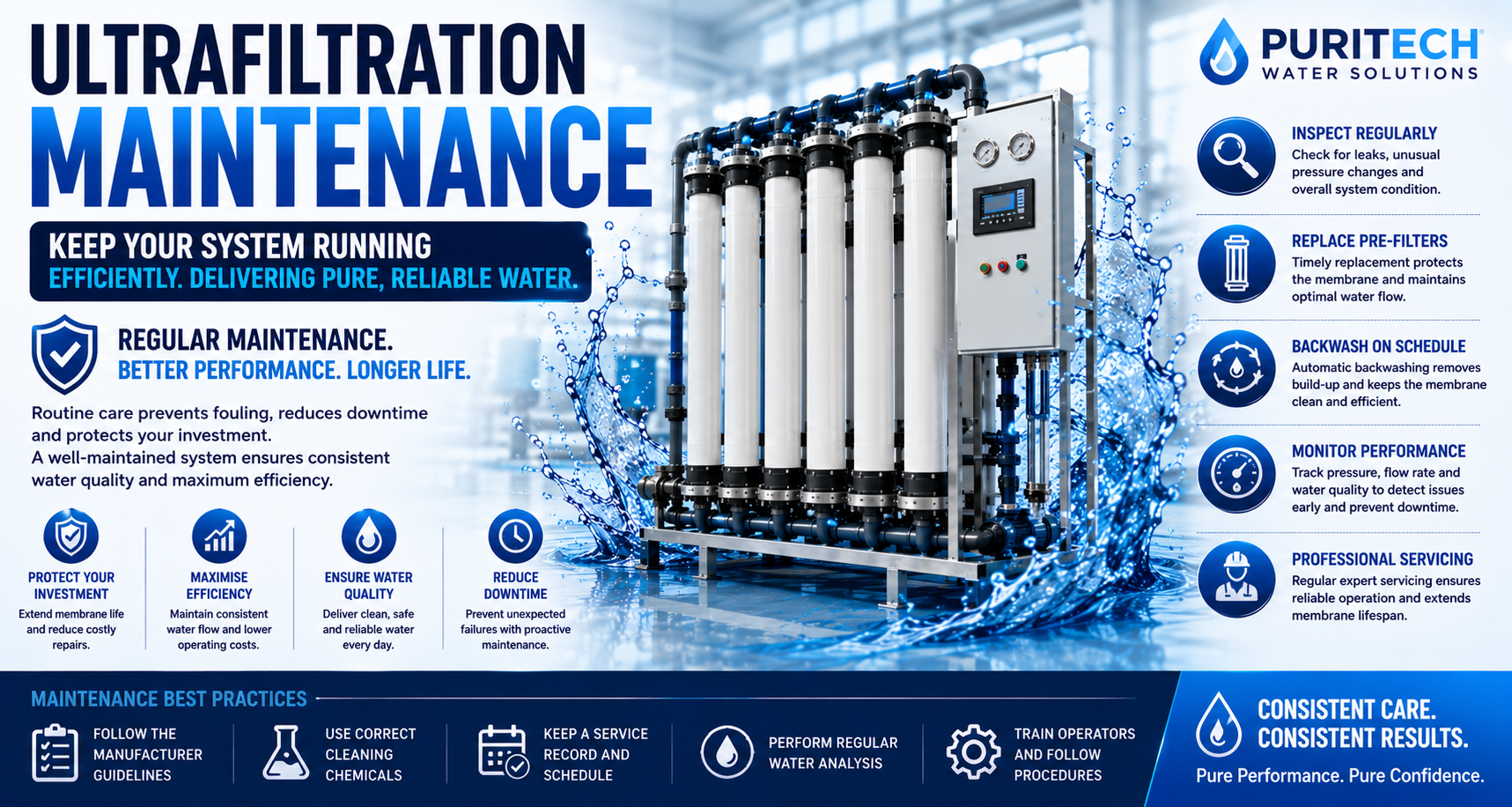
Step 6: Backwashing Maintains Performance
Many commercial and industrial ultrafiltration systems include automatic backwashing.
During this process:
- Water flow reverses temporarily.
- Trapped contaminants are flushed away.
- Membrane performance is restored.
- Fouling is reduced.
Therefore, regular backwashing helps extend membrane life and maintain consistent water quality.
Components of an Ultrafiltration System
A complete ultrafiltration system typically includes:
- Feed pump
- Pre-filters
- Ultrafiltration membrane
- Pressure gauges
- Automatic control valves
- Flow meters
- Membrane housing
- Backwash system
- Control panel
Each component contributes to reliable and efficient operation.
Applications of Ultrafiltration Systems
Ultrafiltration systems are widely used in:
Residential Water Purification
Producing clean drinking water while retaining beneficial minerals.
Commercial Buildings
Providing high-quality water for offices, schools, restaurants, and hospitals.
Industrial Processes
Protecting downstream equipment and improving production water quality.
Food and Beverage Production
Removing suspended particles without altering the water’s mineral composition.
Reverse Osmosis Pre-Treatment
Reducing membrane fouling and improving overall reverse osmosis performance.
Benefits of an Ultrafiltration System
An ultrafiltration system offers numerous advantages.
These include:
- Excellent bacteria removal
- Retention of beneficial minerals
- Chemical-free filtration
- Low operating costs
- Compact footprint
- Reliable performance
- Reduced maintenance requirements
- Long membrane life
As a result, ultrafiltration has become one of the most trusted water treatment technologies available.
Frequently Asked Questions
Does an ultrafiltration system require electricity?
Many systems use an electric pump to provide operating pressure. However, some smaller systems may operate using municipal water pressure alone.
Is an ultrafiltration system suitable for borehole water?
Yes, although the suitability depends on the borehole water quality. Water analysis should always be performed before selecting a treatment solution.
Can an ultrafiltration system replace reverse osmosis?
Not always. Ultrafiltration removes suspended contaminants and microorganisms, whereas reverse osmosis removes dissolved salts and many dissolved chemicals.
How often should an ultrafiltration system be serviced?
Service intervals depend on water quality, system usage, and manufacturer recommendations. Routine inspections and membrane cleaning help maintain optimal performance.
Conclusion
An ultrafiltration system provides a reliable and efficient way to improve water quality without removing beneficial minerals. By combining pre-filtration, advanced membrane technology, and routine maintenance, these systems consistently produce clean, safe water for a wide range of residential, commercial, and industrial applications.
Understanding each stage of the process helps you choose the right system and ensures dependable performance for years to come.