Currently Empty: R0.00

Ultrafiltration Membrane: How It Works and Why It Matters
An ultrafiltration membrane is the heart of every ultrafiltration (UF) system. Although pumps, housings and valves all play important roles, the membrane performs the actual filtration process by separating contaminants from water. Thanks to its microscopic pores, it removes suspended solids, bacteria and many other harmful particles while allowing clean water and beneficial minerals to pass through.
As demand for safe drinking water continues to grow, ultrafiltration membranes have become an important technology for residential, commercial and industrial water treatment. Understanding how they work will help you choose the right water purification solution for your specific needs.
What Is an Ultrafiltration Membrane?
An ultrafiltration membrane is a highly specialised filter made from advanced polymer materials. Unlike traditional sediment or activated carbon filters, it separates contaminants based on particle size rather than chemical treatment.
The membrane contains thousands of tiny hollow fibres, each filled with microscopic pores that allow water molecules to pass while blocking larger contaminants.
This process produces cleaner water without adding chemicals.
How Does an Ultrafiltration Membrane Work?
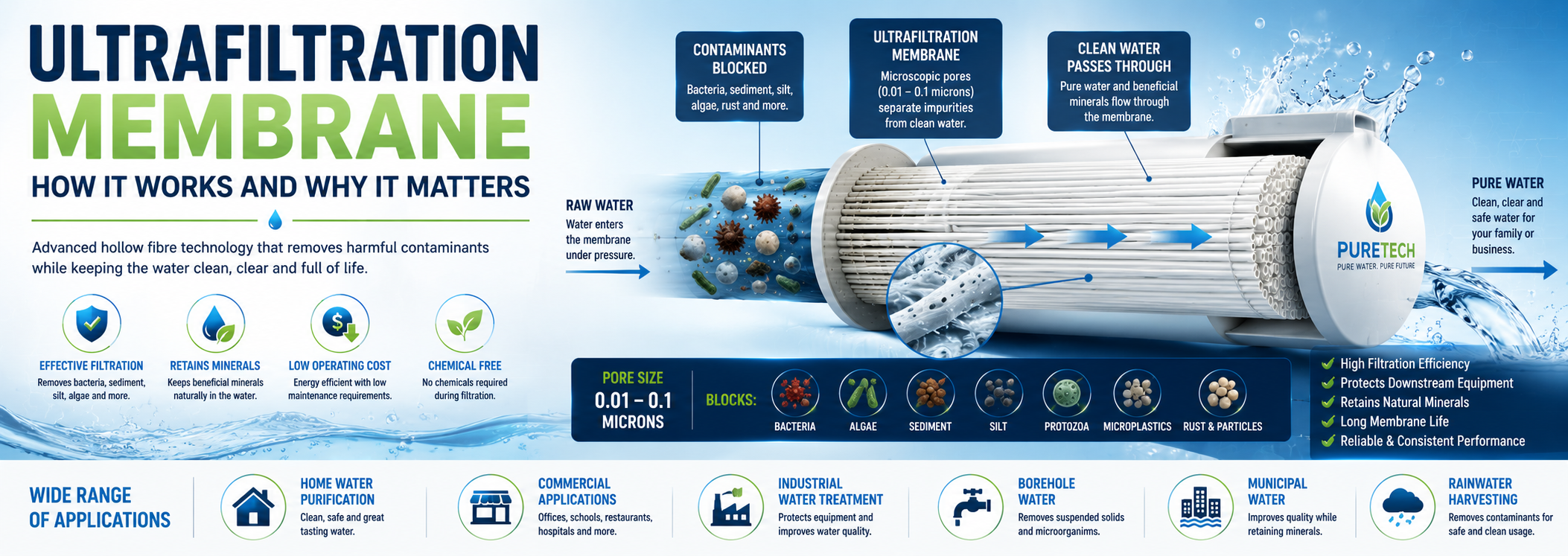
Water enters the membrane under pressure and flows through the hollow fibres.
As the water passes through the microscopic pores, contaminants remain on one side of the membrane while purified water passes through to the outlet.
The filtration process typically includes:
- Raw water enters the UF membrane.
- Suspended particles remain outside the membrane fibres.
- Bacteria and many microorganisms are retained.
- Clean water passes through the pores.
- Waste particles are removed during flushing or backwashing.
As a result, the membrane continuously delivers high-quality filtered water while protecting downstream equipment.
Understanding Ultrafiltration Membrane Pore Size
One of the biggest advantages of an ultrafiltration membrane is its extremely small pore size.
Most UF membranes have pores ranging from 0.01 to 0.1 microns, making them much finer than conventional sediment filters.
These microscopic openings allow water and dissolved minerals to pass through while trapping much larger contaminants.
Because of this precise filtration, ultrafiltration systems can improve water quality without removing naturally occurring minerals that many people prefer to retain.
What Does an Ultrafiltration Membrane Remove?
An ultrafiltration membrane removes a wide range of physical contaminants, including:
- Suspended solids
- Sediment
- Rust particles
- Sand
- Silt
- Mud
- Algae
- Most bacteria
- Many protozoa
- Microplastics
- Fine organic particles
Consequently, ultrafiltration significantly improves water clarity and microbiological quality.
What Does an Ultrafiltration Membrane Not Remove?
Although ultrafiltration is highly effective, it is not designed to remove every contaminant.
Generally, UF membranes do not remove:
- Dissolved salts
- Total Dissolved Solids (TDS)
- Most dissolved minerals
- Many dissolved chemicals
- Heavy metals in dissolved form
- Dissolved nitrates
If these contaminants are present at unacceptable levels, additional treatment—such as reverse osmosis, activated carbon or specialised media—may be required.
Why Are Beneficial Minerals Retained?
Unlike reverse osmosis systems, ultrafiltration membranes do not remove dissolved minerals such as calcium and magnesium.
These minerals are much smaller than the membrane’s pores and therefore pass through with the water.
For many applications using good-quality municipal water, this is a major advantage because the water retains its natural mineral content while becoming cleaner and safer.
Common Applications of Ultrafiltration Membranes
Ultrafiltration membranes are used in a wide variety of industries and water treatment applications.
Residential Water Purification
Homeowners use UF systems to improve municipal water quality while maintaining natural minerals.
Commercial Water Treatment
Restaurants, offices, schools, and healthcare facilities rely on ultrafiltration to provide cleaner water for daily operations.
Industrial Water Treatment
Many industries use UF membranes to protect equipment and improve water quality before further processing.
Borehole Water Treatment
When combined with appropriate pre-treatment, ultrafiltration can remove suspended solids and microorganisms commonly found in borehole water.
Reverse Osmosis Pre-Treatment
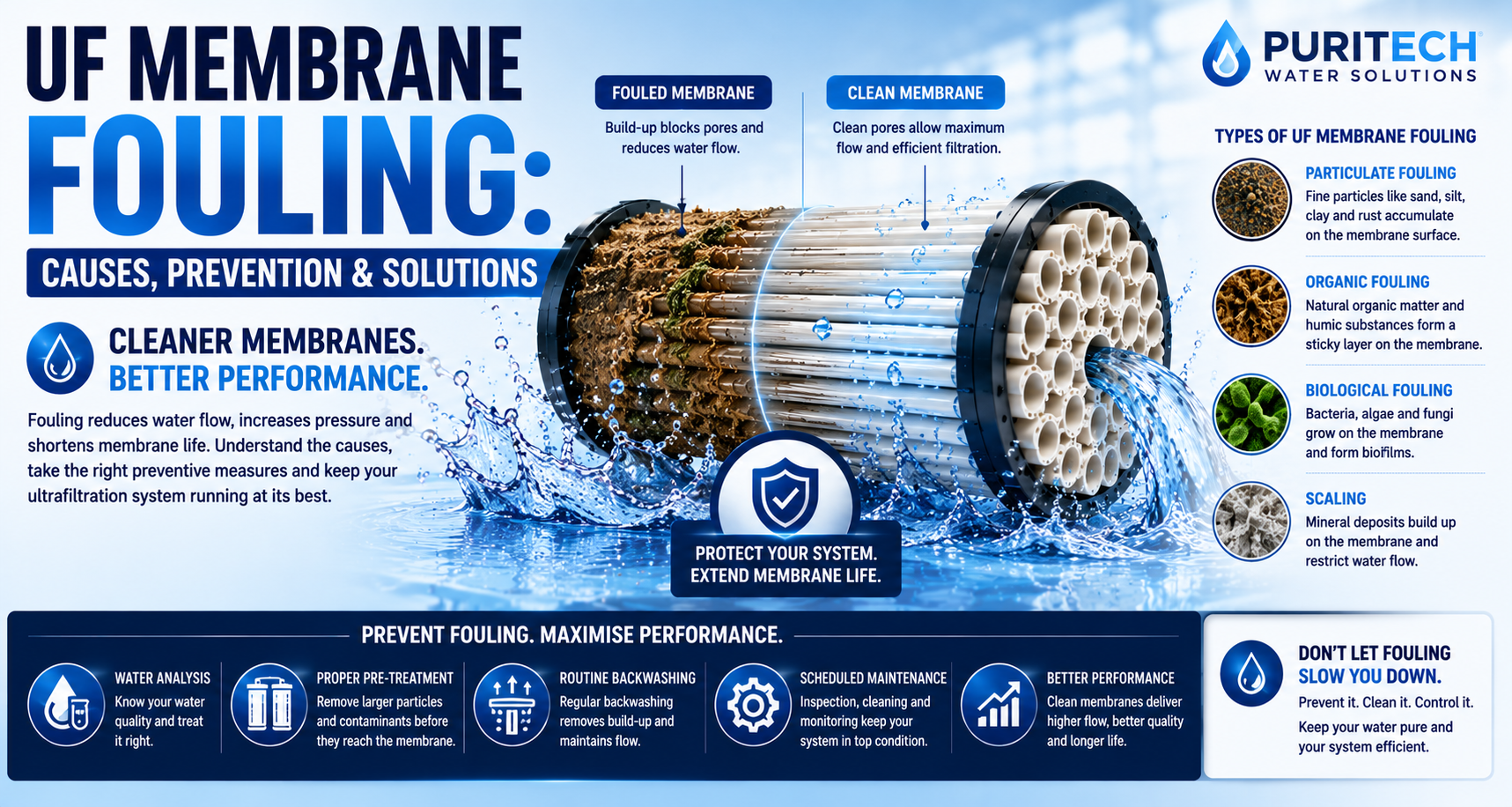
Many reverse osmosis systems use ultrafiltration membranes to reduce suspended solids and biological fouling before water reaches the RO membranes.
This helps improve efficiency and extend membrane life.
Advantages of Ultrafiltration Membranes
Ultrafiltration offers several important benefits.
These include:
- High filtration efficiency
- Chemical-free operation
- Low operating costs
- Continuous water production
- Retention of beneficial minerals
- Excellent bacteria removal
- Compact system design
- Reliable long-term performance
Furthermore, modern UF systems require relatively little maintenance when operated correctly.
How Long Does an Ultrafiltration Membrane Last?
The lifespan of an ultrafiltration membrane depends on several factors, including:
- Incoming water quality
- Pre-treatment effectiveness
- Cleaning frequency
- Operating pressure
- System maintenance
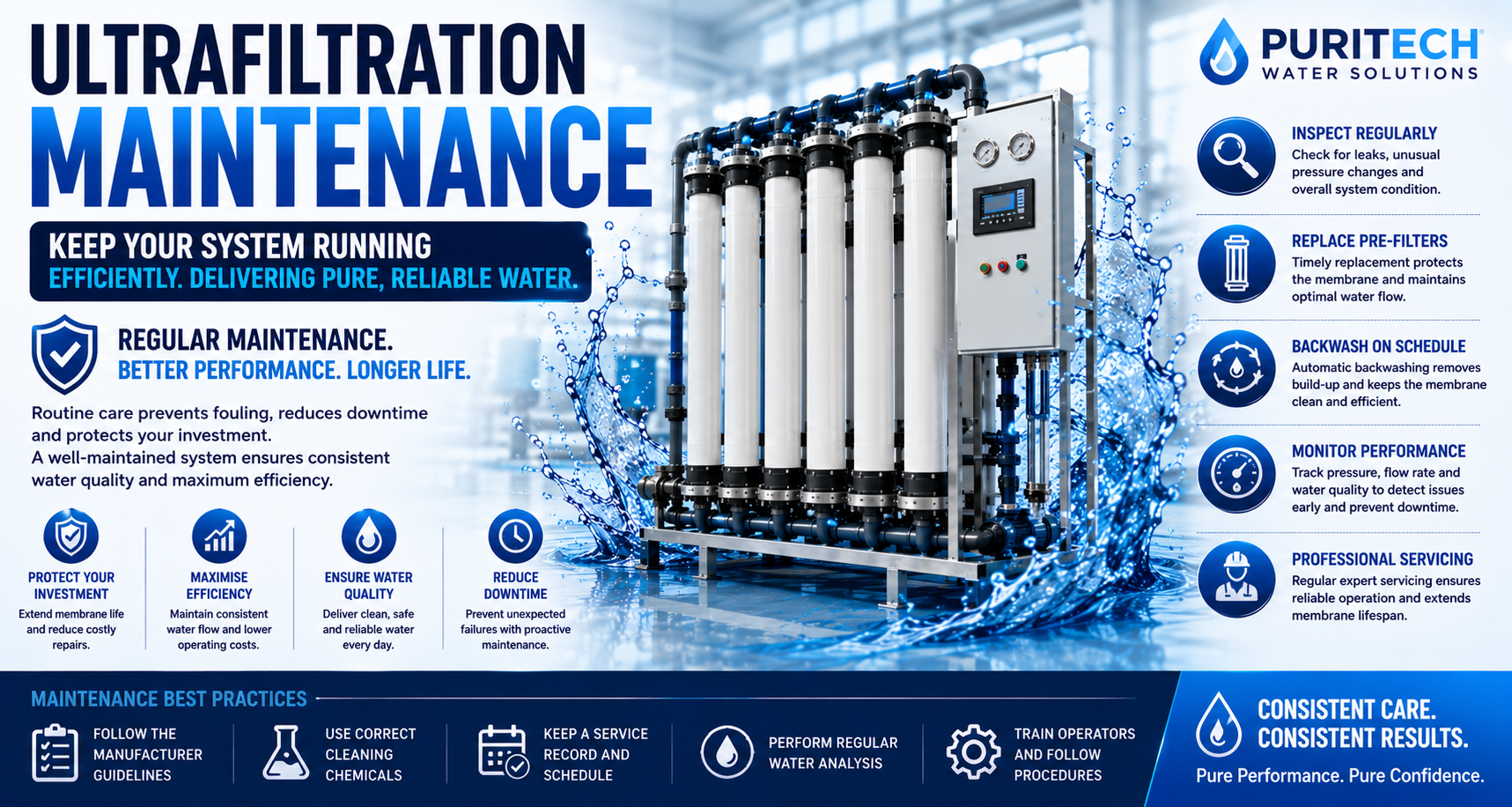
With proper care and routine maintenance, many UF membranes provide reliable performance for several years.
Frequently Asked Questions
Can an ultrafiltration membrane remove bacteria?
Yes. Most ultrafiltration membranes effectively remove bacteria because the microorganisms are larger than the membrane pores.
Does an ultrafiltration membrane remove viruses?
Some larger viruses may be retained, but ultrafiltration is not designed to remove every virus. Water quality should always be assessed to determine whether additional disinfection is necessary.
Does ultrafiltration remove chlorine?
No. Chlorine is dissolved in water, so an activated carbon filter is often installed alongside an ultrafiltration system when chlorine removal is required.
Can an ultrafiltration membrane be cleaned?
Yes. Many systems include flushing or backwashing functions that help maintain membrane performance and extend its service life.
Conclusion
An ultrafiltration membrane is the core component that makes modern ultrafiltration systems so effective. By removing suspended solids, bacteria and many other contaminants while allowing beneficial minerals to remain, it provides an excellent solution for improving water quality in homes, businesses and industrial facilities.
When correctly selected, installed and maintained, an ultrafiltration membrane can deliver reliable, high-quality water for years. Whether you are treating municipal water, borehole water or preparing water for reverse osmosis, understanding how the membrane works is the first step toward choosing the right water treatment solution.