Currently Empty: R0.00

Low-Light Solar Panels vs Standard Solar Panels
Low-light solar panels are engineered to maximise electricity production when sunlight is limited. Unlike conventional photovoltaic modules, these advanced panels continue producing useful energy during cloudy weather, early mornings and late afternoons. Consequently, they can improve daily energy generation in areas that experience changing weather conditions.
Before investing in a solar energy system, it is important to understand how these specialised panels compare with standard models and where each option performs best.
What Are Low-Light Solar Panels?
Low-light solar panels use advanced photovoltaic technology to capture more available sunlight during low-irradiance conditions. Although they cannot generate electricity in complete darkness, they perform more efficiently whenever sunlight is weaker.
Manufacturers achieve this by combining high-efficiency solar cells with advanced coatings and improved cell designs that increase light absorption.
What Are Standard Solar Panels?
Standard photovoltaic panels convert sunlight into electricity using silicon solar cells. They deliver excellent performance under bright, direct sunlight and remain the most common choice for residential, commercial and industrial installations.
While these panels also generate electricity on overcast days, their output generally decreases more than specialised low-light models.
Comparing Their Performance
Both technologies convert sunlight into clean electricity. However, their performance differs depending on weather conditions and available sunlight.
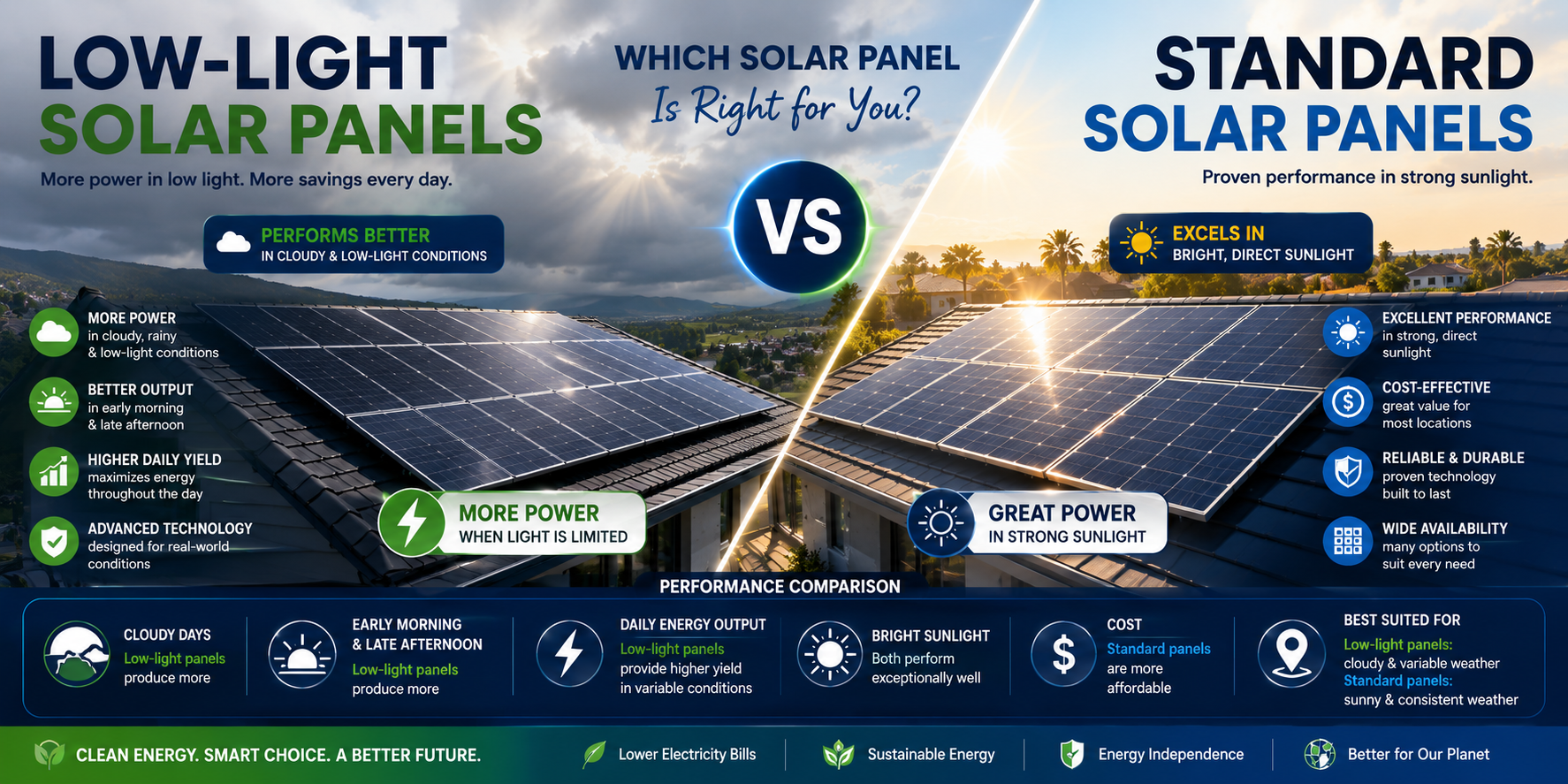
| Feature | Low-Light Solar Panels | Standard Solar Panels |
|---|---|---|
| Cloudy weather | Higher energy production | Moderate energy production |
| Early morning | Better performance | Good performance |
| Late afternoon | Better performance | Good performance |
| Bright sunshine | Excellent | Excellent |
| Overall efficiency | Higher in low-light conditions | Excellent in strong sunlight |
| Typical cost | Higher | Lower |
Benefits of Low-Light Solar Panels
These advanced photovoltaic modules offer several advantages.
These include:
- Higher energy production during cloudy weather
- Improved winter performance
- Better electricity generation in the early morning
- Increased output later in the afternoon
- Greater daily energy harvest
- Improved performance where weather conditions change frequently
As a result, they are often selected for locations that experience frequent cloud cover.
Benefits of Standard Solar Panels
Conventional photovoltaic modules continue to offer outstanding value for many applications.
Their advantages include:
- Lower purchase price
- Proven long-term reliability
- Excellent performance in direct sunlight
- Wide product availability
- Simple system expansion
- Suitable for most climates
For areas that receive abundant sunshine, they remain an excellent investment.
Which Option Generates More Electricity?
The answer depends largely on your location.
If your property enjoys strong sunshine throughout most of the year, either technology can perform exceptionally well. However, regions with frequent cloud cover, mist or shorter winter days often benefit from the improved performance of low-light solar panels.
A professional site assessment can determine which technology will deliver the highest annual energy production.
Are They Worth the Extra Cost?
Advanced low-light technology usually comes with a higher purchase price. Nevertheless, the additional energy produced throughout the year may improve the return on investment, especially in areas with inconsistent sunlight.
Conversely, standard photovoltaic panels often provide the most economical solution for properties located in consistently sunny climates.
Typical Applications
Specialised low-light modules are commonly used in:
- Coastal regions
- High-rainfall areas
- Residential homes
- Commercial buildings
- Remote installations
- Locations with frequent cloud cover
Standard photovoltaic panels are widely installed on:
- Residential rooftops
- Farms
- Factories
- Warehouses
- Schools
- Office buildings
Frequently Asked Questions
Do low-light solar panels work in rainy weather?
Yes. They continue producing electricity whenever daylight is available, although total output is lower than on clear, sunny days.
Can they generate electricity at night?
No. Like all photovoltaic modules, they require sunlight to produce electricity.
Are these panels more efficient?
They generally outperform conventional panels under low-light conditions. However, both technologies deliver excellent performance in bright sunshine.
Which option is better for South Africa?
South Africa enjoys high levels of sunshine across most regions, making standard photovoltaic panels an excellent choice. However, properties located in coastal or frequently overcast areas may benefit from low-light solar panels.
Conclusion
Low-light solar panels provide improved energy generation whenever sunlight is limited, making them an attractive option for locations with variable weather conditions. Standard photovoltaic panels, meanwhile, continue to deliver reliable, cost-effective performance in areas that receive consistent sunshine.
Choosing the right technology depends on your property’s location, energy requirements, and budget. By understanding the strengths of both options, you can select a solar solution that provides reliable electricity generation and long-term savings.